The sample copy of this report is available for access.
“Global Quick Commerce Market to reach a market value of USD 984,740.40 Million by 2033 growing at a CAGR of 20.9%”
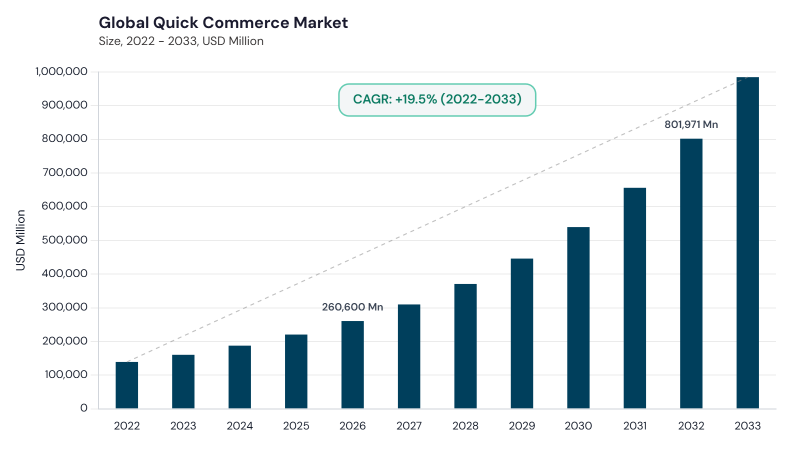
The Global Quick Commerce Market is expected to reach USD 984.7 billion by 2033, growing at a CAGR of 20.9% during (2026 - 2033).
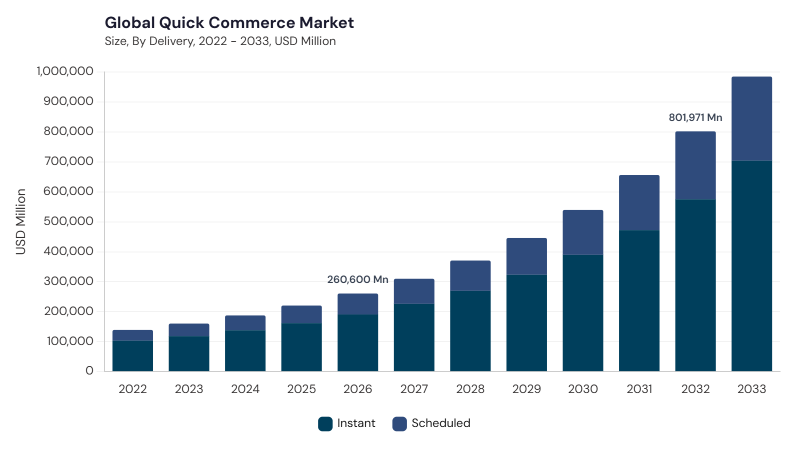
Quick commerce market is driven by rising consumer demand for digital ordering, convenience, ultra-fast delivery, and easy access to daily essentials through online platforms. Increasing smartphone penetration, dark store expansion, urbanization, digital payment adoption, and hyperlocal fulfillment networks are strengthening the market’s growth. The market evolved as an extension of traditional e-commerce, emphasized on faster delivery of everyday essentials. The market developed through automated warehousing, real-time inventory management, micro-fulfillment centers, and driven demand forecasting.
Market is expanding as consumers largely prefer fast, app-based and convenient access to packaged food, groceries, household products, personal care, pharmacy goods, and other essentials. Quick commerce platforms are supporting operations through hyperlocal delivery networks, dark stores, route optimization, predictive logistics, and real-time inventory systems. These capabilities help enhance order accuracy, reduce delivery time, and improve customer satisfaction. The market is further benefitting from expanding urban delivery infrastructure, and digital payments.
Competitive landscape of quick commerce market is technology-driven, with digital commerce ecosystems, rapid delivery platforms, and on-demand logistics providers competing across the market. Global and regional players are also investing in automation, micro-fulfillment centers, strategic retail partnerships, and predictive inventory management to enhance service reliability and platform scale.
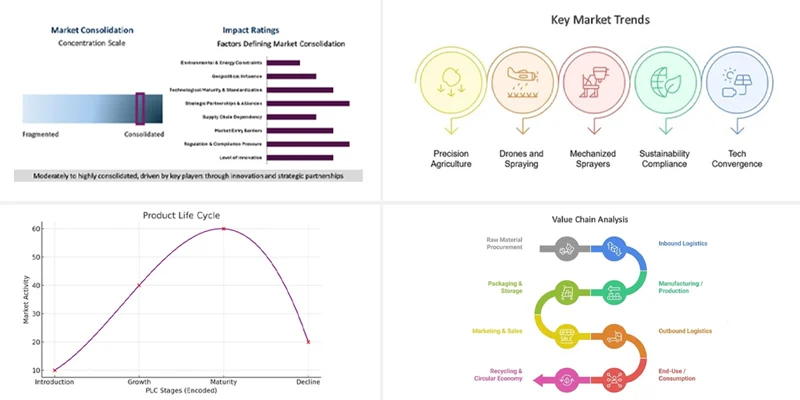

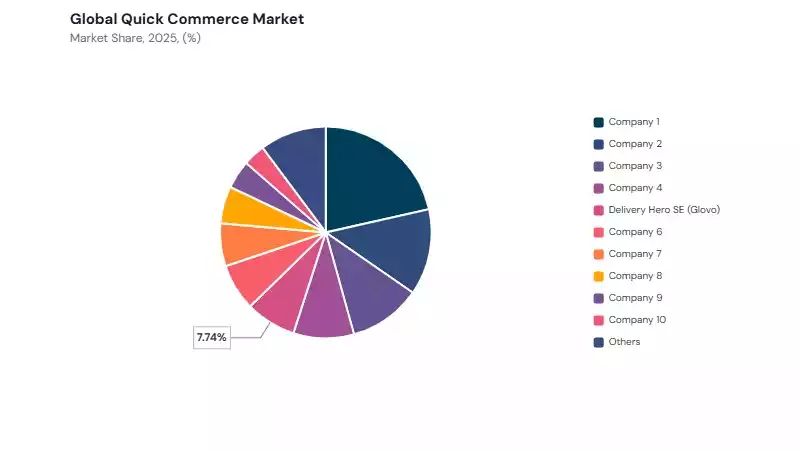
Quick commerce market represents a technology-driven competitive landscape, supported by digital commerce ecosystems, rapid delivery platforms, and on-demand logistics providers. Alibaba Group and Meituan hold strong leadership positions through advanced logistics capabilities, instant retail ecosystems, and integrated digital providers. DoorDash, JD.com, Zepto, Grab, Swiggy, Zomato, and Uber further support competition through fulfillment automation, rapid delivery infrastructure, dark stores, and hyperlocal networks.
Based on Delivery, the market is segmented into Instant and Scheduled. The Instant market dominated the Global Quick Commerce Market by Delivery in 2025, and would continue to be a dominant market till 2033; thereby, achieving a market value of USD 703.9 billion by 2033, growing at a CAGR of 20.5 % during the forecast period. The Scheduled market is expected to witness a CAGR of 22% during (2026 - 2033).
Instant delivery remains central to quick commerce because it directly addresses consumer expectations for speed, convenience, and immediate access to essential goods. This segment depends on dense micro-fulfillment networks, real-time inventory visibility, advanced route optimization, and efficient last-mile delivery fleets. Scheduled delivery supports consumers who prefer planned purchases and better delivery certainty. Together, both delivery models help platforms serve urgent, recurring, and convenience-led shopping needs across urban and emerging locations.
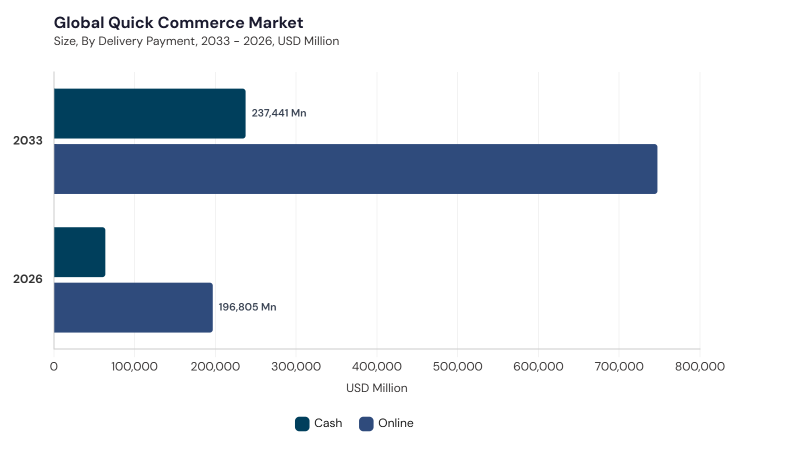
Based on Delivery Payment, the market is segmented into Online and Cash. The Online market dominated the Global Quick Commerce Market by Delivery Payment in 2025, and would continue to be a dominant market till 2033; thereby, achieving a market value of USD 747.3 billion by 2033, growing at a CAGR of 21 % during the forecast period. The Cash market is expected to witness a CAGR of 20.7% during (2026 - 2033).
Online payment strengthens quick commerce by enabling faster checkout, instant payment confirmation, improved order processing, and reduced friction during purchase. Digital payment integration also supports loyalty programs, refunds, promotions, and secure customer transactions. Cash remains important in markets where digital adoption is uneven or consumers prefer payment after delivery. Payment flexibility helps platforms increase accessibility and improve adoption among a broader customer base.
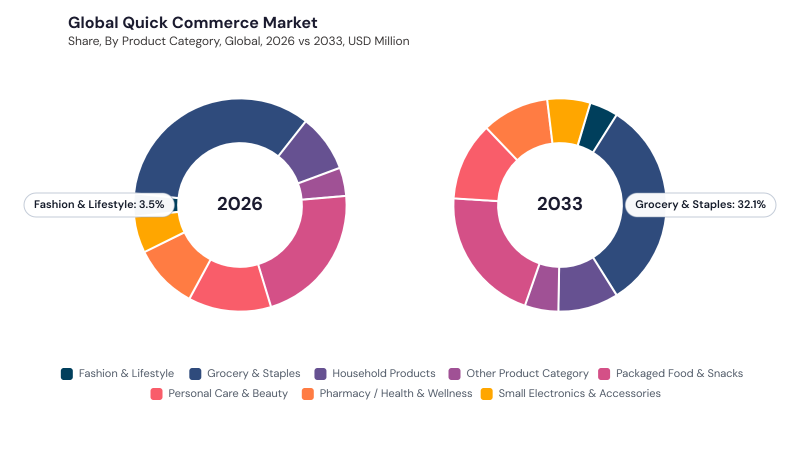
Based on Product Category, the market is segmented into Grocery & Staples, Packaged Food & Snacks, Personal Care & Beauty, Pharmacy / Health & Wellness, Household Products, Small Electronics & Accessories, Fashion & Lifestyle, and Other Product Category. The Grocery & Staples market dominated the Global Quick Commerce Market by Product Category in 2025, and would continue to be a dominant market till 2033; thereby, achieving a market value of USD 316.5 billion by 2033, growing at a CAGR of 20 % during the forecast period. The Packaged Food & Snacks market is expected to witness a CAGR of 20.1% during (2026 - 2033). Additionally, The Personal Care & Beauty market is expected to witness highest CAGR of 19.9% during (2026 - 2033).
Personal Care & Beauty gained demand through recurring hygiene, grooming, and daily-use purchases, while Pharmacy / Health & Wellness benefited from rising demand for OTC medicines and wellness essentials. Household Products supported routine home maintenance needs, and Small Electronics & Accessories served urgent replacement and accessory demand. Fashion & Lifestyle remained an emerging category for quick delivery use cases. Other Product Category improved platform usefulness through niche and specialty product availability.
Free Valuable Insights: Quick Commerce Market Size to reach $984.7 Billion by 2033
Region-wise, the Quick Commerce Market is analyzed across North America, Europe, Asia Pacific, and LAMEA. Asia Pacific region gathered the largest share in quick commerce market in 2025, and is predicted to remain dominant till 2033, achieving a market value of USD 458.7 billion, expanding at a CAGR od 21.3% in the forecast period. North America market is predicted to witness a CAGR of 20.1% during the projection period. Furthermore, Europe market is estimated to grow with a CAGR of 20.6% during 2026-2033.
Europe market is benefiting through investments in sustainability-focused fulfillment models, last-mile delivery networks, and convenience-driven shopping demand. LAMEA region represented steady market growth by urbanization, enhancing internet connectivity, rapid delivery infrastructure investment, and digital commerce growth. Regional expansion is encouraged by payment ecosystems, smartphone adoption, delivery infrastructure, regional platform expansion, urban density, and consumer behavior.
| Report Attribute | Details |
|---|---|
| Market size value in 2026 | USD 260.6 billion |
| Market size forecast in 2033 | USD 984.7 billion |
| Base Year | 2025 |
| Historical Period | 2022 to 2024 |
| Forecast Period | 2026 to 2033 |
| Revenue Growth Rate | CAGR of 20.9% from 2026 to 2033 |
| Number of Pages | 548 |
| Tables | 690 |
| Report Coverage | Market Trends, Revenue Estimation and Forecast, Segmentation Analysis, Regional and Country Breakdown, Competitive Landscape, Market Share Analysis, Company Profiling, Companies Strategic Developments, SWOT Analysis, Product Life Cycle Analysis, Value Chain Analysis, Market Consolidation Analysis, Key Customer Criteria, Pandemic Impact Analysis, and Winning Imperatives |
| Segments Covered | Delivery, Delivery Payment, Product Category, and Geography |
| Country Scope |
|
| Companies Included | Meituan; Alibaba Group Holding Limited; JD.com, Inc.; DoorDash, Inc.; Delivery Hero SE; Uber Technologies, Inc.; Zomato Ltd.; Swiggy Ltd.; Zepto; Grab Holdings Limited |
By Delivery
By Delivery Payment
By Product Category
By Geography
The market is expected to reach USD 984.7 billion by 2033, growing at 20.9% CAGR during 2026-2033.
Instant delivery leads, projected to achieve a market value of USD 703.9 billion by 2033.
Meituan, Alibaba, JD.com, DoorDash, Delivery Hero, Uber, Zomato, Swiggy, Zepto, Grab dominate the market.
Asia Pacific dominates, expected to reach USD 458.7 billion by 2033.
Rapid consumer demand for instantaneous delivery and technological innovation accelerate quick commerce growth.
Grocery & Staples segment leads, projected to reach USD 316.5 billion by 2033.
Our team of dedicated experts can provide you with attractive expansion opportunities for your business.








 Unique Offerings