The sample copy of this report is available for access.
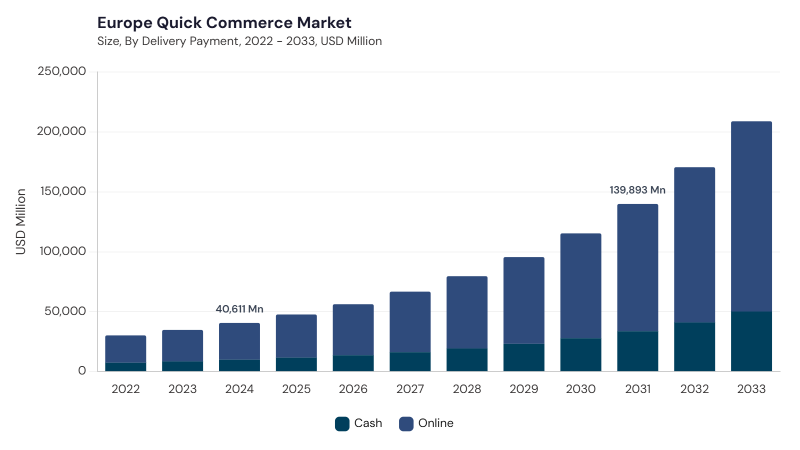
The Europe Quick Commerce Market is expected to reach USD 139.9 billion by 2031, growing at a CAGR of 20.6% during (2026 – 2033).
The Europe Quick Commerce Market developed from the expansion of online retail and same-day delivery models as consumers began expecting faster access to groceries, essentials, and daily-use products. Early quick commerce services were mainly pilot projects supported by localized warehouses, mobile ordering platforms, and basic urban delivery networks. Over time, GPS tracking, real-time inventory visibility, app-based payments, AI analytics, and route optimization improved fulfillment speed and delivery accuracy. The rise of dark stores and micro-fulfillment centers near dense urban areas marked a major shift in the market. Today, the market reflects a structured urban retail ecosystem built around convenience, rapid fulfillment, and localized delivery infrastructure.
The current Europe Quick Commerce Market is shaped by hyperlocal fulfillment, AI-driven logistics, regulatory scrutiny, sustainability goals, and omnichannel retail integration. Companies are moving inventory closer to customers through dark stores, neighborhood hubs, and micro-distribution centers to reduce delivery distances and improve service reliability. AI and machine learning are being used for demand forecasting, route planning, dynamic inventory allocation, and personalized shopping experiences. Operators are also adopting electric bikes, low-emission fleets, recyclable packaging, and localized partnerships to meet European consumer and regulatory expectations. These trends are moving the market toward faster, greener, data-driven, and city-focused quick commerce models.
Based on Delivery, the market is segmented into Instant Delivery and Scheduled Delivery. The Instant market dominated the Europe Quick Commerce Market by Delivery in 2025, and would continue to be a dominant market till 2033; thereby, achieving a market value of USD 100.8 billion by 2031, growing at a CAGR of 20.2 % during the forecast period. The Scheduled market is expected to witness a CAGR of 21.7% during (2026 - 2033).
Instant delivery leads due to strong consumer preference for ultra-fast fulfillment of groceries, daily essentials, snacks, pharmacy products, and household items. This segment is supported by dark stores, micro-fulfillment centers, app-based ordering, real-time tracking, and electric micro-mobility delivery fleets across major cities. Scheduled delivery is gaining importance among customers who prefer planned grocery purchases, flexible time slots, and reliable delivery for larger or less urgent orders. Retailers also benefit from scheduled delivery because it supports better route consolidation, order batching, delivery cost control, and operational efficiency.
Based on Delivery Payment, the market is segmented into Online and Cash. The Online market dominated the Europe Quick Commerce Market by Delivery Payment in 2025, and would continue to be a dominant market till 2033; thereby, achieving a market value of USD 106.2 billion by 2031, growing at a CAGR of 20.7 % during the forecast period. The Cash market is expected to witness a CAGR of 20.4% during (2026 - 2033).
Online payment leads due to strong adoption of digital banking, contactless cards, mobile wallets, secure payment gateways, and app-based checkout across Europe. Digital payment supports faster order confirmation, smoother fulfillment, real-time transaction tracking, loyalty programs, and reduced cash-handling complexity for delivery operators. Cash remains relevant in selected markets and among consumer groups that prefer traditional payment methods or are less comfortable with digital transactions. However, cash adoption is comparatively smaller due to rising digital payment penetration, contactless delivery preferences, and operational challenges related to reconciliation and failed payments.
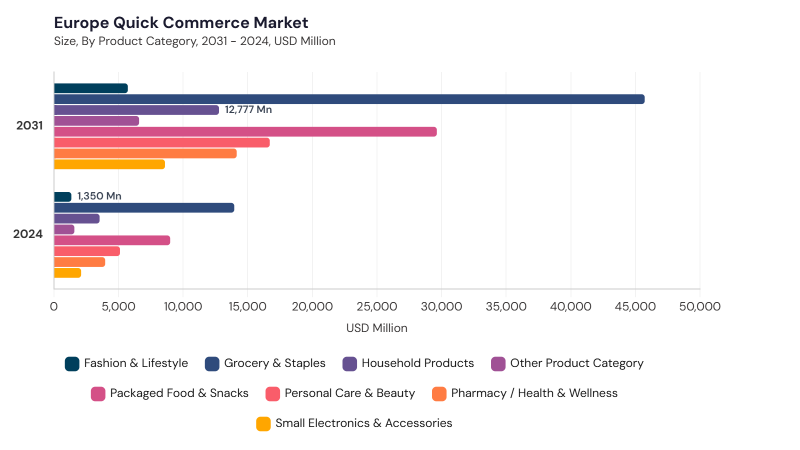
Based on Product Category, the market is segmented into Grocery & Staples, Packaged Food & Snacks, Personal Care & Beauty, Pharmacy / Health & Wellness, Household Products, Small Electronics & Accessories, Fashion & Lifestyle, and Other Product Category. Grocery & Staples lead due to frequent household demand, daily replenishment needs, urban consumer convenience, and partnerships between quick commerce platforms and grocery retailers.
Packaged Food & Snacks benefit from impulse buying, ready-to-eat consumption, and rapid availability through quick delivery platforms. Personal Care & Beauty and Pharmacy / Health & Wellness are expanding through demand for daily essentials, wellness products, grooming items, and urgent non-prescription health products. Household Products, Small Electronics & Accessories, Fashion & Lifestyle, and Other Product Category add diversification as platforms expand beyond essentials into broader retail and lifestyle assortments.
Free Valuable Insights: The Worldwide Quick Commerce Market is projected to reach USD 984.7 Billion billion by 2033, at a CAGR of 20.9%
Based on Country, the market is segmented into Germany, UK, France, Russia, Spain, Italy, and Rest of Europe. The UK market dominated the Europe Quick Commerce Market by Country in 2025, and would continue to be a dominant market till 2033; thereby, achieving a market value of USD 27.7 million by 2031, growing at a CAGR of 19 % during the forecast period. The Germany market is expected to witness a CAGR of 19.6% during (2026 - 2033). Additionally, The France market is expected to witness a CAGR of 21.4% during (2026 - 2033).
Germany leads due to its strong e-commerce base, dense urban centers, advanced fulfillment infrastructure, AI-enabled logistics adoption, and high consumer expectations for reliable delivery. The UK supports growth through mobile commerce, urban micro-fulfillment centers, AI-based route optimization, and demand for fast delivery across groceries and convenience products. France contributes through dark store networks, sustainability-focused logistics, AI-enabled inventory management, and partnerships with retailers and local suppliers. Russia, Spain, and Italy add demand through urban digital adoption, hyperlocal delivery models, rapid grocery delivery, and expanding platform partnerships, while Rest of Europe benefits from warehouse automation, digital payment growth, and localized quick commerce services.

By Delivery
By Delivery Payment
By Product Category
By Country
Set to reach $139.9 Billion by 2031, growing at 20.6% CAGR during 2026-2033.
The UK leads with $27.7 million by 2031, growing at a 19% CAGR during the forecast period.
Instant Delivery dominates with $100.8 billion by 2031, growing at a 20.2% CAGR during the forecast period.
Online segment hits $106.2 billion by 2031, growing at a 20.7% CAGR during the forecast period.
France is expected to witness a 21.4% CAGR during 2026-2033.
Scheduled Delivery is expected to witness a 21.7% CAGR during 2026-2033.
Our team of dedicated experts can provide you with attractive expansion opportunities for your business.




 Unique Offerings