The sample copy of this report is available for access.
“Global PFAS-Free Food Packaging Market to reach a market value of USD 66,089.6 Million by 2033 growing at a CAGR of 6.3%”
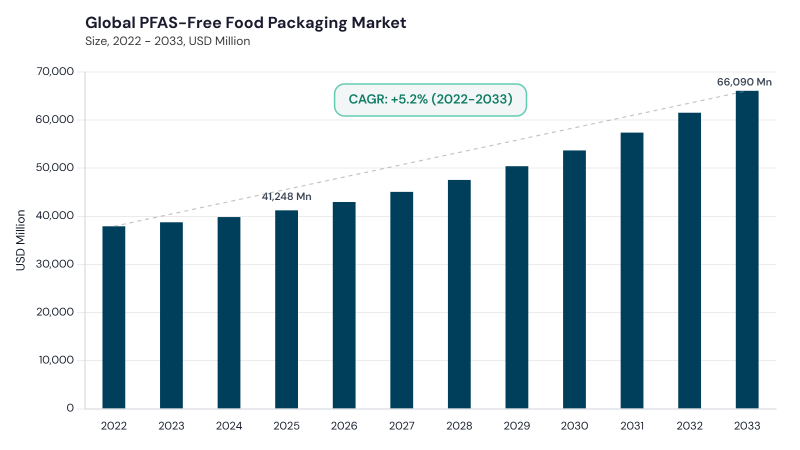
The Global PFAS-Free Food Packaging Market is expected to reach USD 66,089.6 Million by 2033, growing at a CAGR of 6.3% during the forecast period.
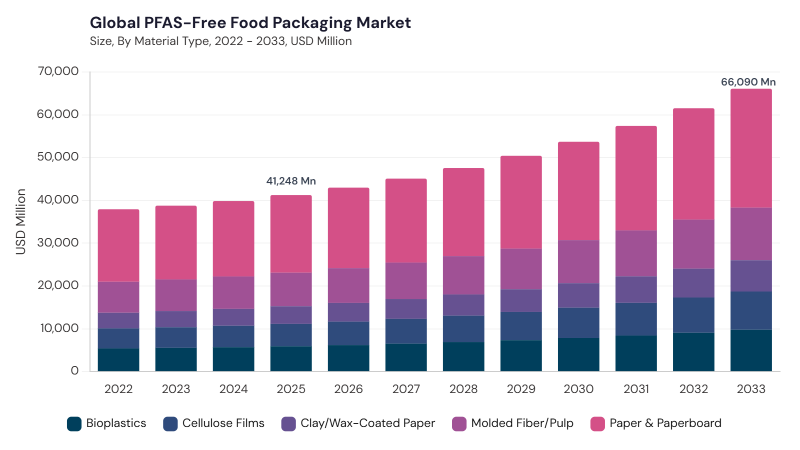
The market growth is driven by increasing regulatory restrictions on PFAS chemicals, rising consumer demand for sustainable packaging solutions, and rapid innovation in biodegradable and recyclable food-contact materials. Food manufacturers, restaurant chains, and packaging companies are increasingly transitioning toward PFAS-free coatings, molded fiber solutions, cellulose-based materials, and recyclable barrier technologies to align with sustainability goals and evolving regulatory standards. Increasing environmental concerns associated with fluorinated compounds and growing adoption of compostable packaging alternatives are further supporting long-term market expansion globally.
The PFAS-Free Food Packaging Market is undergoing rapid transformation as governments, food brands, and consumers increasingly move away from fluorinated chemicals used in traditional grease-resistant food packaging materials. Growing evidence regarding the environmental persistence and potential health risks associated with PFAS exposure has accelerated regulatory bans and industry-wide transitions toward safer alternatives. Manufacturers are investing significantly in bio-based polymers, molded pulp packaging, cellulose films, and advanced biodegradable coatings capable of replicating the performance of PFAS without environmental toxicity.
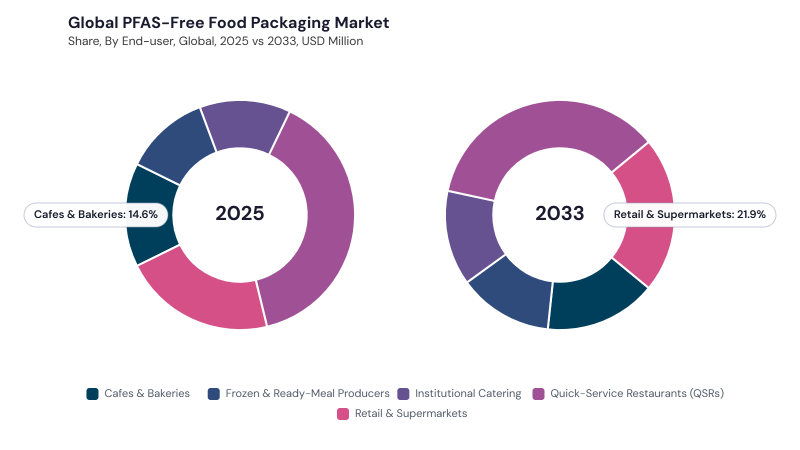
Furthermore, rising demand for recyclable, compostable, and circular-economy-compatible food packaging solutions across foodservice, retail, and takeaway applications is further supporting market expansion globally. Innovations in water-based coatings, plant-derived waxes, and renewable barrier technologies are enabling scalable adoption while meeting food safety, performance, and sustainability requirements.
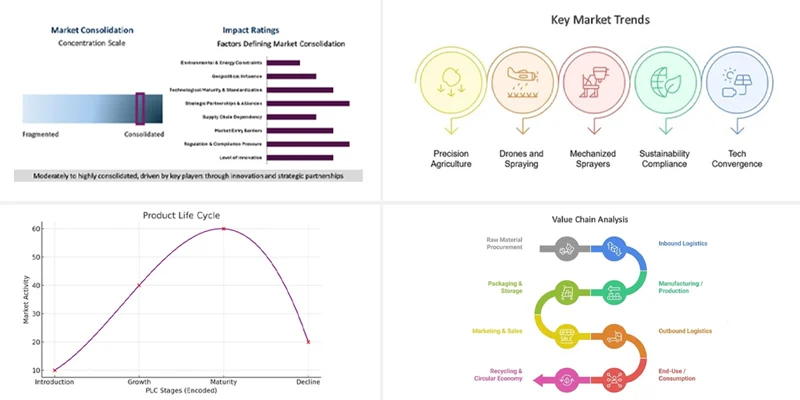

The PFAS-Free Food Packaging Market demonstrates a moderately fragmented competitive landscape characterized by strong participation from fiber-based packaging manufacturers, molded pulp innovators, sustainable material providers, and foodservice packaging companies. Major companies are increasingly focusing on biodegradable coatings, recyclable packaging systems, compostable food containers, and PFAS-free barrier technologies to strengthen competitive positioning.
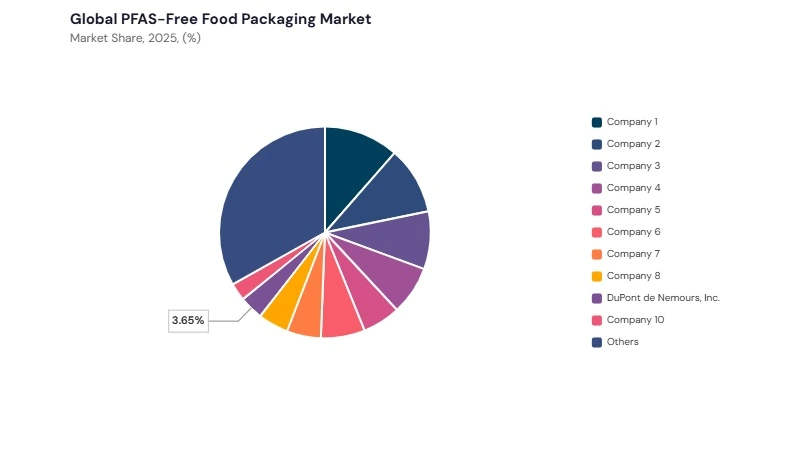
Stora Enso Oyj accounted for a notable market share in 2025 supported by its strong renewable packaging portfolio, sustainable fiber technologies, and increasing investments in PFAS-free food packaging solutions. Companies such as Smurfit WestRock plc, UPM-Kymmene Corporation, Huhtamäki Oyj, and Novolex Holdings, LLC collectively strengthened their market presence through expansion of recyclable foodservice packaging and biodegradable coating technologies.
Other major participants include Graphic Packaging International, LLC, Pactiv Evergreen Inc., Genpak LLC, Dart Container Corporation, and Sabert Corporation. These companies continue to focus on sustainable material innovation, regulatory compliance, and eco-friendly packaging technologies to support long-term market expansion.
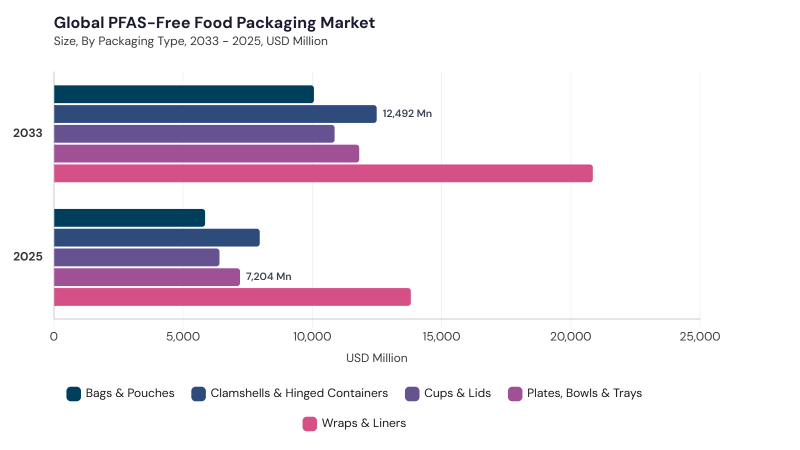
Based on Packaging Type, the market is segmented into Wraps & Liners, Clamshells & Hinged Containers, Plates, Bowls & Trays, Cups & Lids, and Bags & Pouches. The Wraps & Liners segment dominated the market in 2025 owing to extensive adoption across takeaway food packaging, sandwich wraps, bakery applications, and quick-service restaurant operations. The segment is projected to attain a market size of USD 20,854.2 Million by 2033 supported by increasing replacement of fluorinated grease-resistant paper with recyclable and compostable alternatives. On the other hand, the Bags & Pouches segment is expected to witness the fastest CAGR of 7.3% during 2026-2033 due to growing demand for lightweight sustainable flexible packaging and eco-friendly food delivery solutions.
Based on Material Type, the market is segmented into Paper & Paperboard, Molded Fiber/Pulp, Bioplastics, Cellulose Films, and Clay/Wax-Coated Paper. The Paper & Paperboard segment accounted for the largest revenue share of 43.98% in 2025 owing to strong recyclability, biodegradability, and widespread adoption across foodservice packaging applications.
The segment continues to benefit from increasing regulatory support for fiber-based food-contact materials and growing consumer preference for sustainable packaging solutions. Meanwhile, the Bioplastics segment is anticipated to emerge as the fastest-growing category with a CAGR of 6.7% during the forecast period driven by rising adoption of plant-based polymers, compostable packaging materials, and biodegradable food-contact solutions globally.
Based on End-user, the market is segmented into Quick-Service Restaurants (QSRs), Retail & Supermarkets, Cafes & Bakeries, Institutional Catering, and Frozen & Ready-Meal Producers. The Quick-Service Restaurants (QSRs) segment dominated the market in 2025 supported by large-scale sustainability initiatives among global restaurant chains and increasing transition toward PFAS-free food-contact packaging.
The segment is projected to surpass USD 23,576.1 Million by 2033 owing to expanding takeaway food consumption and increasing regulatory compliance requirements for foodservice packaging. In contrast, the Cafes & Bakeries segment is expected to record the highest CAGR of 7.3% during 2026-2033 due to rising adoption of sustainable bakery takeaway packaging and environmentally compliant disposable food containers.
Free Valuable Insights: PFAS-Free Food Packaging Market Size to reach $66,089.6 Million by 2033
Region-wise, the market is analyzed across North America, Europe, Asia Pacific, and LAMEA. North America dominated the market in 2025 accounting for 36.8% revenue share owing to aggressive PFAS regulations, strong sustainability initiatives, and increasing investments in environmentally compliant foodservice packaging solutions.
The region is expected to maintain its leadership position and is projected to reach USD 23,367.3 Million by 2033. Meanwhile, Asia Pacific is anticipated to witness the fastest CAGR of 6.9% during the forecast period supported by rapid urbanization, food delivery expansion, increasing environmental awareness, and rising adoption of sustainable food packaging technologies across China, India, Japan, and Southeast Asia.
| Report Attribute | Details |
|---|---|
| Market size value in 2026 | USD 42,980.6 Million |
| Market size forecast in 2033 | USD 66,089.6 Million |
| Base Year | 2025 |
| Historical Period | 2022 to 2024 |
| Forecast Period | 2026 to 2033 |
| Revenue Growth Rate | CAGR of 6.3% from 2026 to 2033 |
| Number of Pages | 629 |
| Tables | 750 |
| Report Coverage | Market Trends, Revenue Estimation and Forecast, Segmentation Analysis, Regional and Country Breakdown, Competitive Landscape, Sustainability Analysis, Regulatory Landscape, Company Profiling, Strategic Developments |
| Segments Covered | Packaging Type, Material Type, End-user, Region |
| Country Scope | North America (US, Canada, Mexico, Rest of North America); Europe (Germany, UK, France, Italy, Spain, Rest of Europe); Asia Pacific (China, Japan, India, South Korea, Australia, Rest of Asia Pacific); LAMEA (Brazil, UAE, Saudi Arabia, South Africa, Rest of LAMEA) |
| Companies Included | Stora Enso Oyj; Smurfit WestRock plc; UPM-Kymmene Corporation; Huhtamäki Oyj; Novolex Holdings, LLC; Graphic Packaging International, LLC; Pactiv Evergreen Inc.; Genpak LLC; Dart Container Corporation; Sabert Corporation |
By Packaging Type
By Material Type
By End-user
By Geography
The market will reach USD 66,089.6 million by 2033, growing at 6.3% CAGR during 2026-2033.
Wraps & Liners leads and will hit USD 20,854.2 million by 2033.
Stora Enso Oyj, Smurfit WestRock plc, UPM-Kymmene Corporation, Huhtamäki Oyj, and Novolex Holdings lead the space.
North America dominates with 36.8% revenue share, projected to reach USD 23,367.3 million by 2033.
Regulatory pressure, consumer health awareness, and corporate sustainability commitments are accelerating adoption.
Paper & Paperboard dominates with 43.98% revenue share, reaching USD 27,787.0 million by 2033.
Our team of dedicated experts can provide you with attractive expansion opportunities for your business.








 Unique Offerings