The sample copy of this report is available for access.
The Asia Pacific PFAS-Free Food Packaging Market size is projected to reach USD 14,293.8 million by 2030, growing at a CAGR of 6.9% during the forecast period (2026-2033).
The Asia Pacific PFAS-Free Food Packaging Market is witnessing rapid expansion owing to increasing concerns regarding the harmful environmental and health impacts associated with per- and polyfluoroalkyl substances (PFAS) used in conventional food packaging materials. Governments across Asia Pacific are strengthening regulations on PFAS usage in food-contact applications, encouraging foodservice providers, retailers, and packaging manufacturers to shift toward safer and sustainable packaging alternatives. Rising urbanization, increasing packaged food consumption, and the rapid expansion of takeaway and online food delivery services are further driving demand for PFAS-free food packaging solutions across the region.
The market is also benefiting from technological advancements in biodegradable coatings, molded fiber packaging, cellulose-based films, and bio-based barrier materials that provide grease and moisture resistance without the use of harmful fluorinated chemicals. Increasing consumer awareness regarding sustainable packaging, combined with corporate sustainability initiatives and circular economy goals, is accelerating the transition toward recyclable and compostable food packaging formats. Countries such as China, Japan, India, South Korea, and Australia are witnessing rising investments in sustainable packaging infrastructure and fluorine-free material innovation, supporting long-term market growth across Asia Pacific.
Based on Packaging Type, the market is segmented into Wraps & Liners, Clamshells & Hinged Containers, Plates, Bowls & Trays, Cups & Lids, and Bags & Pouches. The Wraps & Liners segment dominated the Asia Pacific PFAS-Free Food Packaging Market in 2025 and would continue to be a dominant segment till 2030; thereby, achieving a market value of USD 4,621.6 million by 2030. The Clamshells & Hinged Containers segment accounted for a market share of 19.5% in 2025 owing to increasing demand for takeaway and ready-to-eat meal packaging applications. Additionally, the Bags & Pouches segment is expected to witness a CAGR of 7.9% during the forecast period (2026-2033).
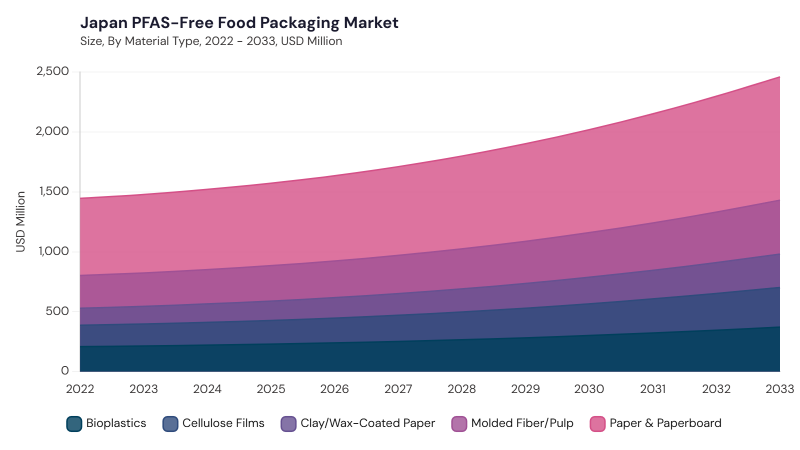
Based on Material Type, the market is segmented into Paper & Paperboard, Molded Fiber/Pulp, Bioplastics, Cellulose Films, and Clay/Wax-Coated Paper. The Paper & Paperboard segment acquired the largest revenue share in the Asia Pacific PFAS-Free Food Packaging Market in 2025 and would continue to be a dominant segment till 2030; thereby, achieving a market value of USD 6,123.3 million by 2030. The Molded Fiber/Pulp segment held a market share of 18.1% in 2025 due to increasing adoption of biodegradable and compostable packaging materials across foodservice applications. Additionally, the Bioplastics segment is expected to witness a CAGR of 7.4% during the forecast period (2026-2033).
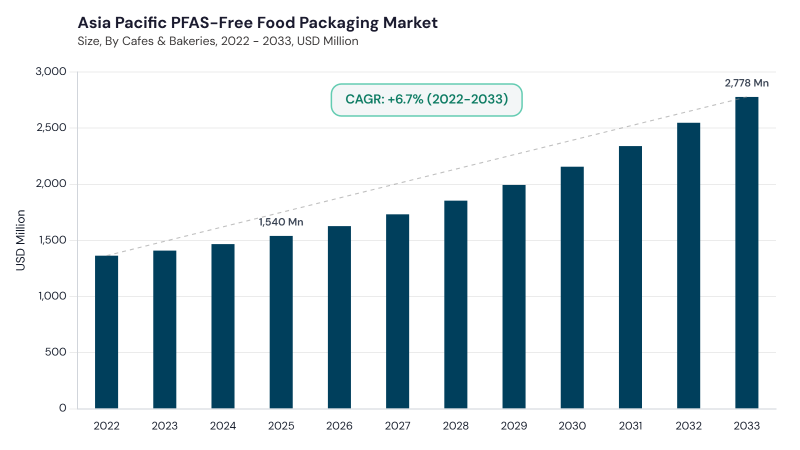
Based on End-user, the market is segmented into Quick-Service Restaurants (QSRs), Retail & Supermarkets, Cafes & Bakeries, Institutional Catering, and Frozen & Ready-Meal Producers. The Quick-Service Restaurants (QSRs) segment dominated the Asia Pacific PFAS-Free Food Packaging Market in 2025 and would continue to be a dominant segment till 2030; thereby, achieving a market value of USD 5,299.9 million by 2030. The Retail & Supermarkets segment accounted for a market share of 21.4% in 2025 owing to increasing adoption of PFAS-free packaging for fresh food and ready-to-eat products. Additionally, the Cafes & Bakeries segment is expected to witness a CAGR of 7.3% during the forecast period (2026-2033).
Free Valuable Insights: PFAS-Free Food Packaging Market is Predicted to reach USD 66,089.6 Million billion by 2033, at a CAGR of 6.3%
Based on Country, the market is segmented into China, Japan, India, South Korea, Australia, Malaysia, Singapore, and Rest of Asia Pacific. China market dominated the Asia Pacific PFAS-Free Food Packaging Market by Country in 2025 and would continue to be a dominant market till 2030; thereby, achieving a market value of USD 4,218.6 million by 2030. The Japan market accounted for a market share of 18.7% in 2025 owing to increasing demand for sustainable retail and takeaway food packaging solutions. Additionally, the India market is expected to witness a CAGR of 7.8% during the forecast period (2026-2033).
The increasing expansion of sustainable foodservice infrastructure, eco-friendly retail packaging, and biodegradable takeaway packaging across Asia Pacific is expected to continue supporting market growth. Regulatory support for reducing PFAS chemicals in food-contact materials and rising investments in recyclable and compostable packaging technologies are further accelerating adoption of PFAS-free food packaging solutions across the region.

By Packaging Type
By Material Type
By End-user
By Country
Market will reach USD 14,293.8 million by 2030, growing at 6.9% CAGR during the forecast period.
China dominates and will achieve USD 4,218.6 million by 2030. Japan holds 18.7% market share in 2025.
Increasing demand for sustainable retail and takeaway food packaging solutions across the region.
India market will witness 7.8% CAGR during the forecast period (2026-2033).
Our team of dedicated experts can provide you with attractive expansion opportunities for your business.




 Unique Offerings