The sample copy of this report is available for access.
“Global Patch Management Market to reach a market value of USD 2710.45 Million by 2033 growing at a CAGR of %”
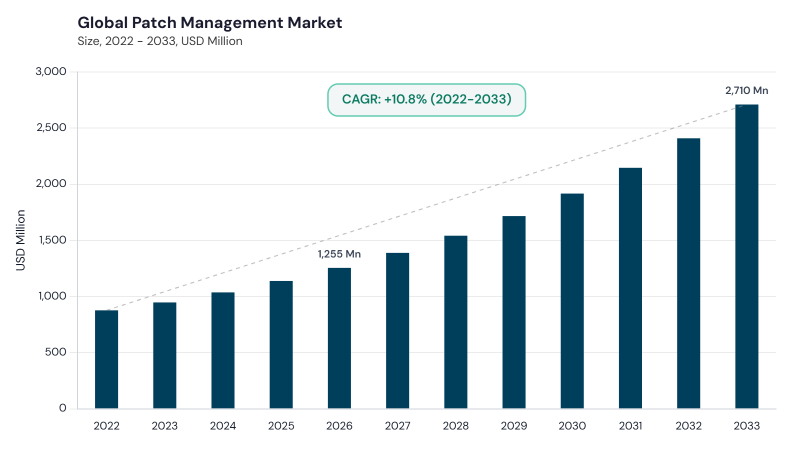
The Global Patch Management Market is expected to reach USD 2710.5 million by 2033, growing at a CAGR of 11.6% during (2026 - 2033).
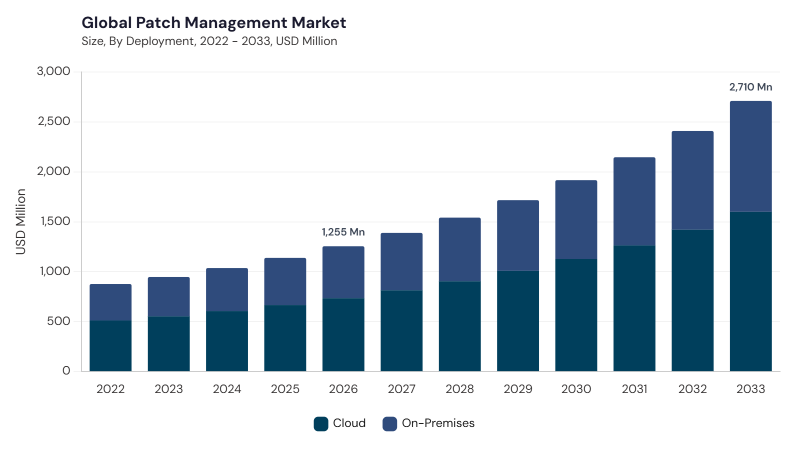
Growing cybersecurity threats, expanding enterprise IT environments, and the need for timely vulnerability remediation are driving the Patch Management Market across BFSI, healthcare, government, IT and telecommunication, manufacturing, retail, and other digitally dependent industries. Adoption is further strengthened by cloud migration, hybrid work, connected endpoints, regulatory compliance, and increasing complexity across multi-platform infrastructure. Patch management originated as a manual and reactive practice focused on applying vendor-issued fixes for software defects and security vulnerabilities.
Rising demand for continuous vulnerability remediation is moving enterprise investment beyond periodic software-update schedules toward risk-based security workflows. Organizations increasingly combine exploit intelligence, asset criticality, and business impact to prioritize updates and reduce exposure windows. Automated testing, staged rollouts, maintenance scheduling, rollback, and post-deployment verification help limit operational disruption while improving remediation consistency. Expanding third-party application portfolios, distributed workforces, connected devices, and operational technology environments are widening patching requirements. Managed services also help organizations address limited internal expertise, while compliance dashboards and audit trails reinforce the role of patch management in enterprise security governance.
Competition centers on automation depth, application coverage, cross-platform compatibility, integration, and deployment reliability. Enterprise software vendors compete with endpoint-management providers, vulnerability-management platforms, and specialized patching companies. Larger suppliers emphasize scalable platforms and integration with established IT ecosystems, while specialists differentiate through third-party application automation, cloud-native delivery, and managed-service-provider functionality. Partnerships increasingly connect vulnerability intelligence with patch execution, while flexible subscription models improve accessibility for smaller organizations. Reliable remediation, transparent reporting, controlled rollout capabilities, and lower administrative effort remain central purchasing considerations.
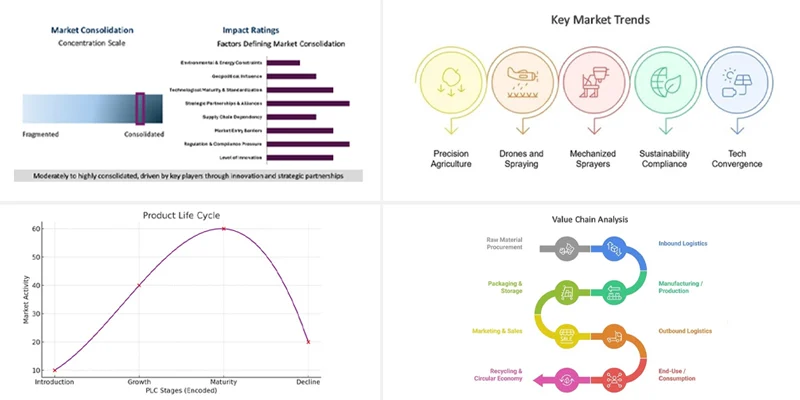

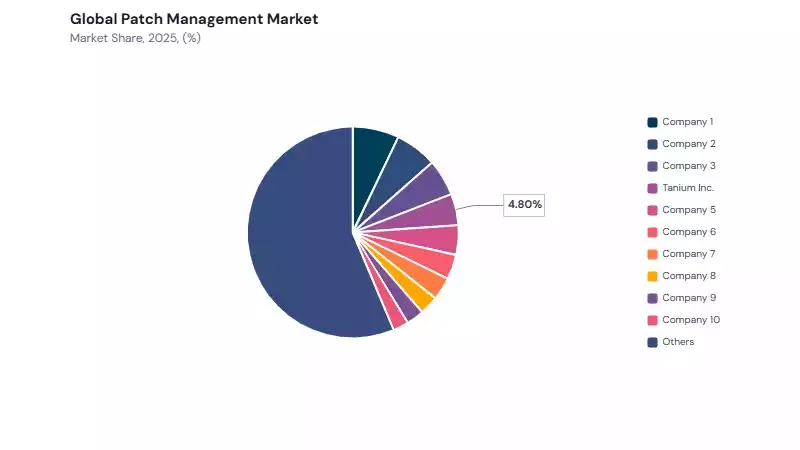
Microsoft Corporation, Zoho Corporation, and Ivanti, Inc. maintain prominent positions through endpoint integration and automated patch-management capabilities. Tanium Inc. and HCLSoftware emphasize enterprise-scale endpoint visibility and control, while Qualys, Inc. connects vulnerability intelligence with remediation. NinjaOne LLC and Automox Inc. compete through cloud-native patching, Patch My PC LLC specializes in third-party application management, and Kaseya Ltd. integrates patching with remote monitoring and management. The market remains moderately fragmented, with application coverage, deployment reliability, compliance reporting, integration capabilities, and administrative efficiency shaping competitive positioning.
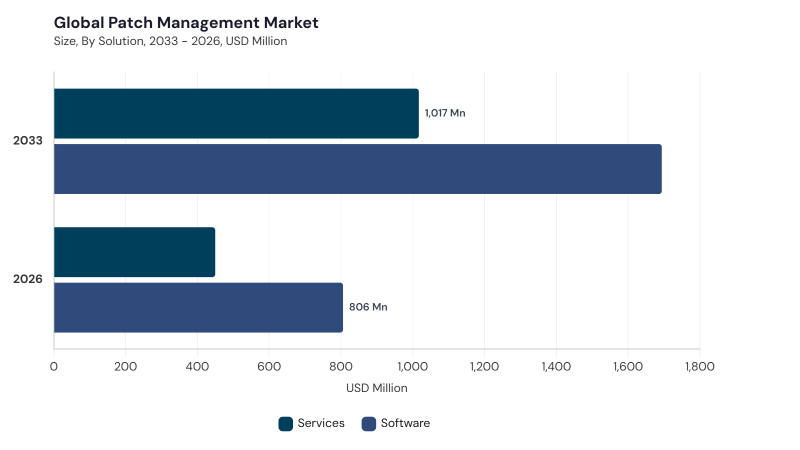
Based on solution, the market is segmented into Software and Services. The Software market dominated the Global Patch Management Market by Solution in 2025, and would continue to be a dominant market till 2033; thereby, achieving a market value of USD 1693.6 million by 2033, growing at a CAGR of 11.2 % during the forecast period. The Services market is expected to witness a CAGR of 12.4% during (2026 - 2033).
Software platforms automate vulnerability identification, patch testing, deployment, verification, and compliance monitoring through centralized controls and security-platform integration. Services include implementation, consulting, managed patching, maintenance, and technical support. Organizations with limited cybersecurity expertise or complex legacy environments rely on service providers to coordinate remediation and maintain operational continuity.
Based on deployment, the market is segmented into Cloud and On-Premises. The Cloud market dominated the Global Patch Management Market by Deployment in 2025, and would continue to be a dominant market till 2033; thereby, achieving a market value of USD 1599.7 million by 2033, growing at a CAGR of 11.7 % during the forecast period. Additionally, The On-Premises market is expected to witness highest CAGR of 11.5% during (2026 - 2033).
Cloud platforms provide centralized administration, scalability, and remote accessibility for distributed endpoints without requiring extensive local infrastructure. On-Premises solutions remain important where organizations require direct control over sensitive systems, patch repositories, and deployment schedules. Governance requirements, isolated infrastructure, legacy compatibility, maintenance resources, and workforce distribution influence deployment selection.
Based on enterprise size, the market is segmented into Large Enterprise and SMEs. The Large Enterprise market dominated the Global Patch Management Market by Enterprise Size in 2025, and would continue to be a dominant market till 2033; thereby, achieving a market value of USD 1450.4 million by 2033, growing at a CAGR of 11.3 % during the forecast period. The SMEs market is expected to witness a CAGR of 12% during (2026 - 2033).
Large enterprises require scalable orchestration across extensive endpoint populations, varied applications, and hybrid infrastructure, supported by asset discovery, risk prioritization, and auditability. SMEs place greater emphasis on affordability, rapid deployment, and straightforward administration. Subscription-based cloud platforms and managed services enable smaller organizations to establish systematic patching without maintaining large internal security teams.
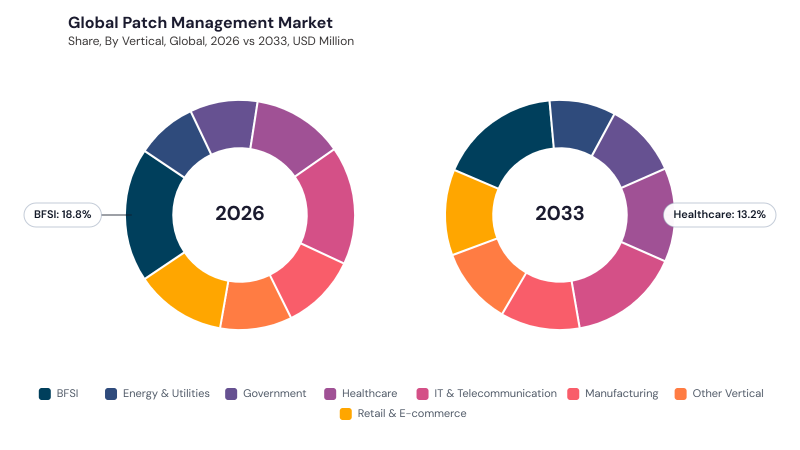
Based on vertical, the market is segmented into BFSI, IT & Telecommunication, Retail & E-commerce, Healthcare, Manufacturing, Government, Energy & Utilities, and Other Vertical. The BFSI market dominated the Global Patch Management Market by Vertical in 2025, and would continue to be a dominant market till 2033; thereby, achieving a market value of USD 464.7 million by 2033, growing at a CAGR of 10.1 % during the forecast period. The IT & Telecommunication market is expected to witness a CAGR of 10.6% during (2026 - 2033). Additionally, The Retail & E-commerce market is expected to witness highest CAGR of 10.7% during (2026 - 2033).
BFSI prioritizes transaction systems and financial-data protection, while IT and telecommunication manages frequent updates across networks, servers, and cloud infrastructure. Retail and e-commerce focuses on payment systems and distributed devices, whereas healthcare emphasizes patient-data protection and clinical availability. Manufacturing, government, and utilities require controlled remediation for operational continuity and critical infrastructure, while other verticals include education, transportation, media, and related industries.
Free Valuable Insights: Patch Management Market Size to reach $2710.5 Million by 2033
Region-wise, the Patch Management Market is analyzed across North America, Europe, Asia Pacific, and LAMEA. The North America market dominated the Global Patch Management Market by Region in 2025, and would continue to be a dominant market till 2033; thereby, achieving a market value of USD 952.8 million by 2033, growing at a CAGR of 10.9 % during the forecast period. The Asia Pacific market is expected to witness a CAGR of 12.5% during (2026 - 2033). Additionally, The Europe market is expected to witness a CAGR of 11.4% during (2026 - 2033).
Mature cybersecurity infrastructure and extensive enterprise software adoption sustain demand across North America. European adoption reflects data-protection priorities, regulatory compliance, and cloud migration. Rapid enterprise digitalization, expanding cloud infrastructure, and increasing cybersecurity spending support growth across Asia Pacific. In LAMEA, digital-infrastructure development and security modernization are widening adoption, although differences in budgets, technical expertise, and infrastructure maturity continue to shape deployment and service requirements.
| Report Attribute | Details |
|---|---|
| Market size value in 2026 | USD 1255.3 million |
| Market size forecast in 2033 | USD 2710.5 million |
| Base Year | 2025 |
| Historical Period | 2022 to 2024 |
| Forecast Period | 2026 to 2033 |
| Revenue Growth Rate | CAGR of 11.6% from 2026 to 2033 |
| Number of Pages | XX |
| Tables | XX |
| Report Coverage | Market Trends, Revenue Estimation and Forecast, Segmentation Analysis, Regional and Country Breakdown, Competitive Landscape, Market Share Analysis, Company Profiling, Companies Strategic Developments, SWOT Analysis, Product Life Cycle Analysis, Value Chain Analysis, Market Consolidation Analysis, Key Customer Criteria, Pandemic Impact Analysis, and Winning Imperatives |
| Segments Covered | Solution, Deployment, Enterprise Size, Vertical, and Geography |
| Country Scope |
|
| Companies Included | Microsoft Corporation; Zoho Corporation; Ivanti, Inc.; Tanium Inc.; HCLSoftware; Qualys, Inc.; NinjaOne LLC; Automox Inc.; Patch My PC LLC; Kaseya Ltd. |
By Solution
By Deployment
By Enterprise Size
By Vertical
By Geography
Expected to reach USD 2710.5 million by 2033, growing at 11.6% CAGR during 2026-2033.
Public cloud tops the chart, projected to hit $188.02 billion by 2033.
Microsoft, Zoho, Ivanti, Tanium, HCLSoftware, Qualys, NinjaOne, Automox, Patch My PC, Kaseya lead the market.
North America leads at $111.24 billion by 2033; Asia Pacific grows at 13.1% CAGR during 2026-2033.
Cybersecurity threats and regulatory compliance boost patch management demand.
Patch Management Market size is expected to reach USD 2710.5 million by 2033, rising at 11.6% CAGR during 2026-2033.
Our team of dedicated experts can provide you with attractive expansion opportunities for your business.






 Unique Offerings
