The sample copy of this report is available for access.
The Europe Patch Management Market is expected to reach USD 629.3 million by 2031, growing at a CAGR of 11.4% during (2026 - 2033).
The Europe Patch Management Market evolved from manual and semi-automated software updating toward centralized platforms capable of continuously identifying, prioritizing, deploying, and validating security patches across increasingly complex IT environments. Expansion of cloud computing, mobile devices, hybrid infrastructure, and diversified endpoints accelerated the transition from reactive patching to automated and risk-based vulnerability remediation. Regulatory requirements surrounding data protection and cybersecurity further strengthened the need for auditable patching processes and consistent security controls. Integration with vulnerability management, endpoint security, IT service management, and broader cyber-risk frameworks has consequently positioned patch management as a core element of enterprise resilience and regulatory compliance across Europe.
Cloud-native architectures, AI-enabled automation, regulatory compliance, virtual patching, and risk-based prioritization are shaping current market development. Organizations increasingly use machine learning, vulnerability intelligence, automated remediation, predictive analytics, and contextual risk scoring to determine patch urgency and minimize operational disruption. Hybrid and multi-cloud environments are increasing demand for centralized platforms capable of managing distributed endpoints while maintaining consistent security policies. Virtual patching is also gaining importance where immediate software updates may disrupt critical workloads or legacy systems. However, high total cost of ownership, fragmented IT environments, interoperability challenges, cybersecurity skills shortages, complex European regulatory requirements, and concerns regarding data sovereignty continue to influence deployment decisions.
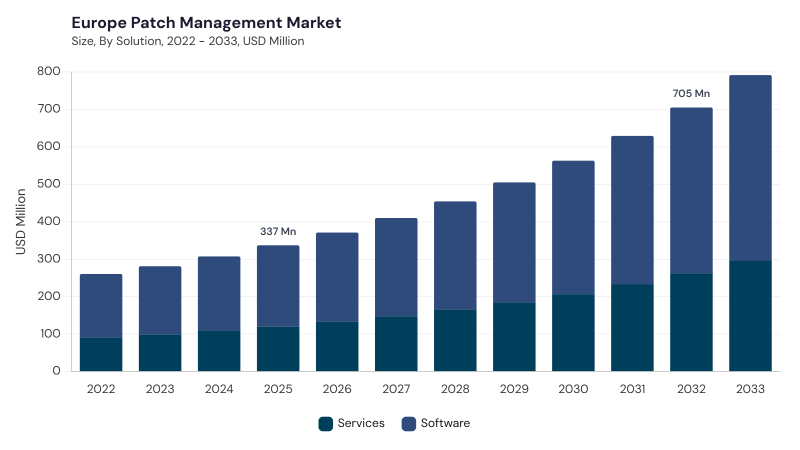
Based on Solution, the market is segmented into Software and Services. The Software market dominated the Europe Patch Management Market by Solution in 2025, and would continue to be a dominant market till 2033; thereby, achieving a market value of USD 396.7 million by 2031, growing at a CAGR of 11 % during the forecast period. The Services market is expected to witness a CAGR of 12.2% during (2026 - 2033).
Software platforms support patch discovery, vulnerability assessment, prioritization, scheduling, deployment, verification, rollback, compliance reporting, and integration with broader security environments. AI-assisted prioritization, zero-touch workflows, cloud-native delivery, and automation are increasing their role within enterprise cyber resilience programs. Services include consulting, managed patching, vulnerability assessment, remediation planning, implementation, and compliance advisory support. Growing cybersecurity complexity, hybrid infrastructure, legacy systems, and shortages of specialized personnel are increasing reliance on managed and professional services, particularly among SMEs and organizations operating highly regulated or operationally sensitive environments.
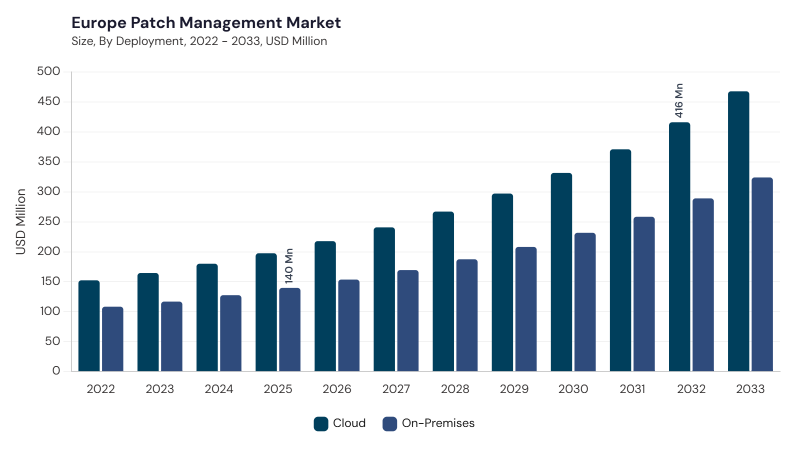
Based on Deployment, the market is segmented into Cloud and On-Premises. The Cloud market dominated the Europe Patch Management Market by Deployment in 2025, and would continue to be a dominant market till 2033; thereby, achieving a market value of USD 370.9 million by 2031, growing at a CAGR of 11.5 % during the forecast period. Additionally, The On-Premises market is expected to witness highest CAGR of 11.3% during (2026 - 2033).
Cloud deployment enables scalable administration, centralized visibility, automated updates, remote endpoint management, SaaS delivery, and integration across hybrid and multi-cloud environments. Subscription-based models and reduced infrastructure requirements also improve accessibility for SMEs and distributed organizations. On-Premises remains relevant for government, healthcare, critical infrastructure, financial institutions, and other environments requiring direct control over data, security policies, and remediation processes. Data sovereignty, regulatory requirements, legacy-system integration, and internal governance preferences continue to support locally managed deployments even as hybrid architectures gain prominence.
Based on Enterprise Size, the market is segmented into Large Enterprise and SMEs. Large Enterprise environments require scalable automation, real-time vulnerability assessment, centralized dashboards, risk-based prioritization, SIEM integration, hybrid-cloud support, and detailed compliance reporting across multiple locations. Increasing adoption of Zero Trust, automated endpoint security, and unified vulnerability management is further integrating patching into broader cyber-risk programs.
SMEs prioritize affordability, ease of deployment, simplified automation, cloud delivery, and managed services because of limited budgets and internal cybersecurity resources. Rising ransomware threats, digitalization, remote work, and regulatory exposure are encouraging smaller businesses to formalize patching through SaaS platforms and outsourced security services.
Based on Vertical, the market is segmented into BFSI, IT & Telecommunication, Retail & E-commerce, Healthcare, Manufacturing, Government, Energy & Utilities, and Other Vertical. BFSI emphasizes rapid remediation, compliance reporting, vulnerability prioritization, and continuity of critical financial systems, while IT & Telecommunication requires frequent patching across networks, data centers, cloud platforms, 5G infrastructure, and software environments.
Retail & E-commerce focuses on POS systems, payment infrastructure, digital storefronts, and customer-data protection, whereas Healthcare requires carefully controlled patching across EHR platforms, medical devices, and clinical networks. Manufacturing increasingly addresses vulnerabilities across IT, OT, SCADA, MES, and IIoT environments, while Government prioritizes secure updates, auditability, and resilience across public-sector infrastructure. Energy & Utilities emphasizes controlled remediation across critical operational systems, while Other Vertical includes education, transportation, professional services, and other increasingly digitized industries.
Free Valuable Insights: The Worldwide Patch Management Market is projected to reach USD 2710.5 Million billion by 2033, at a CAGR of 11.6%
Based on Country, the market is segmented into Germany, UK, France, Russia, Spain, Italy, and Rest of Europe. The Germany market dominated the Europe Patch Management Market by Country in 2025, and would continue to be a dominant market till 2033; thereby, achieving a market value of USD 140.5 million by 2031, growing at a CAGR of 10.1 % during the forecast period. The UK market is expected to witness a CAGR of 10.5% during (2026 - 2033). Additionally, The France market is expected to witness a CAGR of 12.1% during (2026 - 2033).
Across Europe, patch management adoption reflects differences in cybersecurity maturity, regulatory requirements, cloud adoption, industrial structure, and digital transformation. Germany emphasizes Industry 4.0 security, AI-driven prioritization, compliance reporting, hybrid infrastructure, and integration with broader cybersecurity platforms, while the UK focuses on AI-enabled automation, vulnerability-management integration, scalable cloud architectures, and regulatory alignment. France increasingly emphasizes predictive risk prioritization, virtual patching, cloud-native platforms, and compliance-driven remediation, whereas Russia focuses on automation, localized solutions, regulatory transparency, data sovereignty, and distributed-environment security. Spain prioritizes cloud-native and virtual patching, hybrid IT management, audit readiness, and AI-guided remediation, while Italy emphasizes supply-chain security, predictive vulnerability management, cloud-centric patching, and automated remediation. Rest of Europe continues to advance AI-enhanced automation, compliance reporting, hybrid and multi-cloud management, real-time patch intelligence, IoT support, and centralized vulnerability remediation.

By Solution
By Deployment
By Enterprise Size
By Vertical
By Country
Set to reach $629.3 Million by 2031, growing at 11.4% CAGR during 2026-2033.
Germany leads, achieving $140.5 million by 2031, with a 10.1% CAGR during 2026-2033.
Rising enterprise cloud adoption significantly impacts market growth.
Software segment reaches $396.7 million by 2031, growing at 11% CAGR during 2026-2033.
The UK market is expected to witness a 10.5% CAGR during 2026-2033.
Cloud deployment hits $370.9 million by 2031, growing at 11.5% CAGR during 2026-2033.
Our team of dedicated experts can provide you with attractive expansion opportunities for your business.




 Unique Offerings
