The sample copy of this report is available for access.
“Global Off-highway Vehicle Engine Market to reach a market value of USD 82,400.39 Million by 2033 growing at a CAGR of 5.9%”
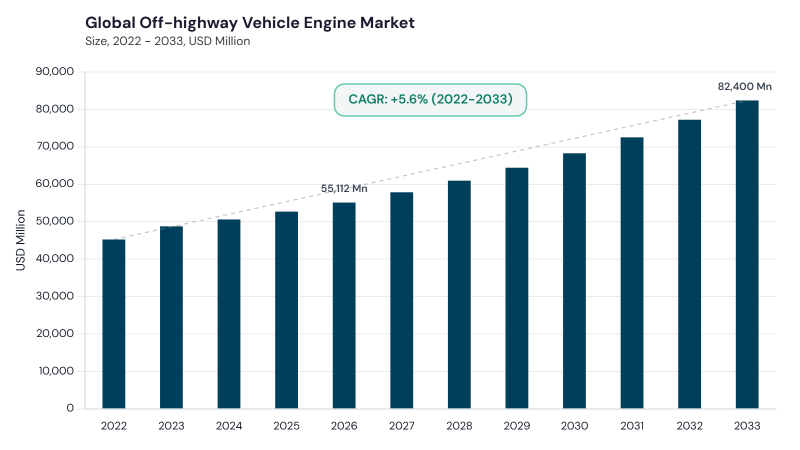
The Global Off-highway Vehicle Engine Market is expected to reach USD 82.4 billion by 2033, growing at a CAGR of 5.9% during (2026 - 2033).
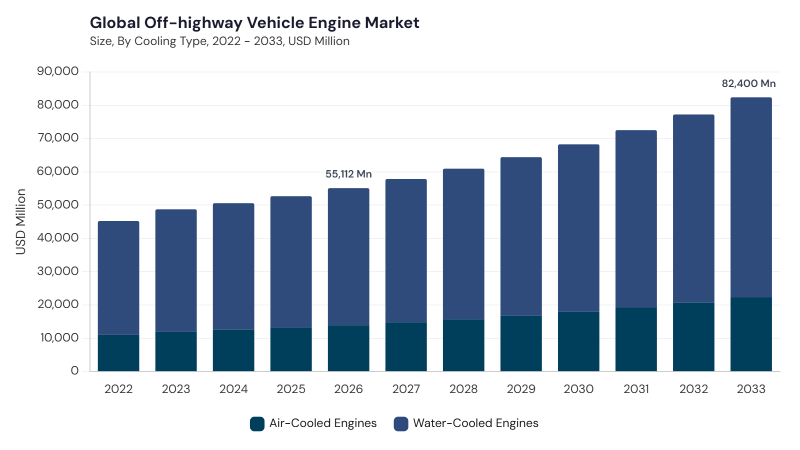
The off-highway vehicle engine market is experiencing expansion supported by growing demand for fuel-efficient, durable, emission-compliant, and high-torque engines across agriculture, construction, mining, material-handling, and forestry applications. Market growth is driven by agricultural mechanization, infrastructure development, hybridization, mining activity, infrastructure development, predictive maintenance, electric controls, and alternative-fuel engine development. Market emerged with mechanization of construction, mining, and agriculture, where rugged engines were required for vehicles operating beyond roadways.
Off-highway vehicle engine market is expanding as operators need engines that lower fuel consumption, deliver strong productivity, dependable operations, and longer service intervals across demanding field conditions. Agriculture, construction, mining, and forestry applications continue to rely on engines capable of variable loads, dust, handling high torque, vibration, and extended duty cycles. Market growth is predicted to be driven by renewable fuels, emission-compliant diesel platforms, hybrid powertrains and the gradual adoption of hydrogen-based and electric propulsion solutions.
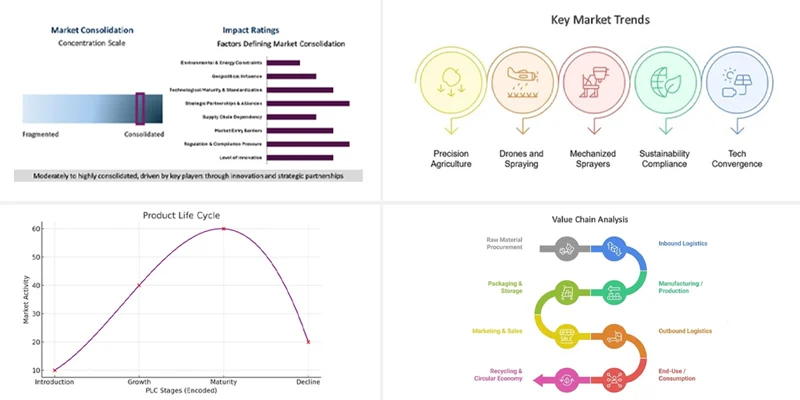
Off-highway vehicle engine market is powertrain-technology driven and moderately consolidated, with competition driven by captive equipment-engine divisions, independent engine manufacturers, and diversified industrial power companies. Market players compete through emissions compliance, fuel efficiency, durability, torque delivery, aftermarket support, and electronic controls. Market compete relies on electrification, hybridization, renewable fuels, hydrogen combustion, predictive diagnostics, hybridization, and regional service networks, and the capability to support OEMs across multiple machinery categories.

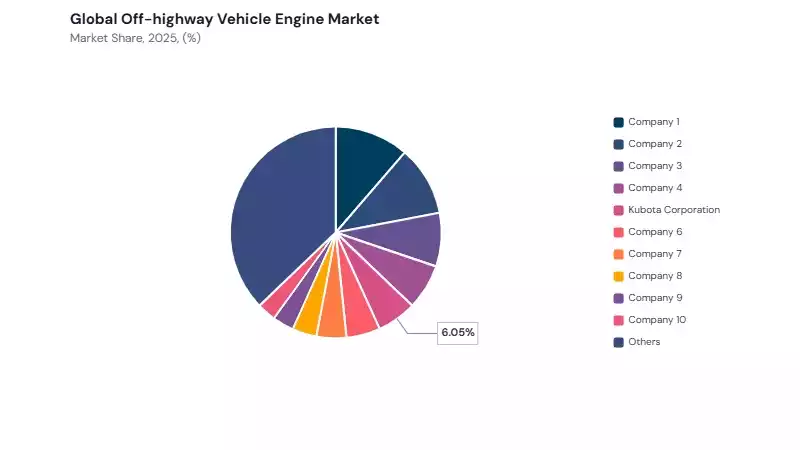
Off highway vehicle engine market seems to be highly competitive with competition driven by Weichai Power, Cummins, John Deere Power Systems, Caterpillar including Perkins, Yanmar, and Kubota. Volvo Penta, FPT Industrial, Komatsu, and DEUTZ further strengthen the competitive landscape through engines for mining, construction, agriculture, captive equipment platforms, and industrial vehicles. Market competition will rely on fuel efficiency, emissions compliance, hybrid systems, alternative-fuel compatibility, aftermarket service strength, digital engine management, and electrification.
Based on Fuel Type, the market is segmented into Diesel and Gasoline. The Diesel market dominated the Global Off-highway Vehicle Engine Market by Fuel Type in 2025, and would continue to be a dominant market till 2033; thereby, achieving a market value of USD 71.1 billion by 2033, growing at a CAGR of 5.8 % during the forecast period. The Gasoline market is expected to witness a CAGR of 6.8% during (2026 - 2033).
Diesel leads the market due to its high torque delivery, fuel efficiency, durability, and strong suitability for heavy-duty construction, agricultural, mining, and industrial machinery. Diesel engines remain essential for prolonged duty cycles, remote operations, and demanding off-road workloads. Gasoline engines serve a smaller but relevant category, mainly used in lighter equipment where lower upfront cost, simpler maintenance, reduced weight, and flexible operation are important. However, emission requirements continue to push both segments toward cleaner combustion and improved engine management.
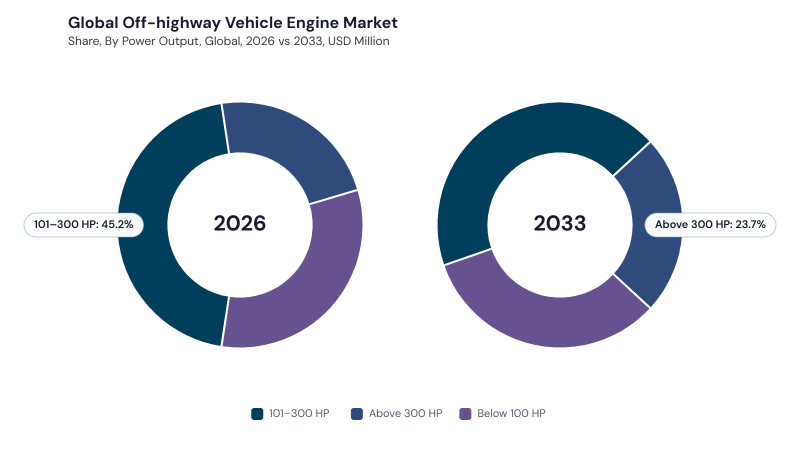
Based on Power Output, the market is segmented into 101–300 HP, Below 100 HP, and Above 300 HP. The 101–300 HP market dominated the Global Off-highway Vehicle Engine Market by Power Output in 2025, and would continue to be a dominant market till 2033; thereby, achieving a market value of USD 35.8 billion by 2033, growing at a CAGR of 5.3 % during the forecast period. The Below 100 HP market is expected to witness a CAGR of 6.3% during (2026 - 2033). The Above 300 HP market is expected to witness a CAGR of 6.5% during (2026 - 2033).
The 101–300 HP segment dominates the market due to its broad application across excavators, loaders, tractors, harvesters, forestry machinery, and medium-duty construction equipment. Below 100 HP engines are strongly used in compact construction machinery, smaller agricultural platforms, utility equipment, and landscaping machinery where maneuverability and fuel economy matter. Above 300 HP engines support high-capacity mining, earthmoving, large agricultural machinery, and heavy construction equipment requiring substantial torque, continuous operation, and reliable power delivery.
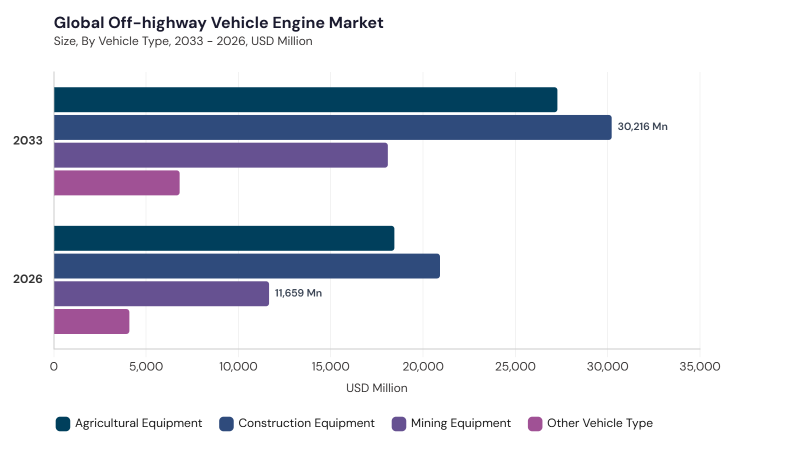
Based on Vehicle Type, the market is segmented into Construction Equipment, Agricultural Equipment, Mining Equipment, and Other Vehicle Type. The Construction Equipment market dominated the Global Off-highway Vehicle Engine Market by Vehicle Type in 2025, and would continue to be a dominant market till 2033; thereby, achieving a market value of USD 30.2 billion by 2033, growing at a CAGR of 5.4 % during the forecast period. The Agricultural Equipment market is expected to witness a CAGR of 5.7% during (2026 - 2033). Additionally, The Mining Equipment market is expected to witness highest CAGR of 6.5% during (2026 - 2033).
Construction Equipment leads the market as infrastructure development, urban construction, road projects, and replacement demand continue to support use of excavators, loaders, bulldozers, cranes, and related machinery. Agricultural Equipment remains a major segment due to farm mechanization, productivity needs, tractors, harvesters, and precision farming equipment. Mining Equipment requires durable, high-torque engines capable of operating under extreme loads and harsh environments. Other Vehicle Type includes forestry, material-handling, landscaping, utility, and specialized industrial equipment.
Based on Cooling Type, the market is segmented into Water-Cooled Engines and Air-Cooled Engines. The Water-Cooled Engines market dominated the Global Off-highway Vehicle Engine Market by Cooling Type in 2025, and would continue to be a dominant market till 2033; thereby, achieving a market value of USD 60.1 billion by 2033, growing at a CAGR of 5.6 % during the forecast period. The Air-Cooled Engines market is expected to witness a CAGR of 6.9% during (2026 - 2033).
Water-Cooled Engines dominate the market due to superior thermal regulation, consistent heavy-load performance, lower overheating risk, and compatibility with high-output engines used in construction, agriculture, mining, and industrial applications. These engines support emission-control systems and prolonged operating cycles where stable temperature management is critical. Air-Cooled Engines remain relevant in compact and lower-power equipment due to simpler construction, lower maintenance complexity, fewer cooling components, and suitability for rugged or remote applications where service access may be limited.
Free Valuable Insights: Off-highway Vehicle Engine Market Size to reach $82.4 Billion by 2033
Region-wise, the Off-highway Vehicle Engine Market is analyzed across North America, Europe, Asia Pacific, and LAMEA. In 2025, the Asia Pacific region led the dominated the off-highway vehicle engine market and is anticipated to grow till 2033, capturing a market value of USD 35.9 billion by 2033, expanding at a CAGR of 6.3% in the forecast period. The North America market is predicted to grow at a CAGR of 5.2%. Moreover, the Europe market is estimated to expand at a CAGR of 5.7% during 2026-2033.
Asia Pacific region led the market because of agricultural mechanization, extensive construction activity, large off-highway machinery production, and mining operations. North America is driven by construction activity, equipment replacement, advanced engine adoption, mining, and agriculture. Europe region benefits from infrastructure modernization, mechanized agriculture, quarrying, and strict emission standards encouraging cleaner powertrains. LAMEA region is experiencing expansion through infrastructure development, mining projects, rising deployment of construction machinery and earthmoving, and agricultural activity.
| Report Attribute | Details |
|---|---|
| Market size value in 2026 | USD 55.1 billion |
| Market size forecast in 2033 | USD 82.4 billion |
| Base Year | 2025 |
| Historical Period | 2022 to 2024 |
| Forecast Period | 2026 to 2033 |
| Revenue Growth Rate | CAGR of 5.9% during (2026 - 2033) |
| Number of Pages | 651 |
| Tables | 690 |
| Report Coverage | Market Trends, Revenue Estimation and Forecast, Segmentation Analysis, Regional and Country Breakdown, Competitive Landscape, Market Share Analysis, Company Profiling, Companies Strategic Developments, SWOT Analysis, Product Life Cycle Analysis, Value Chain Analysis, Market Consolidation Analysis, Key Customer Criteria, Pandemic Impact Analysis, and Winning Imperatives |
| Segments Covered | Fuel Type, Power Output, Vehicle Type, Cooling Type, Region |
| Country Scope |
|
| Companies Included | Cummins Inc., Caterpillar Inc., Weichai Power Co., Ltd., Deere & Company, Kubota Corporation, Yanmar Holdings Co., Ltd., FPT Industrial, DEUTZ AG, Volvo Group, and Komatsu Ltd. |
By Fuel Type
By Power Output
By Vehicle Type
By Cooling Type
By Geography
Expected to reach USD 82.4 billion by 2033, growing at 5.9% CAGR during 2026-2033.
Diesel segment leads, projected to achieve USD 71.1 billion by 2033.
Cummins Inc., Caterpillar Inc., Weichai Power Co., Ltd., and Deere & Company are key players.
Asia Pacific leads with USD 35.9 billion by 2033, driven by construction and agricultural activities.
Electrification, hybridization, and demand for fuel efficiency boost engine innovation and performance optimization.
101–300 HP segment leads, achieving USD 35.8 billion by 2033, serving various machinery needs.
Our team of dedicated experts can provide you with attractive expansion opportunities for your business.








 Unique Offerings