The sample copy of this report is available for access.
The Asia Pacific Off-highway Vehicle Engine Market is expected to reach USD 29.4 billion by 2030, growing at a CAGR of 6.3% during (2026 - 2033).
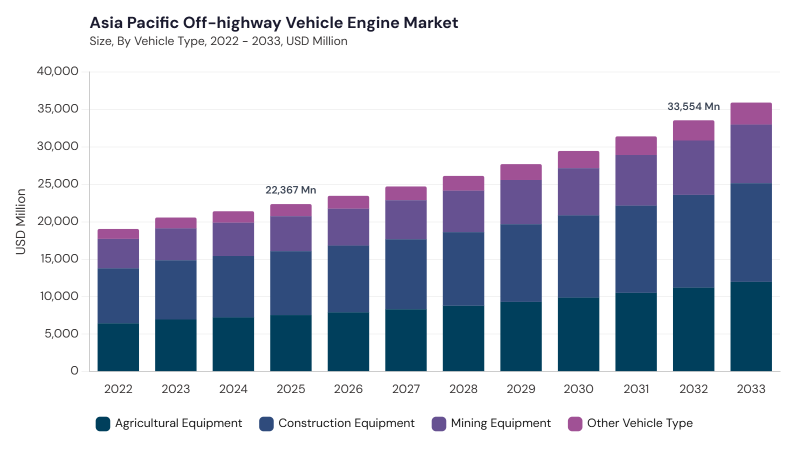
The Asia Pacific Off-highway Vehicle Engine Market evolved alongside industrialization, agricultural mechanization, construction expansion, and resource extraction activities, initially relying heavily on durable diesel engines suited to difficult terrains and prolonged workloads. Advances in electronic fuel injection, turbocharging, combustion technology, materials, and electronic engine management progressively improved performance, fuel efficiency, reliability, and emissions control. Tightening environmental regulations across major regional economies accelerated adoption of advanced after-treatment systems and cleaner engine architectures. The market is now transitioning toward hybrid and electric propulsion while continuing to optimize conventional engines for demanding off-highway applications.
Electrification, stringent emission requirements, telematics, fuel efficiency, and intelligent engine management are shaping current market development. Manufacturers are integrating hybrid propulsion, battery technologies, advanced ECUs, selective catalytic reduction, particulate filters, and digitally connected diagnostics to reduce emissions and operating costs. Telematics and IoT-enabled systems support predictive maintenance, performance monitoring, and improved equipment utilization, while engine downsizing and lightweight components enhance efficiency without sacrificing required output. Regional manufacturing, localized service networks, digital technologies, and partnerships with battery and technology providers are also supporting more responsive product development across Asia Pacific.
Based on Fuel Type, the market is segmented into Diesel and Gasoline. The Diesel market dominated the Asia Pacific Off-highway Vehicle Engine Market by Fuel Type in 2025, and would continue to be a dominant market till 2033; thereby, achieving a market value of USD 25.5 billion by 2030, growing at a CAGR of 6.1 % during the forecast period. The Gasoline market is expected to witness a CAGR of 7.2% during (2026 - 2033).
Diesel engines remain central to tractors, excavators, mining machinery, and other high-load equipment due to their durability, fuel efficiency, operational endurance, and established refueling infrastructure. Advanced fuel injection, turbocharging, selective catalytic reduction, particulate filtration, and electronic controls are improving emissions performance and efficiency. Gasoline engines serve smaller tractors, utility vehicles, landscaping equipment, and lighter machinery where lower initial cost, simpler operation, lighter weight, easier starting, and intermittent duty cycles are important. Continued improvements in combustion and emissions control support their relevance in selected compact applications.
Based on Power Output, the market is segmented into 101–300 HP, Below 100 HP, and Above 300 HP. The 101–300 HP market dominated the Asia Pacific Off-highway Vehicle Engine Market by Power Output in 2025, and would continue to be a dominant market till 2033; thereby, achieving a market value of USD 13.0 billion by 2030, growing at a CAGR of 5.7 % during the forecast period. The Below 100 HP market is expected to witness a CAGR of 6.6% during (2026 - 2033). The Above 300 HP market is expected to witness a CAGR of 6.9% during (2026 - 2033).
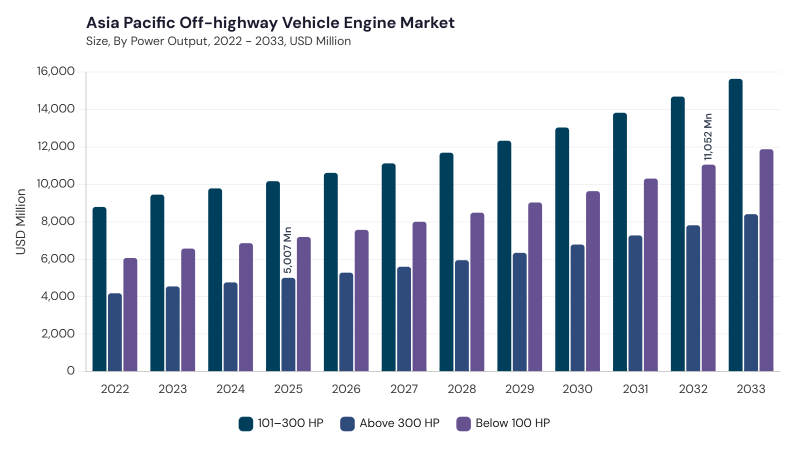
Below 100 HP engines support compact tractors, small loaders, utility vehicles, landscaping machinery, plantation equipment, and other applications where affordability, maneuverability, and fuel economy are important. The 101–300 HP category serves mid-sized agricultural, construction, and industrial equipment through a balance of power, efficiency, emissions compliance, and digital engine management. Above 300 HP engines are used in major mining operations, bulk earthmoving, large infrastructure projects, and high-capacity machinery requiring sustained power and torque, with advanced turbocharging, after-treatment, hybrid assistance, predictive diagnostics, and remote monitoring increasingly supporting performance.
Based on Vehicle Type, the market is segmented into Construction Equipment, Agricultural Equipment, Mining Equipment, and Other Vehicle Type. Construction Equipment includes excavators, loaders, bulldozers, and related machinery requiring high torque, durability, emissions compliance, and increasingly hybrid or connected powertrains. Agricultural Equipment supports tractors, harvesters, irrigation systems, and other mechanized farming applications where fuel efficiency, reliability, telematics, and ease of maintenance are important.
Mining Equipment requires high-output engines capable of enduring dust, heat, altitude, and intensive workloads, while electrification and automation are gradually advancing. Other Vehicle Type includes forestry machinery, port equipment, warehouse vehicles, plantation machinery, airport ground support, landscaping equipment, and specialized utility platforms requiring diverse engine configurations.
Based on Cooling Type, the market is segmented into Water-Cooled Engines and Air-Cooled Engines. Water-Cooled Engines use circulating liquid coolant to maintain stable operating temperatures across construction, agriculture, and mining equipment exposed to prolonged loads and harsh climates. Their thermal-management capability supports engine durability, emissions control, and higher output, with electronic controls further improving cooling precision.
Air-Cooled Engines offer simpler construction, lower maintenance requirements, reduced weight, and easier field servicing, making them suitable for compact agricultural machinery, utility vehicles, and lighter construction equipment. However, their lower heat-dissipation capability generally limits their use in sustained high-output applications.
Free Valuable Insights: Off-highway Vehicle Engine Market is Predicted to reach USD 82.4 Billion billion by 2033, at a CAGR of 5.9%
Based on Country, the market is segmented into China, Japan, India, South Korea, Singapore, Malaysia, and Rest of Asia Pacific. The China market dominated the Asia Pacific Off-highway Vehicle Engine Market by Country in 2025, and would continue to be a dominant market till 2033; thereby, achieving a market value of USD 10.8 billion by 2030, growing at a CAGR of 4.9 % during the forecast period. The Japan market is expected to witness a CAGR of 5.3% during (2026 - 2033). Additionally, The India market is expected to witness a CAGR of 6.8% during (2026 - 2033).
Across Asia Pacific, off-highway engine development is being influenced by emission regulation, electrification, telematics, fuel efficiency, and localization. China is advancing cleaner diesel systems, hybrid and electric powertrains, intelligent engine management, and localized technology development, while Japan emphasizes advanced emissions controls, partial hybridization, digital diagnostics, and high-reliability engineering. India is progressing through electronic engine controls, cleaner combustion, hybrid development, telematics, and localized service expansion, whereas South Korea focuses on emission reduction, smart diagnostics, lightweight components, and technology partnerships. Singapore is strengthening hybrid systems, digital monitoring, advanced after-treatment, and predictive maintenance, while Malaysia emphasizes fuel efficiency, telematics, hybrid technologies, and localized service capabilities. Rest of Asia Pacific continues to develop hybrid powertrains, electrification-ready engines, digital management systems, regional manufacturing, and cleaner propulsion solutions.

By Fuel Type
By Power Output
By Vehicle Type
By Cooling Type
By Country
Set to reach $29.4 Billion by 2030, growing at 6.3% CAGR during 2026-2033.
China leads with a market value of $10.8 billion by 2030, growing at a 4.9% CAGR during 2026-2033.
Diesel engines dominate, reaching $25.5 billion by 2030, with a 6.1% CAGR during 2026-2033.
The 101–300 HP segment will reach $13.0 billion by 2030, growing at a 5.7% CAGR during 2026-2033.
The India market is expected to witness a CAGR of 6.8% during 2026-2033.
The gasoline segment is expected to witness a CAGR of 7.2% during 2026-2033.
Our team of dedicated experts can provide you with attractive expansion opportunities for your business.




 Unique Offerings