The sample copy of this report is available for access.
The North America Waste Management Equipment Market is expected to reach USD 8,579.7 million would witness market growth of 5.0% CAGR during the forecast period (2026-2033).
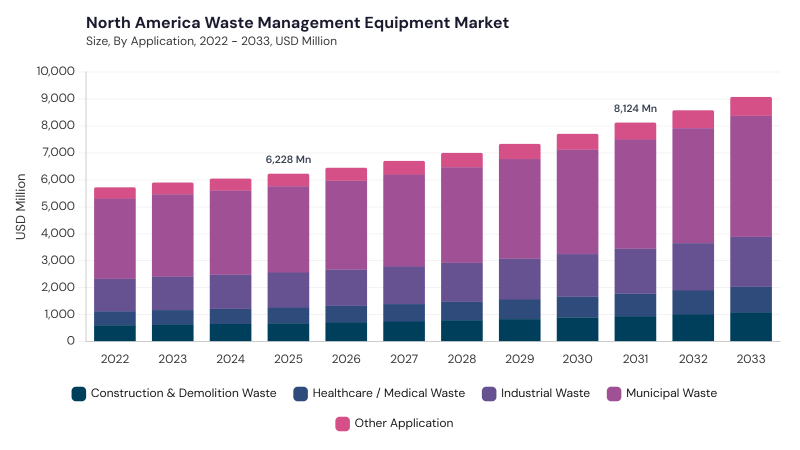
The US market dominated the North America Waste Management Equipment Market by Country in 2025 and would continue to be a dominant market till 2033. The Canada market is expected to witness a CAGR of 4.2% during (2026-2033). Additionally, the Mexico market is expected to witness a CAGR of 6.1% during (2026-2033). The US and Canada led the North America Waste Management Equipment Market by Country with a market share of 77.9% and 12.9% respectively in 2025. The Mexico market is expected to witness highest growth throughout the forecast period.
The North America waste management equipment market is expanding steadily owing to rising municipal solid waste generation, growing environmental concerns, and increasing investments in recycling and waste treatment infrastructure. Municipalities and private waste management operators are increasingly adopting advanced waste collection and processing systems to improve operational efficiency and sustainability. Rapid urbanization and industrial growth across the region continue to generate large volumes of municipal, industrial, and construction waste, thereby creating strong demand for technologically advanced waste handling equipment. Furthermore, the growing integration of automation, AI-enabled sorting systems, and smart waste monitoring technologies is expected to support long-term market expansion across North America.
Based on Automation Level, the market is segmented into Semi-Automated, Manual, and Fully Automated. The Semi-Automated segment dominated the market with the highest revenue share in 2025 owing to its widespread deployment across municipal waste collection operations and is expected to reach USD 3,645.1 million by 2032. Meanwhile, the Fully Automated segment is anticipated to witness a CAGR of 5.3% during (2026-2033) due to increasing adoption of robotic sorting systems and AI-enabled waste processing technologies. The Manual segment continued to maintain a considerable market share across smaller municipalities and cost-sensitive waste management operations throughout the region.
Based on Equipment Type, the market is segmented into Waste Collection Equipment, Waste Processing Equipment, Recycling Equipment, Transfer Equipment, and Other Equipment Type. Waste Collection Equipment accounted for the largest market share in 2025 supported by rising investments in automated garbage trucks and municipal collection infrastructure and is projected to attain a market value of USD 2,185.6 million by 2032. In contrast, the Recycling Equipment segment is expected to register a CAGR of 5.8% during the forecast period (2026-2033) owing to increasing emphasis on circular economy initiatives and recycling infrastructure modernization. Additionally, Waste Processing Equipment continued to contribute a notable share to the market driven by growing industrial and municipal waste treatment requirements.
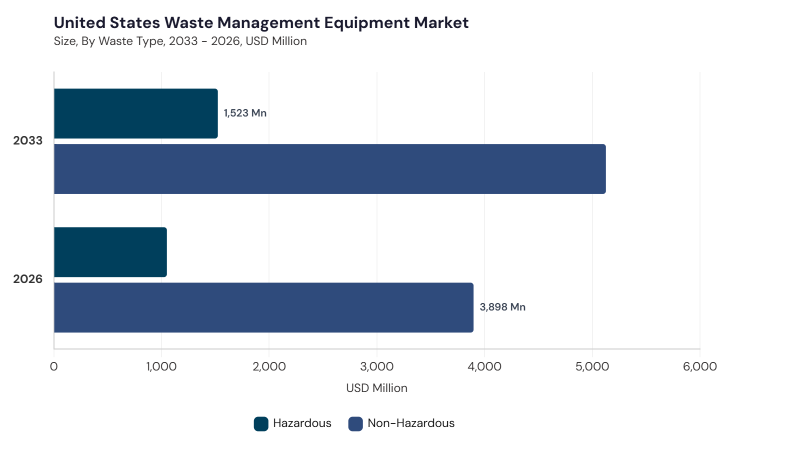
Based on Waste Type, the market is segmented into Municipal Waste, Industrial Waste, Construction & Demolition Waste, Hazardous Waste, and Electronic Waste. The Municipal Waste segment captured the highest revenue share in 2025 due to increasing residential waste generation across urban areas and is expected to reach USD 2,964.8 million by 2032. Meanwhile, the Electronic Waste segment is projected to witness the fastest CAGR of 6.2% during (2026-2033) owing to growing electronic device consumption and stricter regulations related to e-waste recycling. Industrial Waste also maintained a substantial market share supported by expanding manufacturing and industrial activities throughout North America.
Based on End-use, the market is segmented into Municipal Corporations, Industrial Facilities, Commercial Facilities, Recycling Plants, and Other End-use. The Municipal Corporations segment led the market in 2025 with a significant share of overall revenue owing to increasing government expenditure on waste collection and processing infrastructure and is forecast to achieve USD 2,456.3 million by 2032. On the other hand, the Recycling Plants segment is expected to expand at a CAGR of 5.9% during (2026-2033) supported by rising investments in material recovery facilities and sustainable waste processing technologies. Commercial Facilities continued to account for a notable market share due to increasing adoption of organized waste handling systems by retail, hospitality, and commercial establishments.
Free Valuable Insights: The Global Waste Management Equipment Market will hit USD 29,792.0 Million billion by 2033, at a CAGR of 5.6%
The United States dominated the North America Waste Management Equipment Market in 2025 with a market share of 77.9% owing to strong investments in municipal waste infrastructure and widespread adoption of automated waste collection technologies. The country is also expected to maintain its dominance by reaching USD 5,184.7 million by 2032. Meanwhile, Mexico is anticipated to witness the highest CAGR of 6.1% during (2026-2033) driven by rapid urbanization, increasing industrial waste generation, and rising investments in modern waste management infrastructure. Canada continued to maintain a stable market presence supported by government sustainability initiatives and advanced recycling programs across major provinces.

By Automation Level
By Equipment Type
By Waste Type
By End-use
By Country
Set to reach $3,645.1 Million by 2032, growing at 5.0% CAGR during 2026-2033.
The US leads with a market share of 77.9% in 2025.
Increasing adoption of robotic sorting systems and AI-enabled waste processing technologies boosts growth.
Expected to reach $3,645.1 million by 2032, driven by widespread municipal waste collection deployment.
Mexico is anticipated to witness a CAGR of 6.1% during 2026-2033.
Projected to witness the fastest CAGR of 6.2% during 2026-2033 due to growing electronic device consumption.
Our team of dedicated experts can provide you with attractive expansion opportunities for your business.




 Unique Offerings