The sample copy of this report is available for access.
The Asia Pacific Waste Management Equipment Market would witness market growth of 6.1% CAGR during the forecast period (2026-2033) and is projected to reach USD 7,804.1 million by 2030.
The China market dominated the Asia Pacific Waste Management Equipment Market by Country in 2025 and would continue to be a dominant market till 2030; thereby, achieving a market value of USD 2,652.3 million by 2030. The Japan market is expected to witness a CAGR of 5.1% during (2026-2033). Additionally, the India market is expected to witness a CAGR of 7.0% during (2026-2033).
The market is increasingly influenced by the adoption of smart waste management technologies driven by artificial intelligence, IoT-enabled monitoring systems, and automated sorting solutions. Municipalities and private operators are investing in intelligent waste collection infrastructure to optimize transportation routes, reduce fuel consumption, and improve waste segregation efficiency. Growing emphasis on circular economy initiatives and recycling mandates is also encouraging demand for advanced waste recycling and sorting equipment capable of improving material recovery rates. In addition, rising investments in modular and scalable waste treatment infrastructure across emerging economies are expanding the deployment of specialized equipment designed for diverse urban and rural waste management applications.
Rapid urbanization and industrial growth across China, India, Southeast Asia, and other developing economies continue to create significant demand for modern waste management infrastructure. Governments across the region are implementing stricter environmental regulations focused on landfill reduction, hazardous waste treatment, recycling targets, and emission control standards. These regulatory frameworks are accelerating the adoption of energy-efficient incineration systems, waste-to-energy technologies, advanced recycling equipment, and automated waste processing systems. Furthermore, increasing awareness regarding environmental sustainability and public health concerns is encouraging investments in technologically advanced waste handling equipment capable of improving operational efficiency and reducing ecological impact.
Based on Automation Level, the market is segmented into Semi-Automated, Manual, and Fully Automated. The Semi-Automated segment dominated the Asia Pacific Waste Management Equipment Market by Automation Level in 2025 and would continue to be a dominant segment till 2030; thereby, achieving a market value of USD 3,367.0 million by 2030, growing at a CAGR of 5.7% during the forecast period. The Manual segment is expected to witness a CAGR of 6.5% during (2026-2033). Additionally, the Fully Automated segment is expected to witness a CAGR of 6.4% during (2026-2033).
Based on Application, the market is segmented into Municipal Waste, Industrial Waste, Construction & Demolition Waste, Healthcare / Medical Waste, and Other Application. The Municipal Waste segment dominated the Asia Pacific Waste Management Equipment Market by Application in 2025 and would continue to be a dominant segment till 2030; thereby, achieving a market value of USD 4,177.6 million by 2030, growing at a CAGR of 6.1% during the forecast period. The Industrial Waste segment is expected to witness a CAGR of 6.5% during (2026-2033). The Other Application segment is expected to witness a CAGR of 7.6% during (2026-2033).
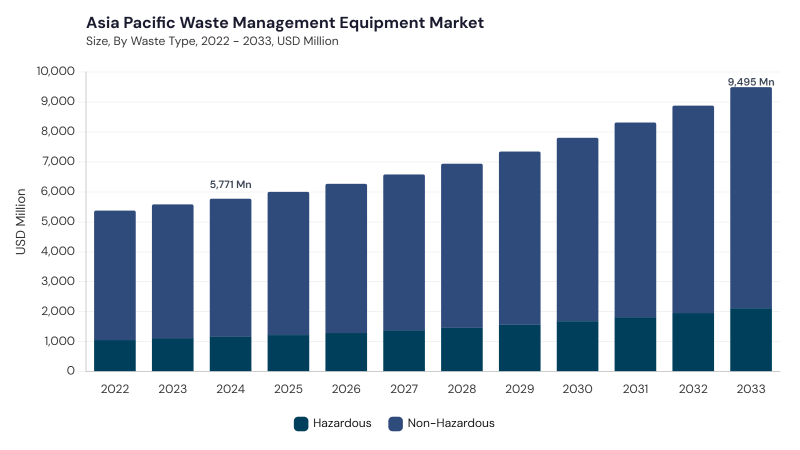
Based on Waste Type, the market is segmented into Non-Hazardous and Hazardous. The Non-Hazardous segment dominated the Asia Pacific Waste Management Equipment Market by Waste Type in 2025 and would continue to be a dominant segment till 2030; thereby, achieving a market value of USD 6,148.6 million by 2030, growing at a CAGR of 6.1% during the forecast period. The Hazardous segment is expected to witness a CAGR of 8.0% during (2026-2033).
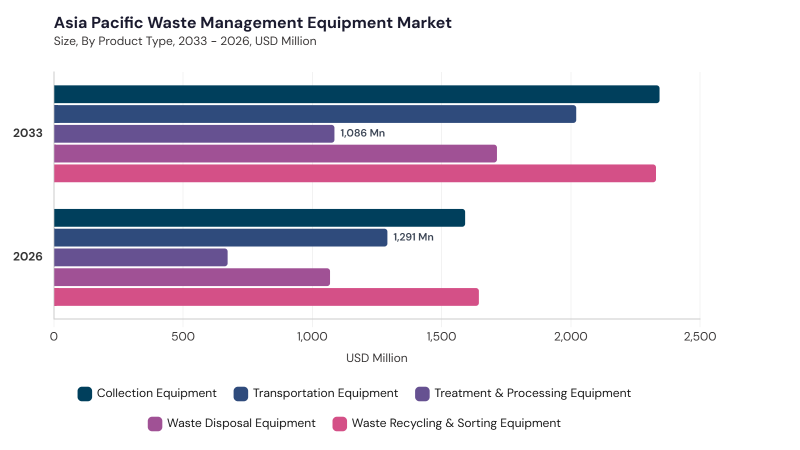
Based on Product Type, the market is segmented into Waste Recycling & Sorting Equipment, Collection Equipment, Transportation Equipment, Waste Disposal Equipment, and Treatment & Processing Equipment. The Waste Recycling & Sorting Equipment segment dominated the Asia Pacific Waste Management Equipment Market by Product Type in 2025 and would continue to be a dominant segment till 2030; thereby, achieving a market value of USD 1,960.9 million by 2030, growing at a CAGR of 5.5% during the forecast period.
The Collection Equipment segment is expected to witness a CAGR of 6.2% during (2026-2033). Additionally, the Transportation Equipment segment is expected to witness the highest CAGR of 7.2% during (2026-2033).
Free Valuable Insights: Waste Management Equipment Market is Predicted to reach USD 29,792.0 Million billion by 2033, at a CAGR of 5.6%
China represents the largest market across the Asia Pacific Waste Management Equipment Market due to rapid urbanization, increasing industrial waste generation, and strong government investments in sustainable waste infrastructure. The country continues to emphasize circular economy development, advanced recycling technologies, and waste-to-energy systems supported by stringent environmental regulations and smart city initiatives.
Japan remains a technologically advanced market focused on high-efficiency recycling equipment, automated sorting systems, and waste-to-energy infrastructure driven by limited landfill availability and strict environmental standards. India is witnessing rapid market expansion supported by rising municipal waste volumes, industrialization, and increasing investments in mechanized waste collection, recycling, and smart waste processing technologies under government-led urban development initiatives. South Korea continues to strengthen its market presence through AI-driven sorting systems, automated recycling technologies, and digitally integrated waste processing infrastructure aligned with sustainability and circular economy goals.

By Automation Level
By Application
By Waste Type
By Product Type
By Country
Set to reach $7,804.1 Million by 2030, growing at 6.1% CAGR during 2026-2033.
China leads with $2,652.3 million by 2030.
Semi-automated segment hits $3,367.0 million by 2030, growing at 5.7% CAGR during 2026-2033.
Hazardous segment is expected to witness a CAGR of 8.0% during 2026-2033.
Municipal waste segment reaches $4,177.6 million by 2030, with a 6.1% CAGR during 2026-2033.
India market is expected to witness a CAGR of 7.0% during 2026-2033.
Our team of dedicated experts can provide you with attractive expansion opportunities for your business.




 Unique Offerings