The sample copy of this report is available for access.
The North America Form-Fill-Seal Machines Market is expected to reach USD 2.5 billion by 2032, growing at a CAGR of 6.2% during (2026 - 2033).
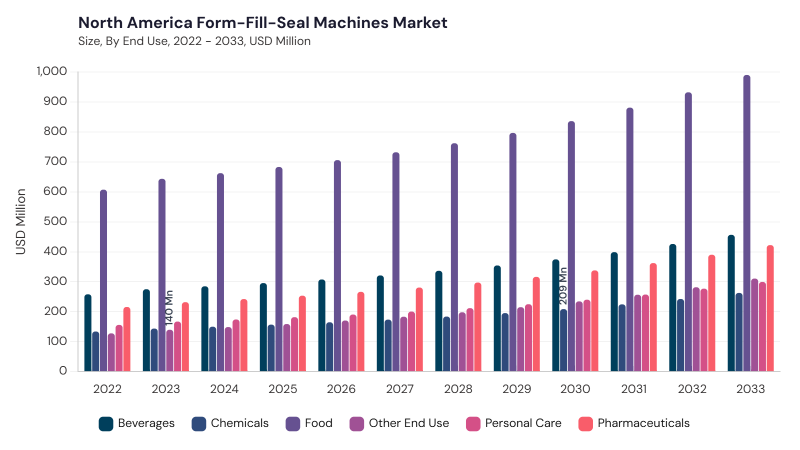
North America Form-Fill-Seal Machines Market is shaped by a mature but technologically progressive packaging-machinery environment supported by food, beverages, pharmaceuticals, personal care, chemicals, household products, pet food, and contract packaging. FFS technology is deeply integrated into regional production because it combines package forming, product filling, and sealing in one automated process. Vertical FFS is widely used for snacks, cereals, coffee, frozen foods, powders, grains, pet food, and confectionery, while Horizontal FFS supports bakery, bars, fresh foods, medical products, personal care, and products requiring controlled horizontal handling.
Automation, flexible machinery, SKU diversity, digitalization, and installed-base modernization are shaping current market development. Manufacturers increasingly need servo-controlled adjustments, recipe management, automated feeding, rapid format changes, machine data, remote support, predictive maintenance, and line-level production visibility. Replacement decisions are moving beyond mechanical condition toward controls, software, lifecycle productivity, OEE, downtime, filling accuracy, material waste, and total cost of ownership. However, high capital cost, sustainable-material conversion complexity, skilled maintenance needs, and controls requirements continue to influence adoption across North America.
Based on Technology, the market is segmented into Vertical FFS and Horizontal FFS. The Vertical FFS market dominated the North America Form-Fill-Seal Machines Market by Technology in 2025, and would continue to be a dominant market till 2033; thereby, achieving a market value of USD 1.3 billion by 2032, growing at a CAGR of 5.8 % during the forecast period. The Horizontal FFS market is expected to witness a CAGR of 6.6% during (2026 - 2033).
Vertical FFS supports snacks, cereals, coffee, confectionery, frozen foods, powders, ingredients, pet food, nutritional products, and other products that can be dosed vertically. It benefits from compact footprint, high throughput, efficient rollstock use, flexible dosing, multihead weighers, auger fillers, and volumetric systems. Horizontal FFS retained a promising presence for bakery, confectionery, bars, fresh foods, meat, cheese, medical products, personal care, and items needing product orientation. Its growth is supported by automatic feeding, robotics, hermetic sealing, servo synchronization, sustainable materials, and rapid format changes.
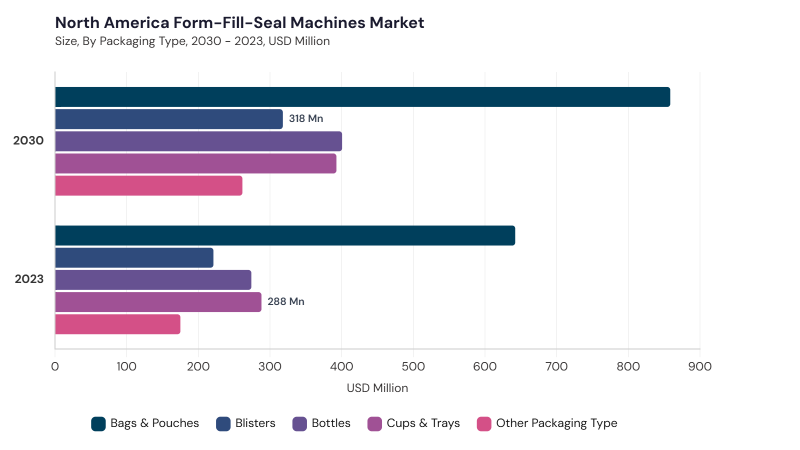
Based on Packaging Type, the market is segmented into Bags & Pouches, Cups & Trays, Bottles, Blisters, and Other Packaging Type. Bags & Pouches are widely used across snacks, frozen foods, pet food, confectionery, powders, ingredients, pharmaceuticals, personal care, and household products. FFS technology enables rollstock-based production of pillow bags, gusseted formats, sachets, stick packs, and pouch configurations.
Cups & Trays gained a substantial share across dairy, prepared meals, fresh foods, portion-controlled products, and thermoform-fill-seal applications. Bottles held relevance in beverages, personal care, household products, chemicals, and liquid filling, while Blisters served pharmaceutical and healthcare packaging. Other Packaging Type supported specialty sachets, medical packages, shaped formats, and application-specific configurations.
Based on End Use, the market is segmented into Food, Beverages, Pharmaceuticals, Personal Care, Chemicals, and Other End Use. Food applications use VFFS for snacks, powders, grains, frozen products, pet food, and ingredients, while HFFS supports bakery, bars, confectionery, and individually wrapped products. Beverages achieved a substantial share through liquid pouches, portion packs, cups, flexible containers, and bottle-related filling and sealing.
Pharmaceuticals demonstrated a significant presence due to unit-dose packaging, blisters, sachets, inspection, traceability, and product protection. Personal Care benefited from sachets, pouches, wipes, samples, and flexible formats, while Chemicals used FFS for liquids, powders, detergents, household cleaners, and specialty formulations. Other End Use covered pet care, medical devices, nonwovens, household goods, agriculture, industrial materials, and contract packaging.
Free Valuable Insights: The Global Form-Fill-Seal Machines Market will hit USD 9674.5 Million billion by 2033, at a CAGR of 6.5%
Based on Country, the market is segmented into US, Canada, Mexico, and Rest of North America. The US market dominated the North America Form-Fill-Seal Machines Market by Country in 2025, and would continue to be a dominant market till 2033; thereby, achieving a market value of USD 1.7 billion by 2032, growing at a CAGR of 5.4 % during the forecast period. The Canada market is expected to witness a CAGR of 8% during (2026 - 2033). Additionally, The Mexico market is expected to witness a CAGR of 7.3% during (2026 - 2033).
Across North America, Form-Fill-Seal Machines adoption varies with food processing scale, automation maturity, flexible packaging use, contract packaging, workforce pressure, and machinery service infrastructure. The US emphasizes mature FFS adoption, snacks, frozen foods, pet food, pharmaceuticals, flexible production, robotics, digitalization, sustainable materials, and modernization of older equipment. Canada focuses on food processing, beverages, pharmaceuticals, pet food, flexible automation, material compatibility, and cross-border machinery support. Mexico is advancing through domestic consumption, export manufacturing, food and beverage production, personal care, flexible packaging, scalable automation, and Spanish-language technical support. Rest of North America remains smaller but benefits from packaged-food growth, compact VFFS systems, gradual automation, durable equipment, distributor support, and remote troubleshooting.

By Technology
By Packaging Type
By End Use
By Country
Set to reach $2.5 Billion by 2032, growing at 6.2% CAGR during 2026-2033.
The US leads with $1.7 billion by 2032, growing at a 5.4% CAGR during 2026-2033.
Vertical FFS technology dominates, achieving $1.3 billion by 2032, with a 5.8% CAGR during 2026-2033.
Vertical FFS hits $1.3 billion by 2032, growing at a 5.8% CAGR during 2026-2033.
The Canada market is expected to witness a CAGR of 8% during 2026-2033.
The Horizontal FFS market is expected to witness a 6.6% CAGR during 2026-2033.
Our team of dedicated experts can provide you with attractive expansion opportunities for your business.




 Unique Offerings
