The sample copy of this report is available for access.
The Asia Pacific Form-Fill-Seal Machines Market is expected to reach USD 2989.4 million by 2030, growing at a CAGR of 6.9% during (2026 - 2033).
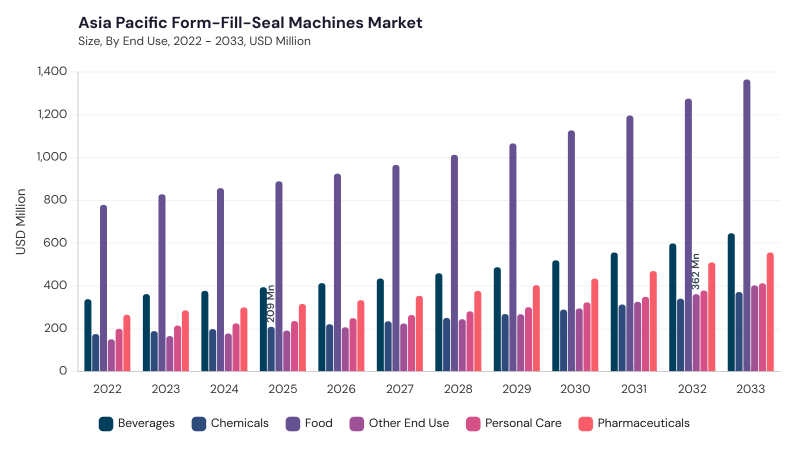
Asia Pacific Form-Fill-Seal Machines Market is shaped by large-scale food and beverage manufacturing, pharmaceuticals, personal care, household products, chemicals, agriculture-related processing, and packaged consumer goods. The region combines highly automated environments in Japan, South Korea, Australia, Singapore, and parts of China with manufacturers in India and Southeast Asia moving from manual or semi-automatic packaging toward automated systems. Demand ranges from straightforward VFFS equipment for grains, powders, snacks, and commodity products to advanced HFFS, thermoform-fill-seal, pharmaceutical, robotic, and integrated packaging lines.
Urbanization, organized retail, food processing, pharmaceutical manufacturing, export production, automation, and flexible packaging are shaping current market development. VFFS machinery is widely applicable across rice, grains, noodles, spices, snacks, tea, coffee, frozen products, powders, and ingredients, while HFFS supports bakery, biscuits, confectionery, bars, medical goods, personal care, and individually packed products. Sustainability and resource efficiency are also gaining importance as Japan and China promote recycling, reduced packaging, and greener packaging practices. However, capital sensitivity, technical-support gaps, skilled maintenance availability, and material-transition complexity continue to influence adoption across Asia Pacific.
Based on Technology, the market is segmented into Vertical FFS and Horizontal FFS. The Vertical FFS market dominated the Asia Pacific Form-Fill-Seal Machines Market by Technology in 2025, and would continue to be a dominant market till 2033; thereby, achieving a market value of USD 1639.6 million by 2030, growing at a CAGR of 6.6 % during the forecast period. The Horizontal FFS market is expected to witness a CAGR of 7.4% during (2026 - 2033).
Vertical FFS supports rice, grains, snacks, noodles, coffee, tea, spices, confectionery, frozen foods, powders, ingredients, pet food, agricultural products, and other free-flowing or particulate products. It benefits from compact automation, roll-fed material use, multihead weighers, augers, volumetric dosing, servo controls, and scalable machinery tiers. Horizontal FFS maintained a promising presence across bakery, biscuits, confectionery, chocolate, bars, fresh foods, medical products, personal care, and individually packaged goods. Its adoption is supported by robotic feeding, vision-guided handling, servo synchronization, rapid changeovers, sustainable-film compatibility, and complete-line integration.
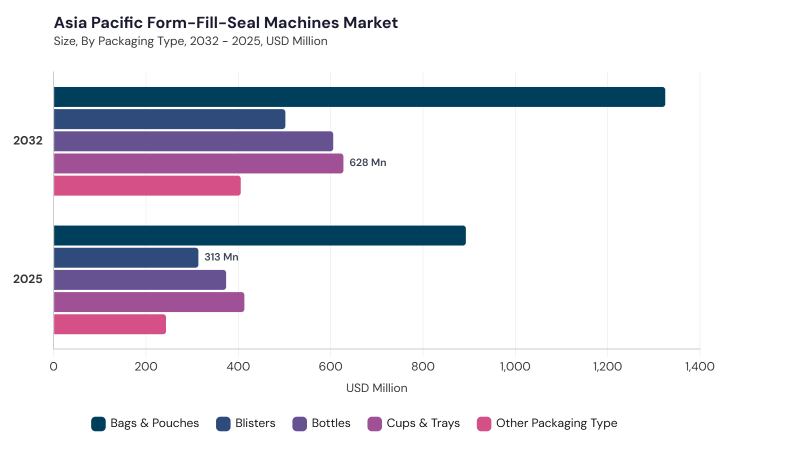
Based on Packaging Type, the market is segmented into Bags & Pouches, Cups & Trays, Bottles, Blisters, and Other Packaging Type. Bags & Pouches are widely used across snacks, rice, grains, noodles, coffee, tea, spices, confectionery, frozen foods, powders, ingredients, pet food, household products, and personal care. Cups & Trays captured a substantial share through dairy, yogurt, desserts, prepared foods, sauces, condiments, meat, seafood, and convenience meals.
Bottles retained a considerable presence in beverages, dairy, pharmaceuticals, personal care, household products, and chemicals. Blisters achieved a noteworthy standing through pharmaceutical, healthcare, nutraceutical, and medical-product packaging. Other Packaging Type demonstrated a promising presence across sachets, stick packs, portion packs, medical packages, and specialized flexible containers.
Based on End Use, the market is segmented into Food, Beverages, Pharmaceuticals, Personal Care, Chemicals, and Other End Use. Food applications cover rice, noodles, snacks, bakery products, confectionery, dairy, frozen foods, seafood, meat, spices, tea, coffee, cereals, prepared meals, sauces, ingredients, fresh produce, and pet food. Beverages secured a substantial share through dairy beverages, juices, concentrates, nutritional products, liquid portion packs, beverage powders, and coffee products.
Pharmaceuticals attained a significant presence through blisters, sachets, liquid unit doses, nutraceuticals, medical products, inspection, and traceability. Personal Care expanded through shampoos, creams, lotions, gels, cosmetics, wipes, refills, travel packs, and samples, while Chemicals used FFS systems for detergents, cleaners, powders, specialty chemicals, agricultural formulations, and granular products. Other End Use covers agricultural products, medical devices, nutraceuticals, nonwovens, hardware, industrial components, and specialized consumer goods.
Free Valuable Insights: Form-Fill-Seal Machines Market is Predicted to reach USD 9674.5 Million billion by 2033, at a CAGR of 6.5%
Based on Country, the market is segmented into China, Japan, India, South Korea, Singapore, Malaysia, and Rest of Asia Pacific. The China market dominated the Asia Pacific Form-Fill-Seal Machines Market by Country in 2025, and would continue to be a dominant market till 2033; thereby, achieving a market value of USD 937.0 million by 2030, growing at a CAGR of 5.3 % during the forecast period. The Japan market is expected to witness a CAGR of 6.1% during (2026 - 2033). Additionally, The India market is expected to witness a CAGR of 7.7% during (2026 - 2033).
Across Asia Pacific, Form-Fill-Seal Machines adoption varies with manufacturing scale, automation maturity, packaged-food demand, machinery localization, service access, and export orientation. China emphasizes large-scale food, beverages, pharmaceuticals, personal care, automation, domestic machinery capability, green packaging, and retrofit demand, while Japan focuses on precision machinery, labor-saving automation, AI, digital manufacturing, resource circulation, and high package quality. India is advancing through food processing, pharmaceuticals, personal care, sachets, scalable automation, domestic machinery, and modular upgrades. South Korea prioritizes smart automation, cosmetics, food, pharmaceuticals, robotics, machine vision, and digital production control. Singapore focuses on advanced manufacturing, pharmaceuticals, biomedical production, compact automation, imports, and regional service support. Malaysia emphasizes food processing, halal manufacturing, Industry 4.0, export packaging, automation, and local integration. Rest of Asia Pacific remains diverse, with growth led by Southeast Asian manufacturing, packaged foods, SMEs, flexible packaging, distributor support, and phased automation.

By Technology
By Packaging Type
By End Use
By Country
Set to reach $2989.4 Million by 2030, growing at 6.9% CAGR during 2026-2033.
China leads with $937.0 million by 2030, growing at 5.3% CAGR during the forecast period.
Rising demand for Vertical FFS technology, reaching $1639.6 million by 2030 at 6.6% CAGR.
Vertical FFS hits $1639.6 million by 2030, growing at 6.6% CAGR during 2026-2033.
India market is expected to witness a CAGR of 7.7% during 2026-2033.
Horizontal FFS is expected to witness a CAGR of 7.4% during 2026-2033.
Our team of dedicated experts can provide you with attractive expansion opportunities for your business.




 Unique Offerings
