The sample copy of this report is available for access.
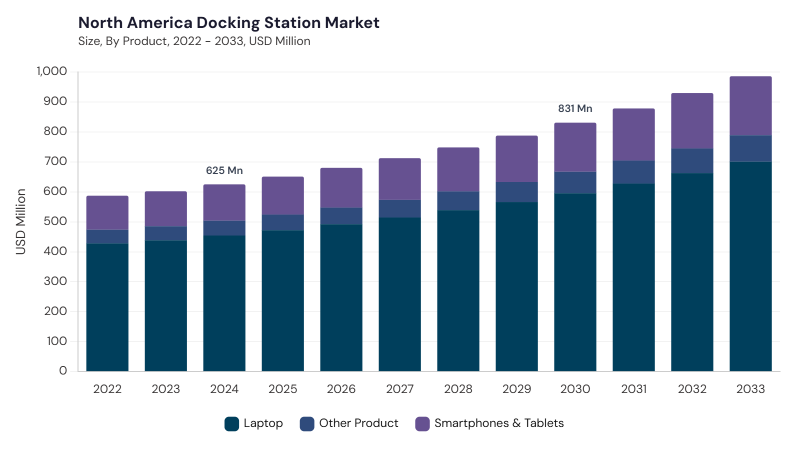
The North America Docking Station Market is expected to reach USD 929.8 million by 2032, growing at a CAGR of 5.4% during (2026 – 2033).
The North America Docking Station Market originated with the rising use of laptops, portable computers, and mobile electronics that required easier connection to external devices. Early docking stations mainly worked as basic port replicators, allowing users to connect monitors, keyboards, Ethernet, USB devices, and other peripherals through a single hub. Over time, USB-C, Thunderbolt, wireless connectivity, fast charging, and high-resolution display support transformed docking stations into advanced productivity tools. The shift from proprietary docks to universal and multi-device solutions expanded adoption across enterprises, home offices, education, and professional users.
The current North America Docking Station Market is shaped by remote work, hybrid office models, USB-C standardization, Thunderbolt adoption, multi-display setups, and demand for secure enterprise connectivity. Users increasingly prefer docking stations that combine charging, data transfer, video output, Ethernet access, and peripheral integration through compact plug-and-play designs. Enterprises are using docking stations to standardize workstations, reduce cable clutter, improve employee productivity, and support device refresh cycles. Product development is also moving toward energy efficiency, recyclable materials, smart power management, firmware updates, and cybersecurity features.
Based on Connectivity, the market is segmented into Wired and Wireless. The Wired market dominated the North America Docking Station Market by Connectivity in 2025, and would continue to be a dominant market till 2033; thereby, achieving a market value of USD 685.3 million by 2032, growing at a CAGR of 5.2 % during the forecast period. The Wireless market is expected to witness a CAGR of 6.2% during (2026 - 2033).
Wired docking stations lead due to their stable performance, faster data transfer, reliable power delivery, Ethernet access, and strong support for multi-monitor professional setups. USB-C and Thunderbolt docks are widely preferred across corporate offices, home workstations, creative workflows, IT departments, and high-performance productivity environments. Wireless docking is gradually expanding as users seek cable-free desk setups, flexible workspaces, and easier device transitions. However, wireless adoption remains comparatively smaller due to bandwidth limits, power delivery constraints, compatibility concerns, and higher dependence on advanced wireless infrastructure.
Based on Product, the market is segmented into Laptop, Smartphones & Tablets, and Other Product. The Laptop market dominated the North America Docking Station Market by Product in 2025, and would continue to be a dominant market till 2033; thereby, achieving a market value of USD 662.6 million by 2032, growing at a CAGR of 5.2 % during the forecast period. The Smartphones & Tablets market is expected to witness a CAGR of 5.8% during (2026 - 2033).
Laptop docking stations lead due to their extensive use in enterprise workstations, remote work setups, hybrid offices, education, finance, IT, design, and professional productivity environments. These docks allow users to convert laptops into desktop-like systems with multiple screens, keyboards, storage devices, audio tools, and network connections. Smartphone and tablet docking stations are gaining relevance as mobile devices support desktop-style workflows, external displays, wireless charging, and peripheral connectivity. Other products include specialized docks for hybrid devices, gaming systems, portable monitors, and niche professional applications requiring customized connectivity.
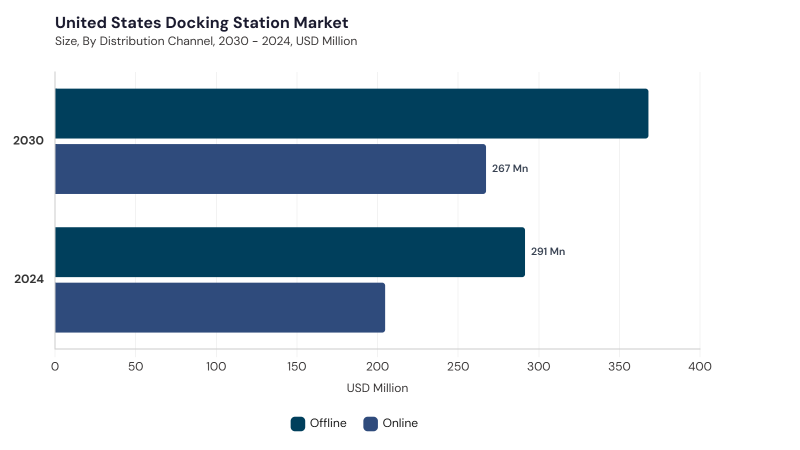
Based on Distribution Channel, the market is segmented into Offline and Online. Offline channels lead due to strong enterprise procurement, physical retail stores, IT hardware distributors, computer accessory outlets, and direct business purchasing models. This channel supports product demonstrations, compatibility checks, bulk buying, warranty assurance, and customized docking solutions for corporate and institutional buyers.
Online channels are growing rapidly due to e-commerce platforms, direct-to-consumer brand stores, digital marketplaces, competitive pricing, product reviews, and convenient access for remote workers and small businesses. Online sales are also supported by rising home-office adoption and consumer preference for comparing technical specifications before purchase.
Free Valuable Insights: The Global Docking Station Market will hit USD 2.7 Billion billion by 2033, at a CAGR of 6.1%
Based on Country, the market is segmented into US, Canada, Mexico, and Rest of North America. The US market dominated the North America Docking Station Market by Country in 2025, and would continue to be a dominant market till 2033; thereby, achieving a market value of USD 701.8 million by 2032, growing at a CAGR of 4.8 % during the forecast period. The Canada market is expected to witness a CAGR of 7.6% during (2026 - 2033). Additionally, The Mexico market is expected to witness a CAGR of 7.1% during (2026 - 2033).
The US leads due to strong enterprise IT spending, widespread hybrid work adoption, high laptop penetration, advanced device ecosystems, and strong demand for USB-C and Thunderbolt docking solutions. Canada contributes through remote work growth, public sector technology upgrades, sustainability-focused procurement, and rising use of universal docking stations across offices and home workspaces. Mexico supports growth through expanding industrial automation, enterprise IT modernization, smart manufacturing, and demand for cost-effective docking solutions. Rest of North America benefits from mobile workforce expansion, e-commerce access, and growing adoption of multi-device connectivity tools.

By Connectivity
By Product
By Distribution Channel
By Country
Set to reach $929.8 Million by 2032, growing at 5.4% CAGR during 2026-2033.
The US leads with $701.8 million by 2032, growing at a CAGR of 4.8% during the forecast period.
Rising demand for wireless connectivity, with a 6.2% CAGR during 2026-2033, is a key growth driver.
The laptop segment will reach $662.6 million by 2032, growing at a CAGR of 5.2% during the forecast period.
The Canada market is expected to witness a CAGR of 7.6% during 2026-2033.
The wireless segment is expected to witness a CAGR of 6.2% during 2026-2033.
Our team of dedicated experts can provide you with attractive expansion opportunities for your business.




 Unique Offerings