The sample copy of this report is available for access.
The Asia Pacific Docking Station Market is expected to reach USD 587.5 million by 2030, growing at a CAGR of 7% during (2026 – 2033).
The Asia Pacific Docking Station Market originated with the rising adoption of portable computing devices, laptops, tablets, and mobile electronics across professional and consumer environments. Early docking stations mainly served as basic port replicators, helping users connect monitors, keyboards, mice, and external peripherals through simple interfaces. Over time, USB-C, Thunderbolt, DisplayPort, fast charging, wireless communication, and multi-display support transformed docking stations into advanced productivity hubs. The rise of hybrid work and mobile-first workflows further expanded their relevance across offices, homes, education, and creative industries.
The current Asia Pacific Docking Station Market is shaped by remote work, BYOD adoption, USB-C standardization, Thunderbolt integration, wireless docking, smart features, and growing demand for multi-device compatibility. Users increasingly prefer compact docking stations that support fast charging, 4K and 8K video output, high-speed data transfer, Ethernet access, and multiple peripherals through a single hub. Enterprises are using docking stations to improve workstation flexibility, simplify IT deployment, and support diverse device ecosystems. Manufacturers are also integrating biometric security, IoT compatibility, AI-enabled diagnostics, and energy-efficient designs.
Based on Connectivity, the market is segmented into Wired and Wireless. The Wired market dominated the Asia Pacific Docking Station Market by Connectivity in 2025, and would continue to be a dominant market till 2033; thereby, achieving a market value of USD 437.8 million by 2030, growing at a CAGR of 6.7 % during the forecast period. The Wireless market is expected to witness a CAGR of 7.8% during (2026 - 2033).
Wired docking stations lead due to their reliable connectivity, faster data transfer, stable power delivery, secure network access, and strong support for professional multi-display setups. USB-C, Thunderbolt, USB, HDMI, DisplayPort, and Ethernet-enabled docks remain widely used in enterprises, education, creative studios, government offices, and IT environments. Wireless docking is gaining traction as users prefer cable-free workspaces, flexible desk arrangements, and easier device switching. However, wireless adoption remains comparatively smaller due to bandwidth limits, security concerns, power delivery restrictions, and higher infrastructure dependence.
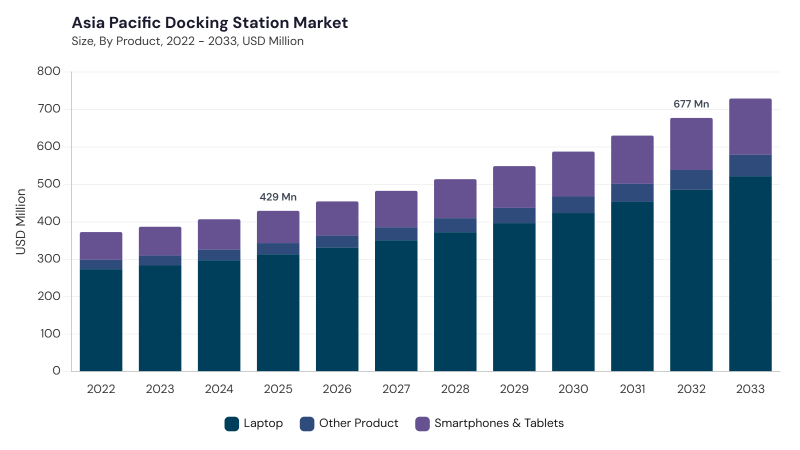
Based on Product, the market is segmented into Laptop, Smartphones & Tablets, and Other Product. The Laptop market dominated the Asia Pacific Docking Station Market by Product in 2025, and would continue to be a dominant market till 2033; thereby, achieving a market value of USD 423.4 million by 2030, growing at a CAGR of 6.7 % during the forecast period. The Smartphones & Tablets market is expected to witness a CAGR of 7.3% during (2026 - 2033).
Laptop docking stations lead due to their strong use in corporate offices, hybrid workspaces, IT services, finance, education, creative industries, and home office environments. These docks allow users to convert laptops into full workstation setups with multiple displays, keyboards, storage devices, Ethernet, charging, and audio peripherals. Smartphones and tablets docking stations are expanding as mobile devices become more useful for presentations, video calls, media workflows, retail operations, and mobile productivity. Other products include multi-device hubs, gaming docks, peripheral docks, USB hubs, video capture docks, and specialized docking platforms for niche applications.
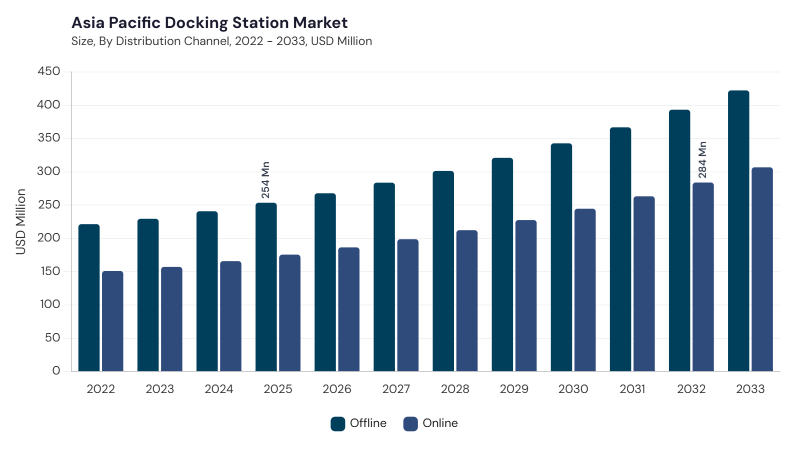
Based on Distribution Channel, the market is segmented into Offline and Online. Offline channels lead due to strong enterprise procurement, electronics specialty stores, IT distributors, system integrators, retail outlets, and business-to-business sales environments. This channel supports product demonstrations, compatibility guidance, immediate availability, customized support, and bulk purchasing for corporate, education, healthcare, and industrial buyers.
Online channels are growing rapidly due to e-commerce platforms, direct-to-consumer websites, regional marketplaces, product reviews, technical comparisons, and competitive pricing. Online sales are especially supported by remote work adoption, rising consumer awareness, and wider access across emerging Asia Pacific markets.
Free Valuable Insights: Docking Station Market is Predicted to reach USD 2.7 Billion billion by 2033, at a CAGR of 6.1%
Based on Country, the market is segmented into China, Japan, India, South Korea, Singapore, Malaysia, and Rest of Asia Pacific. The China market dominated the Asia Pacific Docking Station Market by Country in 2025, and would continue to be a dominant market till 2033; thereby, achieving a market value of USD 181.6 million by 2030, growing at a CAGR of 5.3 % during the forecast period. The Japan market is expected to witness a CAGR of 6.2% during (2026 - 2033). Additionally, The India market is expected to witness a CAGR of 7.7% during (2026 - 2033).
China leads due to strong electronics manufacturing, large laptop and mobile device usage, USB-C and Thunderbolt adoption, local production capabilities, and growing demand from corporate and consumer technology users. Japan contributes through advanced computing ecosystems, high-quality device adoption, sustainability-focused design, and enterprise demand for reliable multi-functional docks. India supports growth through hybrid work adoption, SME digitization, startup ecosystem expansion, e-commerce growth, and demand for affordable docking solutions. South Korea, Singapore, and Malaysia add demand through advanced electronics ecosystems, smart workspaces, mobile productivity, and wireless docking adoption, while Rest of Asia Pacific benefits from digital transformation and rising portable device usage.

By Connectivity
By Product
By Distribution Channel
By Country
Set to reach $587.5 Million by 2030, growing at 7% CAGR during 2026-2033.
China leads with $181.6 million by 2030, growing at a CAGR of 5.3% during the forecast period.
Rising enterprise cloud adoption and AI-driven workloads are the main catalysts.
Wired segment to reach $437.8 million by 2030, growing at a CAGR of 6.7% during the forecast period.
Japan market is expected to witness a CAGR of 6.2% during 2026-2033.
Laptop segment to reach $423.4 million by 2030, growing at a CAGR of 6.7% during the forecast period.
Our team of dedicated experts can provide you with attractive expansion opportunities for your business.




 Unique Offerings