The sample copy of this report is available for access.
The North America Cloud Native Applications Market is expected to reach USD 16.7 billion by 2032, growing at a CAGR of 23.2% during (2026 - 2033).
The North America Cloud Native Applications Market evolved from the shift away from monolithic, on-premises applications toward microservices, containerization, and cloud-optimized software architectures. Early adoption was shaped by Docker, Kubernetes, open-source frameworks, container orchestration, infrastructure-as-code, and CI/CD pipelines that improved deployment speed, scalability, and operational resilience. Over time, enterprises moved from isolated experimentation toward mature hybrid and multicloud deployments supporting workload modernization across diverse industries. Cloud-native development has consequently become a core foundation for application agility, software delivery automation, workload portability, and resilient digital infrastructure across North America.
AI integration, Kubernetes maturity, cloud-native security, and multicloud strategies are shaping current market development. Enterprises increasingly require AI-enabled automation, predictive analytics, intelligent observability, runtime security, zero-trust architectures, DevSecOps integration, and consistent management across public, private, and hybrid environments. Growing use of serverless computing, service meshes, managed container services, API-driven architectures, and developer-focused platforms is strengthening adoption. BFSI, IT & telecom, healthcare, retail, manufacturing, and public-sector organizations are using cloud-native approaches to modernize legacy workloads and improve application responsiveness. However, regulatory complexity, high deployment costs, legacy migration challenges, security concerns, and shortages of skilled cloud-native professionals continue to influence adoption.
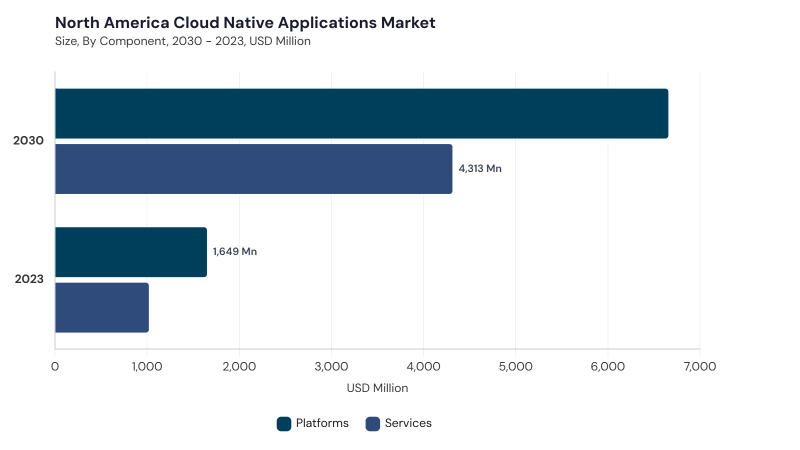
Based on Component, the market is segmented into Platforms and Services. The Platforms market dominated the North America Cloud Native Applications Market by Component in 2025, and would continue to be a dominant market till 2033; thereby, achieving a market value of USD 10.1 billion by 2032, growing at a CAGR of 22.8 % during the forecast period. The Services market is expected to witness a CAGR of 23.8% during (2026 - 2033).
Platforms provide the foundation for cloud-native development through Kubernetes ecosystems, runtime environments, infrastructure interfaces, microservices management, container lifecycle automation, and application portability across cloud environments. They support faster software delivery, scalability, workload resilience, and operational consistency across hybrid and multicloud infrastructures. Services remain important as enterprises require migration, modernization, integration, consulting, security, managed operations, DevOps enablement, and lifecycle support. As cloud-native ecosystems become more sophisticated, organizations with legacy environments and limited internal expertise increasingly rely on services to accelerate modernization, reduce implementation risk, and improve governance.
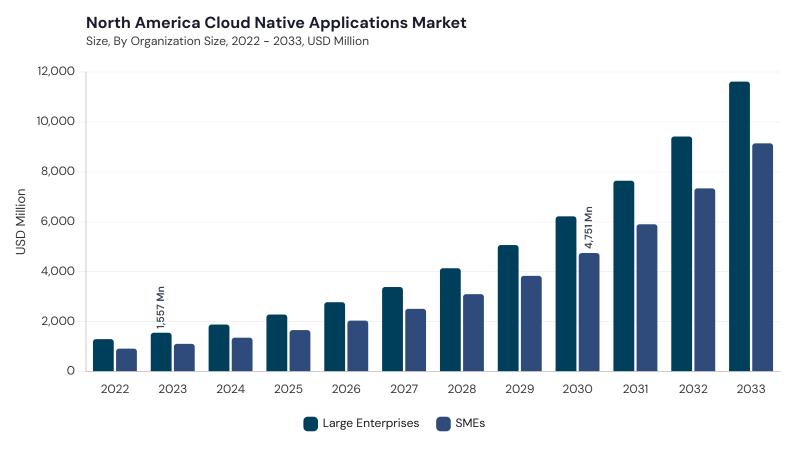
Based on Organization Size, the market is segmented into Large Enterprises and SMEs. The Large Enterprises market dominated the North America Cloud Native Applications Market by Organization Size in 2025, and would continue to be a dominant market till 2033; thereby, achieving a market value of USD 9.4 billion by 2032, growing at a CAGR of 22.7 % during the forecast period. The SMEs market is expected to witness a CAGR of 23.9% during (2026 - 2033).
Large Enterprises use cloud-native applications to modernize legacy systems, containerize workloads, adopt microservices, automate CI/CD pipelines, improve release frequency, and manage complex hybrid and multicloud environments. These organizations prioritize security integration, regulatory compliance, platform resilience, observability, and scalable orchestration across distributed operations. SMEs maintain a promising presence as managed cloud platforms, open-source tools, subscription-based development solutions, and PaaS offerings reduce infrastructure dependency and lower adoption barriers. Smaller businesses increasingly use cloud-native applications to accelerate product development, support digital-first business models, improve customer engagement, and scale operations without large physical IT investments.
Based on Deployment Type, the market is segmented into Public, Hybrid, and Private. Public deployment enables rapid provisioning, elastic capacity, managed Kubernetes, serverless computing, AI-enabled services, and cost-efficient scaling for web-scale, SaaS, e-commerce, and enterprise applications. Hybrid deployment holds a substantial position as organizations combine cloud scalability with existing infrastructure, sensitive workloads, data sovereignty requirements, and phased modernization strategies.
Private deployment remains relevant for regulated, security-sensitive, government, healthcare, defense, and financial environments requiring dedicated infrastructure, strong governance, and direct operational control. Advances in container portability, unified orchestration, service mesh technologies, and multi-environment management are improving consistency across all deployment models.
Based on Application, the market is segmented into BFSI, IT & Telecom, Retail and E-commerce, Manufacturing, Healthcare, Government & Public Sector, and Other Application. BFSI uses cloud-native applications for transaction platforms, fraud detection, risk analytics, personalized financial services, compliance automation, and secure digital banking. IT & Telecom relies on cloud-native architectures for network automation, software-defined services, 5G-related modernization, distributed applications, and real-time analytics.
Retail and E-commerce use scalable architectures for digital storefronts, omnichannel experiences, recommendation engines, inventory visibility, and high-traffic transaction platforms, while Manufacturing applies cloud-native solutions to smart factories, industrial analytics, connected operations, and supply chain visibility. Healthcare uses secure interoperable platforms for digital health, EHR modernization, telemedicine, and analytics, while Government & Public Sector modernizes citizen services, public data systems, cybersecurity, and legacy workloads. Other Application includes education, media, transportation, energy, and professional services adopting cloud-native tools for scalable digital platforms and data-driven operations.
Free Valuable Insights: The Global Cloud Native Applications Market will hit USD 53.9 Billion billion by 2033, at a CAGR of 23.8%
Based on Country, the market is segmented into US, Canada, Mexico, and Rest of North America. The US market dominated the North America Cloud Native Applications Market by Country in 2025, and would continue to be a dominant market till 2033; thereby, achieving a market value of USD 12.6 billion by 2032, growing at a CAGR of 22.4 % during the forecast period. The Canada market is expected to witness a CAGR of 25.9% during (2026 - 2033). Additionally, The Mexico market is expected to witness a CAGR of 25.1% during (2026 - 2033).
Across North America, cloud-native application adoption reflects differences in digital maturity, regulatory priorities, cloud infrastructure, industry modernization, and enterprise technology investment. The US emphasizes AI-powered application development, intelligent observability, legacy modernization, serverless computing, developer productivity, and advanced automation, while Canada focuses on hybrid and multicloud strategies, data sovereignty, secure service meshes, encryption models, local cloud infrastructure, and developer enablement. Mexico emphasizes edge computing integration, DevSecOps adoption, multi-cloud strategies, middleware platforms, API modernization, AI-driven automation, and secure deployment practices aligned with local compliance needs. Rest of North America continues to advance hybrid cloud integration, cloud-native security, edge computing, AI-infused monitoring, application lifecycle management, and interoperable platforms supporting regional digital transformation.

By Component
By Organization Size
By Deployment Type
By Application
By Country
Set to reach $16.7 Billion by 2032, growing at 23.2% CAGR during 2026-2033.
The US leads with $12.6 billion by 2032, growing at 22.4% CAGR during 2026-2033.
Rising enterprise cloud adoption and AI-driven workloads are the main catalysts.
Platforms segment hits $10.1 billion by 2032, growing at 22.8% CAGR during 2026-2033.
Canada is expected to witness a CAGR of 25.9% during 2026-2033.
Services segment is expected to witness a CAGR of 23.8% during 2026-2033.
Our team of dedicated experts can provide you with attractive expansion opportunities for your business.




 Unique Offerings
