The sample copy of this report is available for access.
The Asia Pacific Cloud Native Applications Market is expected to reach USD 8.3 billion by 2030, growing at a CAGR of 24.4% during (2026 - 2033).
The Asia Pacific Cloud Native Applications Market evolved from cautious early cloud adoption based on basic IaaS and SaaS models toward advanced application architectures built on containers, microservices, and orchestration platforms. Kubernetes, Docker, automated workflows, agile development practices, and regional cloud-platform investments accelerated the transition from legacy systems to cloud-native operating models. The COVID-19 pandemic further strengthened migration as enterprises required remote operations, scalability, resilience, and faster digital service delivery. The market now reflects a mature and diverse ecosystem where hybrid and multicloud deployments, real-time analytics, automated pipelines, and localized cloud strategies support application modernization across developed and emerging Asia Pacific economies.
Hybrid and multicloud adoption, AI and ML integration, cloud-native security, edge computing, and industry-specific digital transformation are shaping current market development. Enterprises increasingly require workload portability, container security, vulnerability scanning, compliance automation, predictive analytics, adaptive workload management, and integrated cloud orchestration across distributed environments. Expansion of hyperscale data centers, 5G networks, smart-city initiatives, industrial IoT, digital payments, mobile-first services, and AI-driven platforms is strengthening demand across BFSI, IT & telecom, retail, manufacturing, healthcare, government, and other sectors. However, uneven cloud infrastructure, connectivity gaps, complex regulations, data-sovereignty requirements, legacy integration challenges, operational complexity, and cloud-native skill shortages continue to influence adoption across the region.
Based on Component, the market is segmented into Platforms and Services. The Platforms market dominated the Asia Pacific Cloud Native Applications Market by Component in 2025, and would continue to be a dominant market till 2033; thereby, achieving a market value of USD 5.0 billion by 2030, growing at a CAGR of 24 % during the forecast period. The Services market is expected to witness a CAGR of 25% during (2026 - 2033).
Platforms provide the foundation for cloud-native development through container orchestration, container runtimes, microservices frameworks, Kubernetes distributions, serverless environments, container registries, and PaaS offerings. These platforms help enterprises modernize legacy systems, scale applications, improve portability, automate deployment, and support hybrid and multicloud strategies across diverse technology environments. Services remain important as organizations require application reengineering, cloud architecture consulting, implementation, integration, migration support, security assessments, DevOps enablement, managed runtime operations, and operational support. Growing cloud spending, talent scarcity, governance requirements, and complex modernization programs are strengthening reliance on service providers across Asia Pacific.
Based on Organization Size, the market is segmented into Large Enterprises and SMEs. The Large Enterprises market dominated the Asia Pacific Cloud Native Applications Market by Organization Size in 2025, and would continue to be a dominant market till 2033; thereby, achieving a market value of USD 4.7 billion by 2030, growing at a CAGR of 23.8 % during the forecast period. The SMEs market is expected to witness a CAGR of 25.1% during (2026 - 2033).
Large Enterprises use cloud-native applications to restructure monolithic systems, enable CI/CD pipelines, manage distributed workloads, integrate AI-driven automation, support multi-country operations, and improve application resilience. These organizations prioritize high availability, security, compliance, observability, container orchestration, edge computing, and hybrid or multicloud architectures to support large-scale operations. SMEs maintain a promising presence as managed cloud services, PaaS tools, serverless computing, pay-as-you-go models, and low-cost development platforms reduce infrastructure and technical barriers. Start-ups, digital-first businesses, fintech firms, e-commerce companies, and media enterprises increasingly use cloud-native tools to accelerate innovation, prototype faster, scale services, and manage technology spending more efficiently.
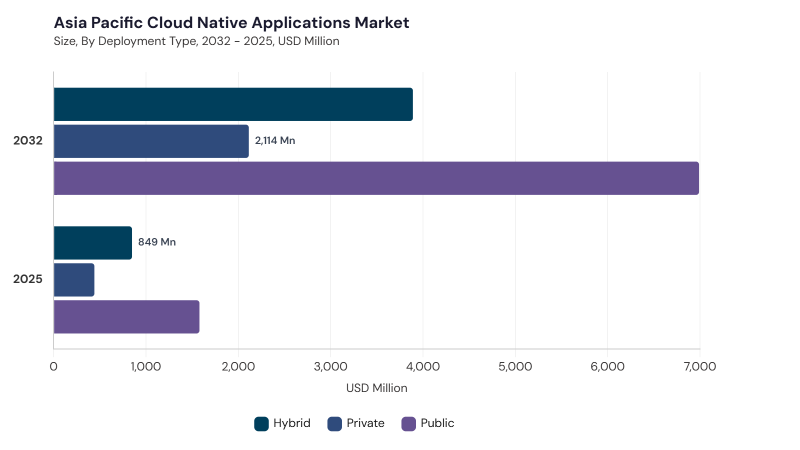
Based on Deployment Type, the market is segmented into Public, Hybrid, and Private. Public deployment supports rapid resource provisioning, elastic scalability, managed Kubernetes, serverless computing, SaaS delivery, API-based workflows, and cost-efficient application development across startups, SMEs, enterprises, and public-sector initiatives. Hybrid deployment holds a substantial position as enterprises combine existing technology investments, private infrastructure, public cloud scalability, regulatory control, and gradual modernization of mission-critical applications.
Private deployment remains relevant for financial institutions, healthcare providers, public authorities, and security-sensitive enterprises requiring dedicated infrastructure, stronger governance, data control, and customized security configurations. Improvements in workload portability, orchestration, container security, and cross-environment management are making deployment choices more flexible across Asia Pacific.
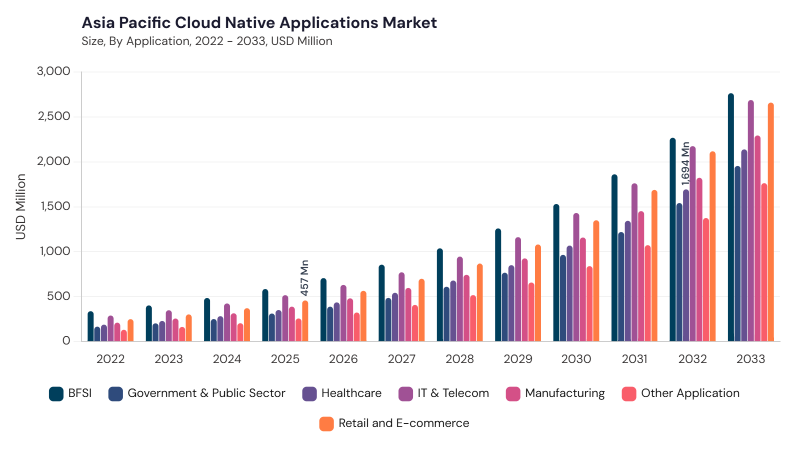
Based on Application, the market is segmented into BFSI, IT & Telecom, Retail and E-commerce, Manufacturing, Healthcare, Government & Public Sector, and Other Application. BFSI uses cloud-native applications for digital banking, fraud detection, payment gateways, insurance automation, risk analytics, compliance, and secure financial platforms. IT & Telecom relies on cloud-native architectures for 5G rollout, network digitization, NFV, service orchestration, CI/CD, cybersecurity, and customer experience management.
Retail and E-commerce adopt cloud-native systems for mobile commerce, online marketplaces, digital wallets, recommendation engines, supply-chain visibility, and high-traffic transaction platforms, while Manufacturing uses them for smart factories, industrial IoT, predictive maintenance, robotics control, and production analytics. Healthcare applies cloud-native platforms to EHR, telemedicine, patient data management, remote diagnostics, and AI-enabled clinical tools, while Government & Public Sector uses them for e-governance, digital identity, smart-city platforms, public safety, and citizen-facing services. Other Application includes education, logistics, travel, media, energy, and professional services adopting cloud-native systems for scalable digital operations.
Free Valuable Insights: Cloud Native Applications Market is Predicted to reach USD 53.9 Billion billion by 2033, at a CAGR of 23.8%
Based on Country, the market is segmented into China, Japan, India, South Korea, Singapore, Malaysia, and Rest of Asia Pacific. The China market dominated the Asia Pacific Cloud Native Applications Market by Country in 2025, and would continue to be a dominant market till 2033; thereby, achieving a market value of USD 2.2 billion by 2030, growing at a CAGR of 22.2 % during the forecast period. The Japan market is expected to witness a CAGR of 23.5% during (2026 - 2033). Additionally, The India market is expected to witness a CAGR of 25.1% during (2026 - 2033).
Across Asia Pacific, cloud-native application adoption reflects differences in cloud maturity, regulatory requirements, data localization, digital infrastructure, industry modernization, and enterprise technology investment. China emphasizes AI integration, edge computing, domestic cloud platforms, cybersecurity compliance, data sovereignty, and cloud-native adoption across finance, manufacturing, government, and smart-city initiatives, while Japan focuses on AI-driven automation, edge deployment, localized infrastructure, compliance, and advanced development practices across fintech, healthcare, and enterprise applications. India prioritizes DevOps, CI/CD, edge computing, cloud security, data residency, AI and ML integration, and scalable cloud-native ecosystems supported by banking, e-commerce, telecommunications, startups, and government digital initiatives. South Korea emphasizes AI-native infrastructure, fintech innovation, 5G-enabled cloud platforms, hybrid and multicloud adoption, and secure API ecosystems, whereas Singapore focuses on container orchestration, edge computing, compliance-driven cloud-native frameworks, managed Kubernetes, and secure multicloud deployments. Malaysia emphasizes hybrid and multicloud strategies, AI and ML integration, DevSecOps, regional data centers, workforce training, and localized cloud-native services. Rest of Asia Pacific continues to advance hybrid cloud adoption, AI-enabled applications, digital transformation, cloud automation, security, and localized cloud-native solutions across emerging and developing markets.

By Component
By Organization Size
By Deployment Type
By Application
By Country
Set to reach $8.3 Billion by 2030, growing at 24.4% CAGR during 2026-2033.
China dominates with a market value of USD 2.2 billion by 2030, growing at 22.2% CAGR during 2026-2033.
Rising enterprise cloud adoption and AI-driven workloads are the main catalysts.
Platforms segment to reach USD 5.0 billion by 2030, growing at 24% CAGR during 2026-2033.
India market is expected to witness a CAGR of 25.1% during 2026-2033.
Large enterprises segment to achieve USD 4.7 billion by 2030, growing at 23.8% CAGR during 2026-2033.
Our team of dedicated experts can provide you with attractive expansion opportunities for your business.




 Unique Offerings
