The sample copy of this report is available for access.
The North America Climate Adaptation Market is expected to reach USD 23.9 billion by 2032, growing at a CAGR of 14% during (2026 – 2033).
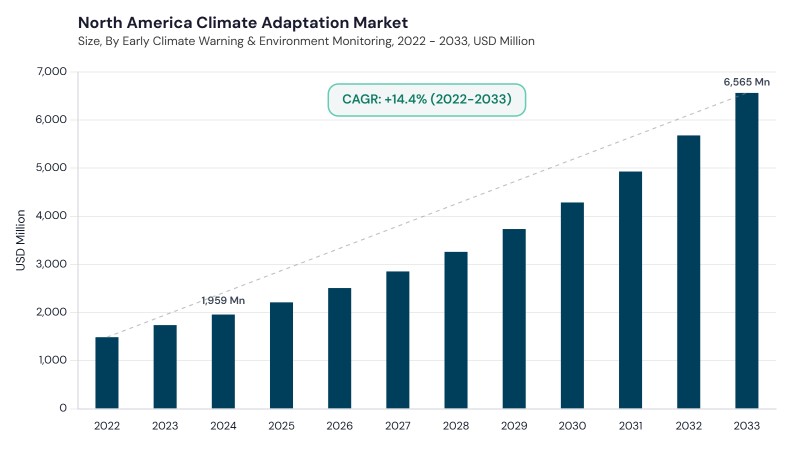
The North America Climate Adaptation Market originated in response to the region’s increasing exposure to extreme weather events, rising sea levels, shifting climate patterns, and related impacts on infrastructure, agriculture, ecosystems, and communities. Early activities were fragmented and focused mainly on localized risk assessments and incremental infrastructure adjustments. Over time, the market evolved through the adoption of climate modeling, predictive analytics, geospatial tools, and systematic vulnerability assessments. The integration of adaptation planning into government and corporate strategies marked a major transition from reactive responses to proactive resilience-building.
The North America Climate Adaptation Market is being shaped by climate risk analytics, scenario planning, sustainable finance, resilience bonds, nature-based solutions, and growing public-private collaboration. Organizations are adopting climate adaptation solutions to strengthen urban planning, agriculture, water management, disaster preparedness, energy infrastructure, and ecosystem resilience. Demand is supported by government agencies, power generation companies, oil and gas operators, chemical and petrochemical firms, education institutions, and other climate-sensitive industries. Providers are focusing on IoT-enabled monitoring, AI-driven climate models, decision-support platforms, resilient materials, ecosystem restoration, early warning systems, and localized adaptation services.
Based on Solution, the market is segmented into Technology-based, Natural-based, Early Climate Warning & Environment Monitoring, and Enhanced Natural Industry. The Technology-based market dominated the North America Climate Adaptation Market by Solution in 2025, and would continue to be a dominant market till 2033; thereby, achieving a market value of USD 6.8 billion by 2032, growing at a CAGR of 13 % during the forecast period. The Natural-based market is expected to witness a CAGR of 14.4% during (2026 - 2033). Additionally, The Early Climate Warning & Environment Monitoring market is expected to witness highest CAGR of 14.7% during (2026 - 2033).
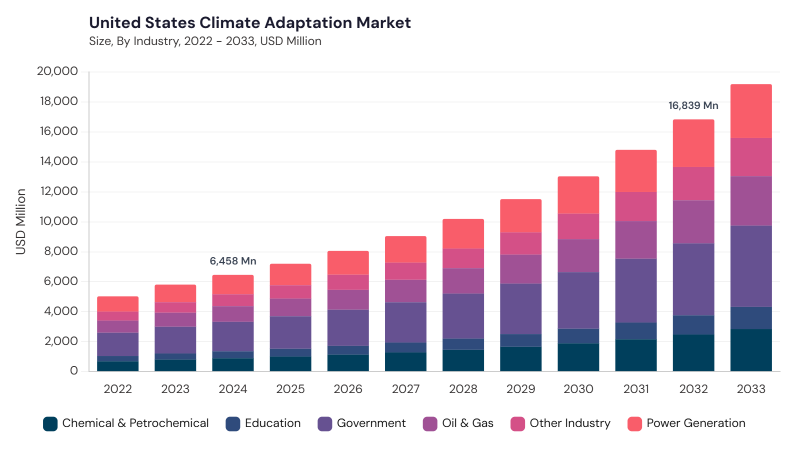
Technology-based leads due to increasing investments in AI-powered climate analytics, geospatial monitoring, predictive modeling, smart data platforms, resilient infrastructure design, and digital risk assessment systems. These solutions help governments, enterprises, and infrastructure operators identify vulnerabilities and implement proactive adaptation strategies. Natural-based remains significant as wetland restoration, afforestation, green infrastructure, soil conservation, and ecosystem-based resilience gain policy and funding support. Early Climate Warning & Environment Monitoring continues to expand through satellite observation, ground sensors, remote sensing, and disaster preparedness tools, while Enhanced Natural Industry supports climate-resilient agriculture, sustainable forestry, water resource management, and nature-positive industrial practices.
Based on Industry, the market is segmented into Government, Power Generation, Oil & Gas, Chemical & Petrochemical, Education, and Other Industry. Government leads due to increasing investments in climate resilience programs, infrastructure modernization, disaster risk reduction, public asset protection, environmental policies, and emergency response systems. This segment also drives adaptation through regulation, funding programs, urban planning, flood mitigation, and natural resource management.
Power Generation remains significant as energy operators strengthen grids, generation assets, and renewable infrastructure against extreme weather and temperature-related disruptions. Oil & Gas uses adaptation to protect critical assets and manage operational risks, while Chemical & Petrochemical focuses on resilient facility design, water recycling, and process continuity. Education and Other Industry contribute through campus resilience, climate literacy, healthcare preparedness, transportation resilience, real estate adaptation, and climate-smart agriculture.
Free Valuable Insights: The Global Climate Adaptation Market will hit USD 92.5 Billion billion by 2033, at a CAGR of 14.7%
Based on Country, the market is segmented into US, Canada, Mexico, and Rest of North America. The US market dominated the North America Climate Adaptation Market by Country in 2025, and would continue to be a dominant market till 2033; thereby, achieving a market value of USD 16.8 billion by 2032, growing at a CAGR of 13.2 % during the forecast period. The Canada market is expected to witness a CAGR of 16% during (2026 - 2033). Additionally, The Mexico market is expected to witness a CAGR of 15.3% during (2026 - 2033).
The US leads due to climate risk disclosure pressure, advanced climate analytics, digital twin technologies, green infrastructure, flood mitigation, wildfire resilience, drought adaptation, and social-equity-focused resilience planning. Canada supports market growth through climate risk integration in financial frameworks, geospatial technologies, predictive models, resilient infrastructure, nature-based approaches, and collaborative governance involving local stakeholders. Mexico is advancing through environmental finance mechanisms, climate risk reporting, hydrological monitoring, smart water management, drought-resistant practices, and public-private partnerships. Rest of North America benefits from climate risk disclosures, nature-based solutions, advanced modeling, agricultural resilience, water management, and localized adaptation planning.

By Solution
By Industry
By Country
Set to reach $23.9 Billion by 2032, growing at 14% CAGR during 2026-2033.
The US leads with $16.8 billion by 2032, growing at a CAGR of 13.2% during the forecast period.
Technology-based solutions dominate, reaching $6.8 billion by 2032 at a 13% CAGR during the forecast period.
Natural-based segment expects a 14.4% CAGR during 2026-2033.
Canada market is expected to witness a CAGR of 16% during 2026-2033.
Mexico market is expected to witness a CAGR of 15.3% during 2026-2033.
Our team of dedicated experts can provide you with attractive expansion opportunities for your business.




 Unique Offerings