The sample copy of this report is available for access.
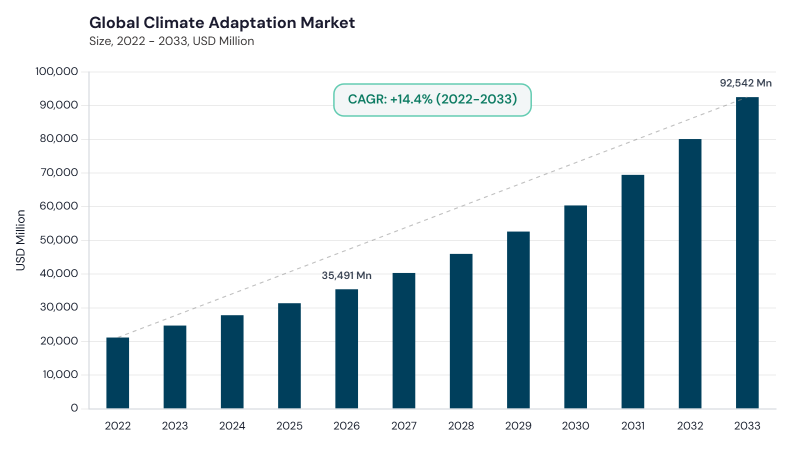
“Global Climate Adaptation Market to reach a market value of USD 92,541.63 Million by 2033 growing at a CAGR of 14.7%”
The Global Climate Adaptation Market is expected to reach USD 92.5 billion by 2033, growing at a CAGR of 14.7% during (2026 - 2033).
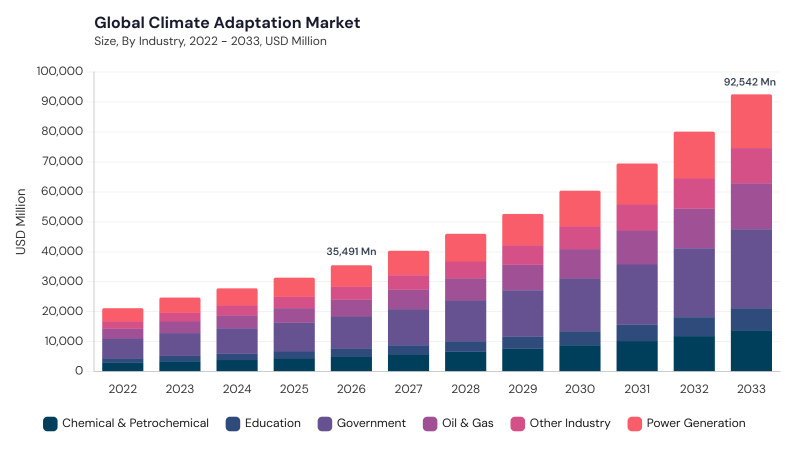
This market is supported by increasing exposure to extreme weather events, rising climate-related infrastructure risks, and growing demand for resilient solutions across agriculture, energy, water, transportation, urban development, and public infrastructure. Demand is also rising as governments, businesses, and communities focus on disaster preparedness, resource security, operational continuity, long-term resilience, and reduced economic losses from climate-related disruptions. The market originated from the recognition that climate change impacts require more than emission reduction measures.
The market is growing as stakeholders shift from fragmented local responses toward proactive, integrated climate adaptation frameworks. Advanced climate risk analytics, AI-enabled modeling, decision-support software, ecosystem-based approaches, resilient infrastructure, and adaptation finance are reshaping project design and investment planning. Nature-based solutions are also gaining traction due to their dual role in adaptation and carbon sequestration.
The competitive environment is moderately consolidated and innovation-driven, shaped by technology providers, consulting and service firms, infrastructure developers, environmental specialists, financial institutions, and public-sector stakeholders. Competition is influenced by climate risk assessment tools, data integration, nature-based adaptation capabilities, regulatory compliance, local implementation expertise, and scalable resilience platforms. The market continues to balance global technological capability with regional customization and localized climate vulnerability management.
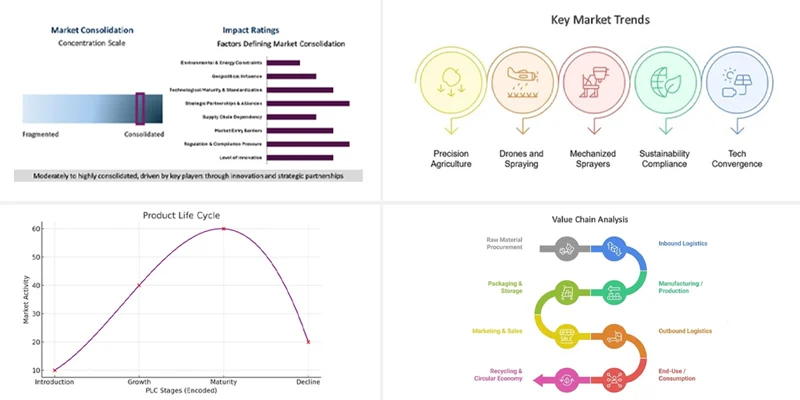


The Climate Adaptation Market reflects a moderately consolidated yet rapidly evolving competitive landscape driven by the urgent global need to reduce climate-related risks. Competition is shaped by innovation, strategic positioning, regulatory responsiveness, and the ability to deliver measurable resilience outcomes. Technology providers, engineering consultants, infrastructure developers, environmental advisory firms, and finance-linked adaptation specialists compete through advanced risk analytics, climate modeling, digital monitoring, nature-based solutions, resilient infrastructure planning, and localized implementation expertise. Since the uploaded file does not provide a separate “List of Key Companies Profiled” section, specific company profiling has been kept as Not Available.
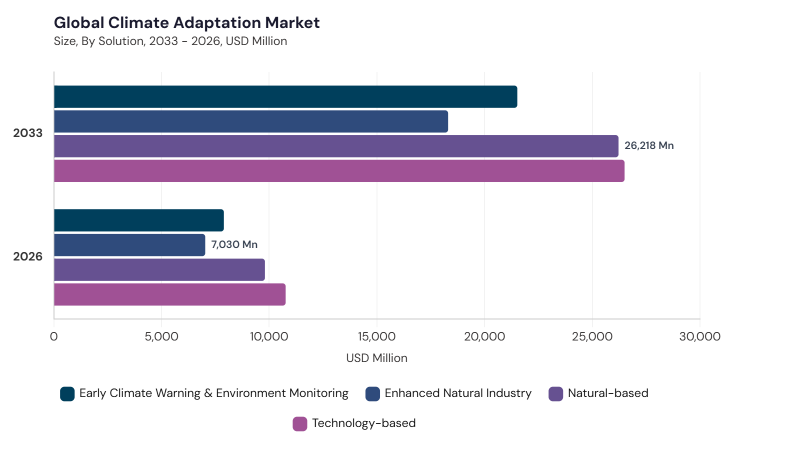
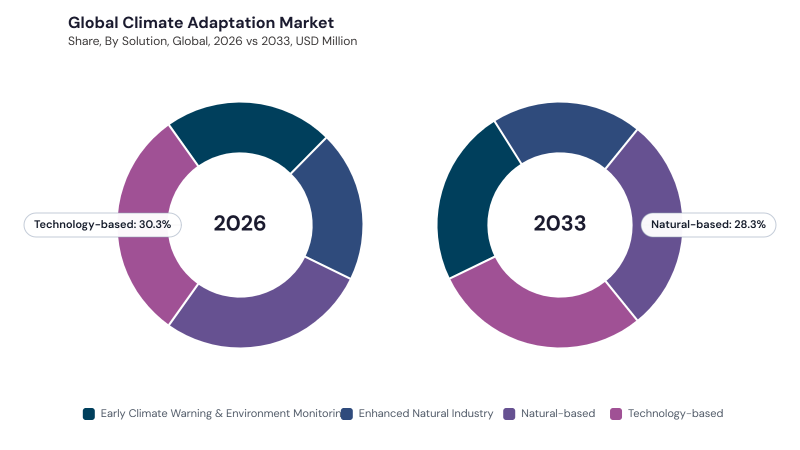
Based on Solution, the market is segmented into Technology-based, Natural-based, Early Climate Warning & Environment Monitoring, and Enhanced Natural Industry. The Technology-based market dominated the Global Climate Adaptation Market by Solution in 2025, and would continue to be a dominant market till 2033; thereby, achieving a market value of USD 26.4 billion by 2033, growing at a CAGR of 13.7 % during the forecast period. The Natural-based market is expected to witness a CAGR of 15.1% during (2026 - 2033). Additionally, The Early Climate Warning & Environment Monitoring market is expected to witness highest CAGR of 15.4% during (2026 - 2033).
Technology-based solutions lead the market as organizations adopt AI-driven climate analytics, predictive modeling, digital infrastructure, remote sensing, and risk assessment platforms. Natural-based solutions support ecosystem restoration, wetland rehabilitation, afforestation, green infrastructure, and biodiversity protection. Early Climate Warning & Environment Monitoring strengthens disaster preparedness through forecasting, environmental monitoring, and real-time climate data systems, while Enhanced Natural Industry supports resilient agriculture, forestry, fisheries, aquaculture, and resource management.
Based on Industry, the market is segmented into Government, Power Generation, Oil & Gas, Chemical & Petrochemical, Education, and Other Industry. The Government market dominated the Global Climate Adaptation Market by Industry in 2025, and would continue to be a dominant market till 2033; thereby, achieving a market value of USD 26.3 billion by 2033, growing at a CAGR of 13.7 % during the forecast period. The Power Generation market is expected to witness a CAGR of 13.8% during (2026 - 2033). Additionally, The Oil & Gas market is expected to witness highest CAGR of 15.4% during (2026 - 2033).
Government leads the market due to public investment in resilience programs, disaster risk reduction, sustainable infrastructure, and climate policy implementation. Power Generation focuses on climate-resilient energy infrastructure, grid modernization, and renewable integration, while Oil & Gas emphasizes operational resilience and environmental compliance. Chemical & Petrochemical adopts climate risk management and sustainable production practices, while Education and Other Industry support climate research, public awareness, transportation, agriculture, healthcare, and climate-resilient operational planning.
Free Valuable Insights: Climate Adaptation Market Size to reach $92.5 Billion by 2033
Region-wise, the Climate Adaptation Market is analyzed across North America, Europe, Asia Pacific, and LAMEA. The Asia Pacific market dominated the Global Climate Adaptation Market by Region in 2025, and would continue to be a dominant market till 2033; thereby, achieving a market value of USD 31.0 billion by 2033, growing at a CAGR of 15.2 % during the forecast period. The North America market is expected to witness a CAGR of 14% during (2026 - 2033). Additionally, The Europe market is expected to witness a CAGR of 14.3% during (2026 - 2033).
Asia Pacific leads the market due to rapid urbanization, rising vulnerability to extreme weather events, and government initiatives supporting sustainable infrastructure development. North America is supported by climate technology investments, disaster preparedness programs, and advanced environmental monitoring systems. Europe benefits from stringent climate policies, sustainability targets, and ecosystem restoration funding, while LAMEA is developing through climate-resilient infrastructure, water resource management, and environmental conservation initiatives.
| Report Attribute | Details |
|---|---|
| Market size value in 2026 | USD 35.4 billion |
| Market size forecast in 2033 | USD 92.5 billion |
| Base Year | 2025 |
| Historical Period | 2022 to 2024 |
| Forecast Period | 2026 to 2033 |
| Revenue Growth Rate | CAGR of 14.7% from 2026 to 2033 |
| Number of Pages | 535 |
| Tables | 600 |
| Report Coverage | Market Trends, Revenue Estimation and Forecast, Segmentation Analysis, Regional and Country Breakdown, Competitive Landscape, Market Share Analysis, Company Profiling, Companies Strategic Developments, SWOT Analysis, Product Life Cycle Analysis, Value Chain Analysis, Market Consolidation Analysis, Key Customer Criteria, Pandemic Impact Analysis, and Winning Imperatives |
| Segments Covered | Solution, Industry, and Geography |
| Country Scope |
|
| Companies Included | AECOM; Jacobs Solutions Inc.; WSP Global Inc.; Arcadis N.V.; Tetra Tech, Inc.; Stantec Inc.; Ramboll Group A/S; Arup Group Limited; Sweco AB; Royal HaskoningDHV |
By Solution
By Industry
By Geography
Valued at USD 35.4 billion in 2026, reaching USD 92.5 billion by 2033, growing at 14.7% CAGR during 2026-2033.
Technology-based solutions lead, projected to hit USD 26.4 billion by 2033.
AECOM, Jacobs Solutions Inc., WSP Global Inc., Arcadis N.V., Tetra Tech, Inc., Stantec Inc., Ramboll Group A/S, Arup Group Limited, Sweco AB, Royal HaskoningDHV.
The Government segment leads, expected to reach USD 26.3 billion by 2033.
Asia Pacific leads, projected to achieve USD 31.0 billion by 2033.
Rapid expansion of climate technology startups and innovation ecosystems boosts market growth.
Our team of dedicated experts can provide you with attractive expansion opportunities for your business.








 Unique Offerings