The sample copy of this report is available for access.
The North America Aviation Cloud Market is expected to reach USD 5.9 billion by 2032, growing at a CAGR of 11.5% during (2026 – 2033).
The North America Aviation Cloud Market traces its origins to the early 2000s when cloud computing began transforming traditional IT infrastructures across industries. Initially, aviation stakeholders relied on localized servers and on-premises software for flight management, maintenance scheduling, supply chain logistics, and operational support. Over time, increasing demand for operational efficiency, scalability, interoperability, cybersecurity, and regulatory-compliant data governance accelerated the adoption of cloud technologies. The market evolved from isolated cloud applications toward comprehensive aviation cloud ecosystems supporting flight operations, passenger services, cargo tracking, maintenance visibility, regulatory reporting, real-time analytics, and secure digital aviation services.
The integration of IoT technologies, artificial intelligence, machine learning, hybrid cloud models, edge computing, and aviation-specific cybersecurity frameworks is shaping the next phase of market growth across North America. Companies are increasingly investing in integrated cloud platforms, local data centers, regional cloud nodes, AI-driven analytics, predictive maintenance tools, sustainability analytics, and compliance-focused architectures to improve data governance, service latency, operational visibility, and regulatory alignment. Advancements in cloud-based software, real-time collaboration, environmental analytics, flight data integration, and airport digital technologies are also supporting improved scalability, operational efficiency, service quality, and market expansion.
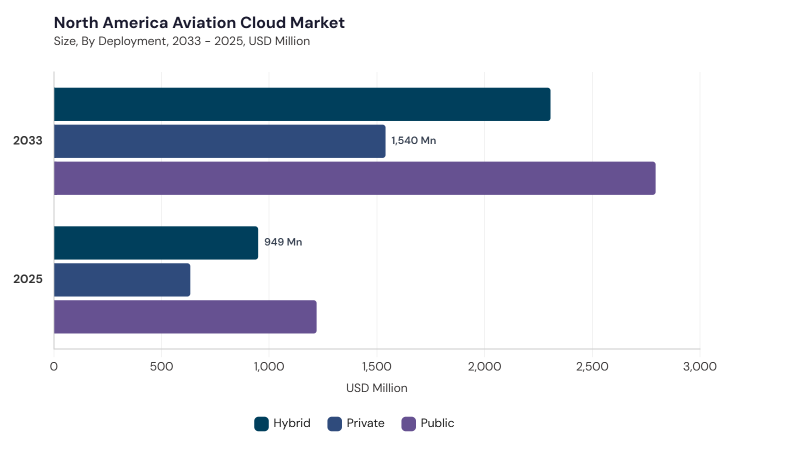
Based on Deployment, the market is segmented into Public, Hybrid, and Private. The Public market dominated the North America Aviation Cloud Market by Deployment in 2025, and would continue to be a dominant market till 2033; thereby, achieving a market value of USD 2.5 billion by 2032, growing at a CAGR of 11.1 % during the forecast period. The Hybrid market is expected to witness a CAGR of 11.9% during (2026 - 2033). The Private market is expected to witness a CAGR of 11.9% during (2026 - 2033).
The Public cloud segment leads the market due to scalability, faster implementation, lower infrastructure ownership burden, and wide adoption of cloud-based aviation applications. Airlines and airports use public cloud environments for passenger services, analytics, booking support, operational dashboards, collaboration tools, and digital aviation workflows where flexibility and rapid access are important. Hybrid cloud is also gaining strong traction as aviation organizations combine public cloud scalability with controlled private infrastructure for sensitive operational data, regulated workloads, legacy aviation systems, and mission-critical applications requiring stronger governance and security.
Based on End User, the market is segmented into Airlines, Airports, OEMs, and MROs. The Airlines market dominated the North America Aviation Cloud Market by End User in 2025, and would continue to be a dominant market till 2033; thereby, achieving a market value of USD 2.5 billion by 2032, growing at a CAGR of 10.9 % during the forecast period. The Airports market is expected to witness a CAGR of 11.7% during (2026 - 2033). The MROs market is expected to witness a CAGR of 12.3% during (2026 - 2033).
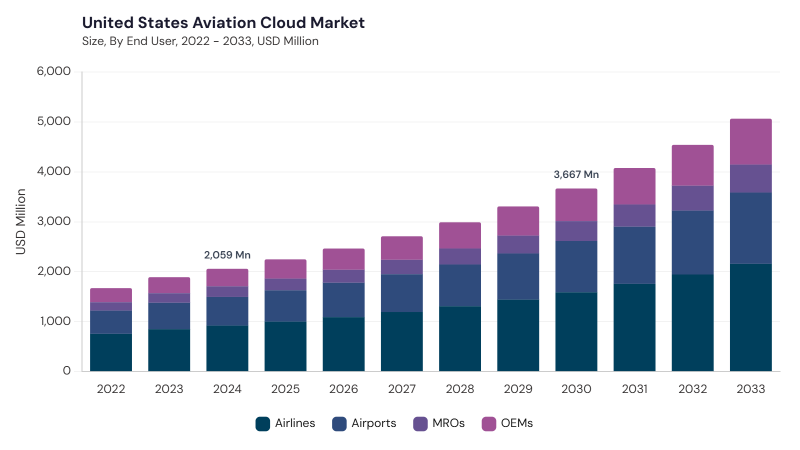
Airlines lead the market due to cloud adoption across flight operations, passenger management, revenue systems, crew planning, disruption recovery, loyalty platforms, fleet management, and operational analytics. Airlines use cloud platforms to improve agility, cost optimization, real-time decision-making, and integration with legacy systems. Airports also represent a major end-user category, using cloud platforms for terminal operations, passenger flow management, baggage coordination, security coordination, resource planning, airport-wide data sharing, and smart airport initiatives supported by IoT, AI, and real-time analytics.
Based on Service Model, the market is segmented into Software as a Service, Infrastructure as a Service, and Platform as a Service. Software as a Service leads the market due to strong adoption of aviation-specific applications for flight operations, passenger services, maintenance management, analytics, crew scheduling, cargo handling, airport workflows, and enterprise collaboration.
SaaS reduces local software management, supports faster updates, and enables users to access applications across multiple locations. Infrastructure as a Service also records substantial demand as aviation enterprises require scalable computing, storage, networking, disaster recovery, cybersecurity support, and data hosting capabilities to manage large aviation datasets and mission-critical workloads.
Based on Application, the market is segmented into Flight Operations, Passenger Service, Maintenance & Management Systems, Data Analytics and Business Intelligence, Cargo Management & Baggage Handling, Supply Chain Management, and Other Application. Flight Operations leads the market due to growing use of cloud-based flight planning, dispatch coordination, weather data integration, fuel optimization, crew scheduling, aircraft tracking, route adjustment, and operational decision support.
These platforms support safer, more efficient, and data-driven aviation operations. Passenger Service is also gaining strong adoption as airlines and airports use cloud solutions for digital check-in, mobile engagement, loyalty systems, disruption communication, self-service tools, biometric passenger experiences, AI-based support, and personalized travel services across multiple passenger touchpoints.
Free Valuable Insights: The Global Aviation Cloud Market Size to reach $18.2 Billion by 2033
Based on Country, the market is segmented into the US, Canada, Mexico, and Rest of North America. The US market dominated the North America Aviation Cloud Market by Country in 2025, and would continue to be a dominant market till 2033; thereby, achieving a market value of USD 4.5 billion by 2032, growing at a CAGR of 10.8 % during the forecast period. The Canada market is expected to witness a CAGR of 14.1% during (2026 - 2033). Additionally, The Mexico market is expected to witness a CAGR of 13.4% during (2026 - 2033).
The US leads with strong digital transformation, FAA NextGen initiatives, AI analytics, predictive maintenance, compliance tools, and secure cloud infrastructure. Canada is gaining traction through cloud-enabled flight operations, maintenance tracking, passenger services, airport resource management, cybersecurity, and data sovereignty-focused cloud systems. Mexico is emerging steadily, supported by rising aircraft movements, passenger growth, airport modernization, real-time analytics, and cloud-based flight management. Rest of North America is also contributing through gradual airport digitization, regional aviation modernization, cloud-based operational tools, and growing demand for secure aviation data management. The increasing use of AI, IoT, edge computing, blockchain maintenance records, and localized cloud solutions is further strengthening the region’s aviation cloud ecosystem.

By Deployment
By End User
By Service Model
By Application
By Country
Set to reach USD 5.9 billion by 2033, growing at 11.5% CAGR during 2026-2033.
The US leads with USD 4.5 billion by 2032, growing at 10.8% CAGR during the forecast period.
Rising enterprise cloud adoption and AI-driven workloads are the main catalysts.
Public segment hits USD 2.5 billion by 2032, growing at 11.1% CAGR during the forecast period.
The Canada market is expected to witness a CAGR of 14.1% during 2026-2033.
Airlines segment reaches USD 2.5 billion by 2032, growing at 10.9% CAGR during the forecast period.
Our team of dedicated experts can provide you with attractive expansion opportunities for your business.




 Unique Offerings