The sample copy of this report is available for access.
“Global Aviation Cloud Market to reach a market value of USD 18,212.40 Million by 2033 growing at a CAGR of 12.1%”
The Global Aviation Cloud Market is expected to reach USD 18.2 Billion by 2033, growing at a CAGR of 12.1% during (2026 – 2033).
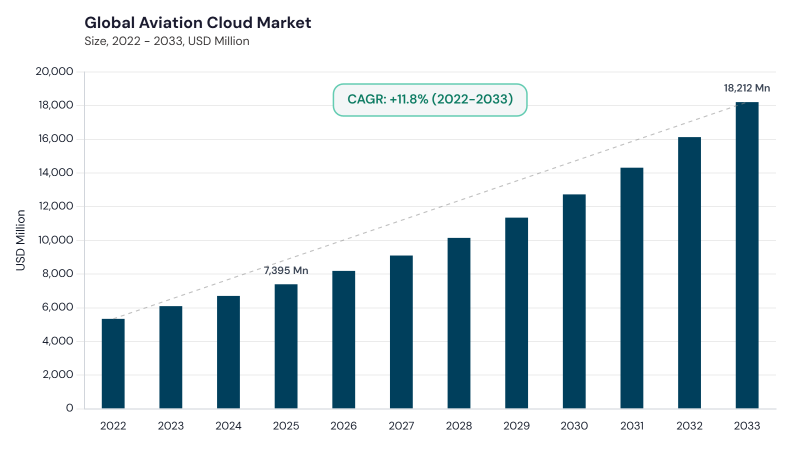
The Global Aviation Cloud Market is witnessing strong growth, driven by aviation digitalization, cloud infrastructure modernization, real-time data accessibility, predictive analytics, and increasing demand for connected aviation ecosystems. The market originated from the broader digital transformation of airlines, airports, maintenance providers, and aviation service organizations seeking scalable data storage, operational efficiency, and improved collaboration. Over time, aviation cloud solutions evolved from basic data hosting and workflow management into advanced platforms supporting artificial intelligence, Internet of Things integration, predictive maintenance, passenger service optimization, flight operations, cargo visibility, and regulatory compliance.
The Aviation Cloud Market is witnessing sustained expansion as airlines, airports, OEMs, MRO providers, and aviation technology firms increasingly migrate from legacy systems to scalable and secure cloud environments. Cloud platforms help aviation stakeholders improve real-time collaboration, data visibility, operational resilience, maintenance planning, passenger experience, cargo coordination, and business intelligence. The market is also benefiting from artificial intelligence and predictive analytics, which support fuel optimization, delay forecasting, aircraft health monitoring, dynamic scheduling, and proactive maintenance. At the same time, aviation organizations are increasingly adopting hybrid and multi-cloud models to balance performance, compliance, data security, and operational flexibility.
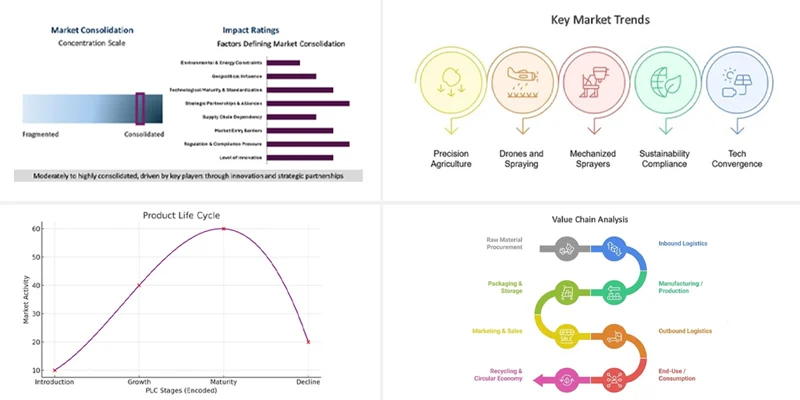
The Aviation Cloud Market is characterized by a moderately consolidated and aviation-digitalization-driven competitive environment consisting of hyperscale cloud providers, aviation-specific technology vendors, enterprise software companies, managed service providers, and cloud infrastructure specialists. Competition is centered on cloud scalability, cybersecurity, aviation-specific functionality, real-time analytics, interoperability, regulatory compliance, operational resilience, and passenger experience capabilities. Hyperscale cloud providers compete through infrastructure scale, artificial intelligence services, analytics capabilities, and partner ecosystems, while aviation-focused technology providers compete through domain expertise, mission-critical applications, airport systems, baggage management, passenger processing, and aviation workflow integration.

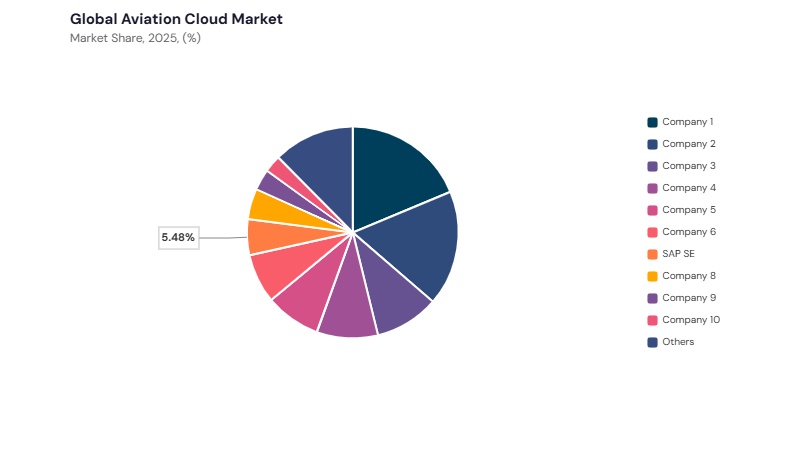
The Aviation Cloud Market exhibits a relatively concentrated and aviation-digitalization-driven competitive structure, with major cloud platform providers and aviation-focused technology companies holding strong positions. Amazon Web Services leads the market, supported by extensive adoption among airlines, airports, maintenance providers, aviation software vendors, and travel technology companies. Microsoft Corporation maintains a strong position through Azure cloud adoption across airport modernization, airline operations, passenger platforms, and aviation enterprise applications. Google, SITA, and IBM also represent major participants, supported by data analytics, artificial intelligence, aviation communication systems, hybrid cloud capabilities, and enterprise transformation services.
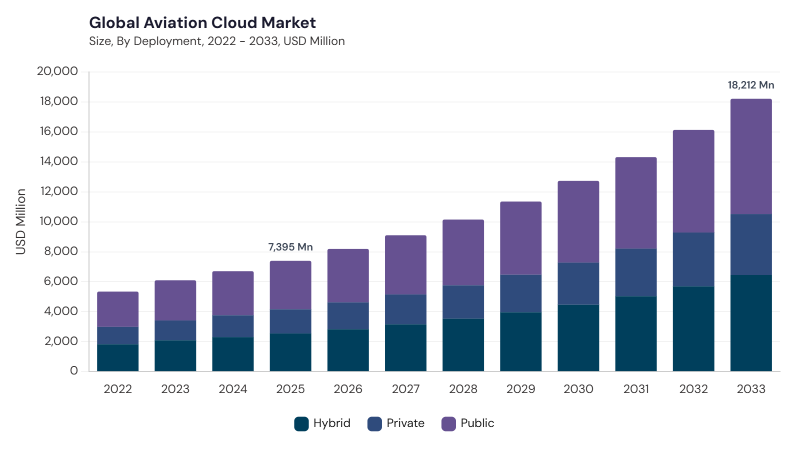
Based on Deployment, the market is segmented into Public, Hybrid, and Private. The Public market dominated the Global Aviation Cloud Market by Deployment in 2025, and would continue to be a dominant market till 2033; thereby, achieving a market value of USD 7.7 Billion by 2033, growing at a CAGR of 11.6 % during the forecast period. The Hybrid market is expected to witness a CAGR of 12.5% during (2026 - 2033). The Private market is expected to witness a CAGR of 12.4% during (2026 - 2033).
Public cloud solutions help aviation organizations reduce infrastructure burden, accelerate digital deployment, and support scalable aviation workloads. Hybrid cloud models allow airlines, airports, and MRO providers to manage sensitive data securely while using public cloud resources for flexible workloads and backup requirements. Private cloud environments support highly sensitive aviation operations where data integrity, uptime, regulatory control, and cybersecurity are essential. As aviation cloud adoption matures, hybrid and multi-cloud strategies are becoming increasingly important across the sector.
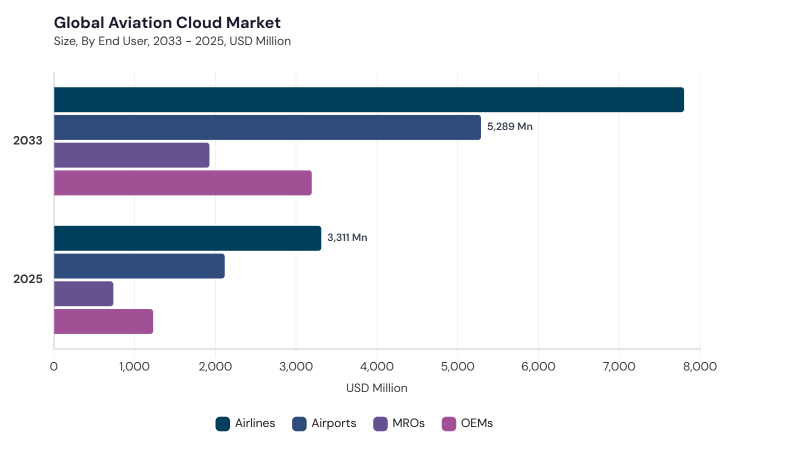
Based on End User, the market is segmented into Airlines, Airports, OEMs, and MROs. The Airlines market dominated the Global Aviation Cloud Market by End User in 2025, and would continue to be a dominant market till 2033; thereby, achieving a market value of USD 7.8 Billion by 2033, growing at a CAGR of 11.5 % during the forecast period. The Airports market is expected to witness a CAGR of 12.3% during (2026 - 2033). The MROs market is expected to witness a CAGR of 12.9% during (2026 - 2033).
Airlines use cloud technologies to manage complex operational datasets and improve decision-making across flight planning, passenger services, and fleet performance. Airports benefit from cloud-based command systems, smart sensors, passenger platforms, and real-time analytics. OEMs leverage cloud environments to support global engineering collaboration, manufacturing data, compliance documentation, and lifecycle monitoring. MROs use aviation cloud systems to reduce downtime, support digital maintenance records, optimize parts availability, and improve aircraft reliability.
Based on Service Model, the market is segmented into Software as a Service, Infrastructure as a Service, and Platform as a Service. The Software as a Service (SaaS) market dominated the Global Aviation Cloud Market by Service Model in 2025, and would continue to be a dominant market till 2033; thereby, achieving a market value of USD 7.4 Billion by 2033, growing at a CAGR of 11.4 % during the forecast period. The Infrastructure as a Service (IaaS) market is expected to witness a CAGR of 12.5% during (2026 - 2033). The Platform as a Service (PaaS) market is expected to witness a CAGR of 12.7% during (2026 - 2033).
Software as a Service enables rapid deployment of aviation-specific tools without extensive internal infrastructure management. Infrastructure as a Service provides the backbone for aviation data processing, flight analytics, simulation, cybersecurity, and large-scale operational workloads. Platform as a Service supports innovation by allowing aviation software developers and system integrators to build cloud-native applications using modular development tools, micro services, and application programming interfaces. Together, these service models support the broader shift toward scalable, flexible, and intelligent aviation cloud ecosystems.
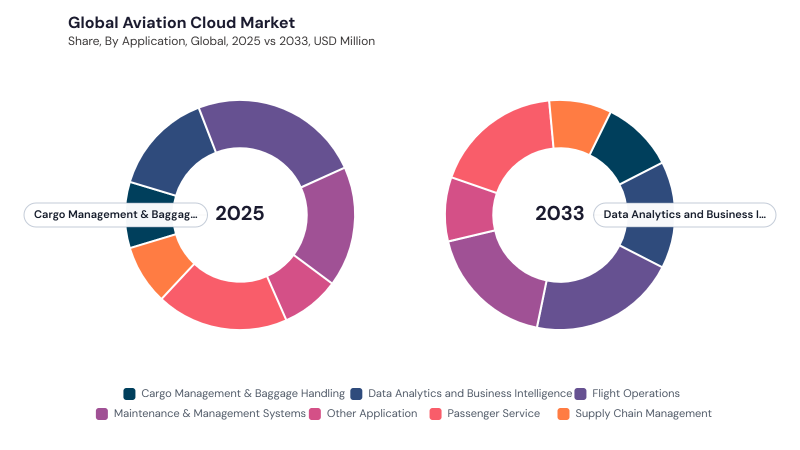
Based on Application, the market is segmented into Flight Operations, Passenger Service, Maintenance and Management Systems, Data Analytics and Business Intelligence, Cargo Management and Baggage Handling, Supply Chain Management, and Other Application. The Flight Operations market dominated the Global Aviation Cloud Market by Application in 2025, and would continue to be a dominant market till 2033; thereby, achieving a market value of USD 3.7 Billion by 2033, growing at a CAGR of 9.9 % during the forecast period. The Passenger Service market is expected to witness a CAGR of 11.8% during (2026 - 2033). Additionally, The Maintenance & Management Systems market is expected to witness highest CAGR of 13% during (2026 - 2033).
Flight operations depend on reliable and low-latency cloud platforms that support safety, scheduling, and operational resilience. Passenger service applications enhance customer engagement, personalization, booking management, and service transparency. Maintenance systems use cloud analytics to improve aircraft availability and reduce unscheduled downtime. Data analytics and business intelligence enable aviation stakeholders to extract insights from operational, customer, and fleet data. Cargo, baggage, and supply chain applications improve visibility, coordination, and responsiveness across aviation logistics networks.
Free Valuable Insights: Aviation Cloud Market Size to reach $18.2 Billion by 2033
Region-wise, the Aviation Cloud Market is analyzed across North America, Europe, Asia Pacific, and LAMEA. The North America market dominated the Global Aviation Cloud Market by Region in 2025, and would continue to be a dominant market till 2033; thereby, achieving a market value of USD 6.6 Billion by 2033, growing at a CAGR of 11.5 % during the forecast period. The Asia Pacific market is expected to witness a CAGR of 12.7% during (2026 - 2033). Additionally, The Europe market is expected to witness a CAGR of 11.7% during (2026 - 2033).
North America benefits from mature cloud ecosystems, advanced airline operations, and strong enterprise technology adoption. Europe is shaped by data governance, aviation safety standards, environmental reporting, and digital airport transformation. Asia Pacific is supported by rapidly growing aviation hubs, airline fleet expansion, airport infrastructure investment, and passenger service modernization. LAMEA continues to grow as airports and airlines invest in cloud-enabled operations, passenger processing, and infrastructure resilience.
| Report Attribute | Details |
|---|---|
| Market size value in 2026 | USD 8.2 Billion |
| Market size forecast in 2033 | USD 18.2 Billion |
| Base Year | 2025 |
| Historical Period | 2022 to 2024 |
| Forecast Period | 2026 to 2033 |
| Revenue Growth Rate | CAGR of 12.1% from 2026 to 2033 |
| Number of Pages | 722 |
| Tables | 870 |
| Report Coverage | Market Trends, Revenue Estimation and Forecast, Segmentation Analysis, Regional and Country Breakdown, Competitive Landscape, Market Share Analysis, Company Profiling, Companies Strategic Developments, SWOT Analysis, Product Life Cycle Analysis, Value Chain Analysis, Market Consolidation Analysis, Key Customer Criteria, Pandemic Impact Analysis, and Winning Imperatives |
| Segments Covered | Deployment, End User, Service Model, Application, Region |
| Country Scope |
|
| Companies Included | Amazon Web Services, Microsoft Corporation, Google, SITA, IBM Corporation, Oracle Corporation, SAP SE, Salesforce, Kyndryl, and NEC Corporation |
By Deployment
By End User
By Service Model
By Application
By Geography
Expected to reach USD 18.2 Billion by 2033, growing at 12.1% CAGR during 2026-2033.
Public cloud leads, projected to achieve a market value of USD 7.7 Billion by 2033.
Amazon Web Services, Microsoft Corporation, Google, SITA, and IBM Corporation are key players.
North America dominates, expected to reach USD 6.6 Billion by 2033.
Integration of AI and predictive analytics, digital twin technologies, and sustainability focus drive growth.
Flight operations lead, projected to reach USD 3.7 Billion by 2033.
Our team of dedicated experts can provide you with attractive expansion opportunities for your business.








 Unique Offerings