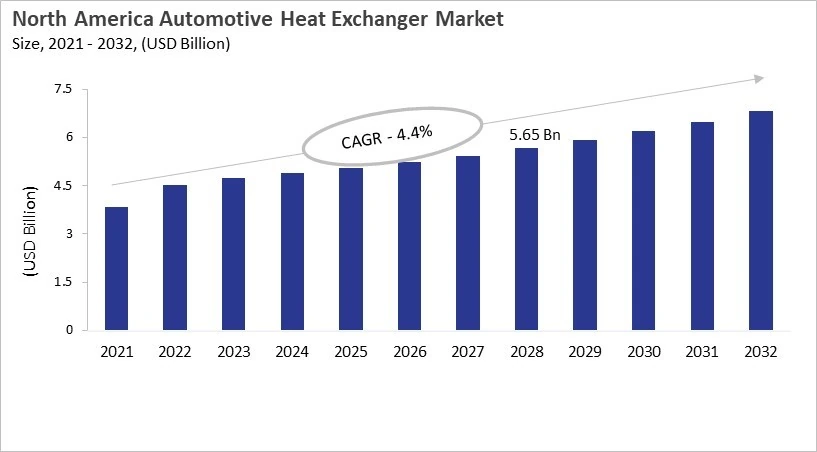
The North America Automotive Heat Exchanger Market is expected to reach $5.65 billion by 2028 and would witness market growth of 4.4% CAGR during the forecast period (2025-2032).
The US market dominated the North America Automotive Heat Exchanger Market by Country in 2024, and would continue to be a dominant market till 2032; thereby, achieving a market value of $4,722.4 million by 2032. The Canada market is experiencing a CAGR of 6.9% during (2025 - 2032). Additionally, The Mexico market would exhibit a CAGR of 5.2% during (2025 - 2032). The US and Canada led the North America Automotive Heat Exchanger Market by Country with a market share of 73.2% and 10% in 2024. The US market is expected to witness a CAGR of 3.7% during throughout the forecast period.
The North American Automotive Heat Exchanger Market has undergone significant changes since it first relied on simple radiator systems for internal combustion engines. Now, it has a complex ecosystem of advanced thermal management solutions. Initially, the market focused on cooling engines, but it expanded as more specialized components, such as oil coolers, condensers, evaporators, and charge air coolers, were introduced to meet the higher performance needs. Over time, improvements in materials and manufacturing processes made it more durable and better at transferring heat. These were important turning points in its evolution. The shift toward electrification and hybrid vehicles has changed the market in recent years. This has created a need for integrated systems that can cool batteries and power electronics, as well as traditional applications, which aligns with sustainability goals and regulatory requirements.
The market is currently being shaped by three primary trends: the rapid adoption of electric vehicles, the shift toward lightweight and high-performance materials, and the utilization of digital engineering tools. Companies are now investing in new, small, and efficient heat exchanger designs and utilizing virtual testing to accelerate development cycles and enhance product reliability. To strengthen their market presence and meet evolving OEM needs, key players are employing strategies that focus on innovation, strategic partnerships, and expanding their capacity across different regions. Competitive dynamics are a balance between technological differentiation and cost efficiency. Both global and regional manufacturers compete to stay relevant and gain market share by investing in advanced research and development, localized production, and streamlined supply chains.
Based on Type, the market is segmented into Liquid-to-Air, and Air-to-Air. With a compound annual growth rate (CAGR) of 3.3% over the projection period, the Liquid-to-Air Market, dominate the US Automotive Heat Exchanger Market by Type in 2024 and would be a prominent market until 2032. The Air-to-Air market is expected to witness a CAGR of 4.3% during (2025 - 2032).
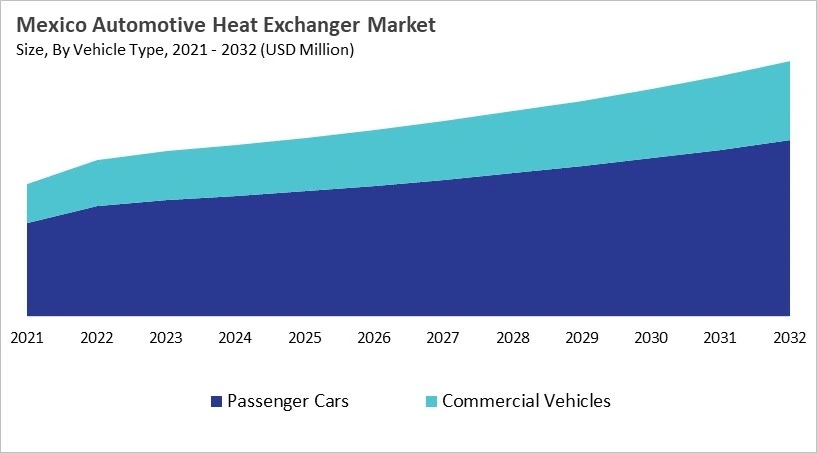
Based on Vehicle Type, the market is segmented into Passenger Cars, and Commercial Vehicles. The Passenger Cars market segment dominated the Mexico Automotive Heat Exchanger Market by Vehicle Type is expected to grow at a CAGR of 5 % during the forecast period thereby continuing its dominance until 2032. Also, The Commercial Vehicles market is anticipated to grow as a CAGR of 5.8 % during the forecast period during (2025 - 2032).
Free Valuable Insights: The Global Automotive Heat Exchanger Market will hit USD 32.69 billion by 2032, at a CAGR of 4.9%
The market for automotive heat exchangers in the United States is growing steadily. This is because there is a strong base of automotive manufacturing and a steady demand for both passenger and commercial vehicles. Heat exchangers are very important for managing heat because they make engines more efficient, last longer, and improve the performance of the whole vehicle. Regulatory pressure to cut emissions and improve fuel efficiency is speeding up the use of new heat exchanger technologies. The rise of electric and hybrid cars is also changing demand, as there is a growing need for specialized thermal solutions for batteries and power electronics. Technological progress, such as lighter materials and smaller designs, is also helping the market grow. But high production costs, complicated engineering needs, and fierce competition are still big problems for people in the industry.

By Type
By Propulsion
By Vehicle Type
By Country
Market will reach $5.65 billion by 2028, growing at 4.4% CAGR during 2025-2032.
The US dominates with 73.2% market share in 2024 and $4.72 billion expected by 2032.
Canada shows 6.9% CAGR during 2025-2032 while Mexico exhibits 5.2% CAGR during the same period.
US market grows at 3.7% CAGR during 2025-2032, maintaining its dominant position through 2032.
Canada holds 10% market share in 2024, ranking second after the US.
Our team of dedicated experts can provide you with attractive expansion opportunities for your business.




 Unique Offerings