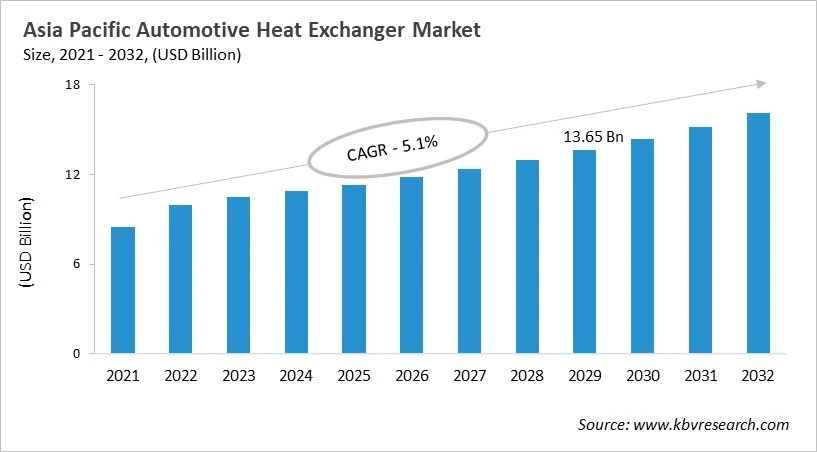
The Asia Pacific Automotive Heat Exchanger Market is expected to reach $13.65 billion by 2029 and would witness market growth of 5.1% CAGR during the forecast period (2025-2032).
The China market dominated the Asia Pacific Automotive Heat Exchanger Market by Country in 2024, and would continue to be a dominant market till 2032; thereby, achieving a market value of $5,800.2 million by 2032. The Japan market is registering a CAGR of 4.3% during (2025 - 2032). Additionally, The India market would showcase a CAGR of 6.2% during (2025 - 2032). The China and Japan led the Asia Pacific Automotive Heat Exchanger Market by Country with a market share of 40% and 16.2% in 2024. The Malaysia market is expected to witness a CAGR of 7.9% during throughout the forecast period.
The Asia Pacific Automotive Heat Exchanger Market has changed a lot over the years, moving from traditional copper and brass radiator systems to more advanced, lightweight, and efficient ones. At first, the market was focused on basic engine cooling for internal combustion vehicles. Then, aluminum-based heat exchangers came along, which had better thermal performance, were lighter, and were cheaper. The advent of brazed aluminum technologies represented a significant breakthrough, facilitating compact and resilient designs optimized for enhanced engine performance. The development of modular and multi-functional heat exchanger systems sped up even more because of growing regulatory pressure for better fuel economy and lower emissions. Because of this, the market today is always coming up with new materials and designs to meet the growing needs for thermal management in the region's automotive industry.
Some of the main trends that are shaping the market right now are the move toward lighter materials, the quick electrification of vehicles, and the use of smart cooling technologies. The growing use of aluminum alloys fits with goals to cut down on emissions, and the rise of electric and hybrid vehicles has made heat exchangers useful for cooling batteries and power electronics as well. Smart thermal systems that can be monitored in real time are also making things more efficient and reliable. Digital transformation and advanced manufacturing practices are helping market players strengthen their positions through R&D investments, strategic partnerships, and expanding into new regions in major automotive hubs. The competitive landscape is still very fluid. Global companies are focusing on being the best in technology, while regional companies are focusing on being cost-effective and local. Together, these two groups are driving innovation and long-term growth in the market.
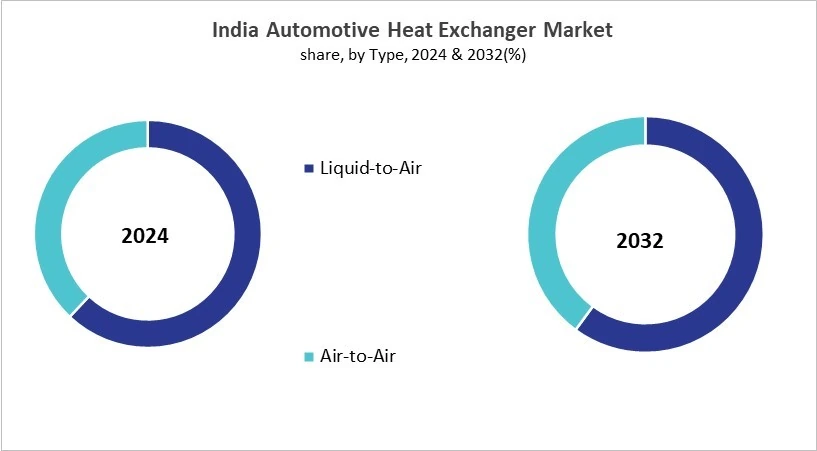
Based on Type, the market is segmented into Liquid-to-Air, and Air-to-Air. With a compound annual growth rate (CAGR) of 5.8% over the projection period, the Liquid-to-Air Market, dominate the India Automotive Heat Exchanger Market by Type in 2024 and would be a prominent market until 2032. The Air-to-Air market is expected to witness a CAGR of 6.9% during (2025 - 2032).
Based on Vehicle Type, the market is segmented into Passenger Cars, and Commercial Vehicles. The Passenger Cars market segment dominated the China Automotive Heat Exchanger Market by Vehicle Type is expected to grow at a CAGR of 3.5 % during the forecast period thereby continuing its dominance until 2032. Also, The Commercial Vehicles market is anticipated to grow as a CAGR of 4.3 % during the forecast period during (2025 - 2032).
Free Valuable Insights: Automotive Heat Exchanger Market is Predicted to reach USD 32.69 billion by 2032, at a CAGR of 4.9%
The Chinese automotive heat exchanger market has changed from making simple copper-brass and aluminum units for regular cars to making advanced, lightweight, and high-efficiency thermal management solutions. Technological progress, stricter rules on fuel economy and emissions, and the quick growth of new energy vehicles, which need special cooling systems for their batteries and electric drivetrains, have all contributed to growth. Some important trends are the use of aluminum-based materials, the addition of smart thermal management systems, and a growing focus on designs that are small and high-performance. To stay ahead of the competition, market leaders focus on new ideas, strategic partnerships, and making things locally. The industry is still seeing technological differentiation, cost optimization, and continuous improvement because of fierce competition between companies in the US and around the world.

By Type
By Propulsion
By Vehicle Type
By Country
Market will reach $13.65 billion by 2029, growing at 5.1% CAGR during 2025-2032.
China leads with 40% market share in 2024 and will reach $5,800.2 million by 2032.
Expanding automotive production and rising vehicle electrification across the region fuel demand.
Japan's market grows at 4.3% CAGR during 2025-2032.
India's market expands at 6.2% CAGR during 2025-2032.
Liquid-to-Air dominates India's market and grows at 5.8% CAGR during the projection period.
Our team of dedicated experts can provide you with attractive expansion opportunities for your business.




 Unique Offerings