The sample copy of this report is available for access.
The North America Automotive Data Analytics Platform Market is expected to reach USD 4.1 billion by 2032, growing at a CAGR of 22% during (2026 – 2033).
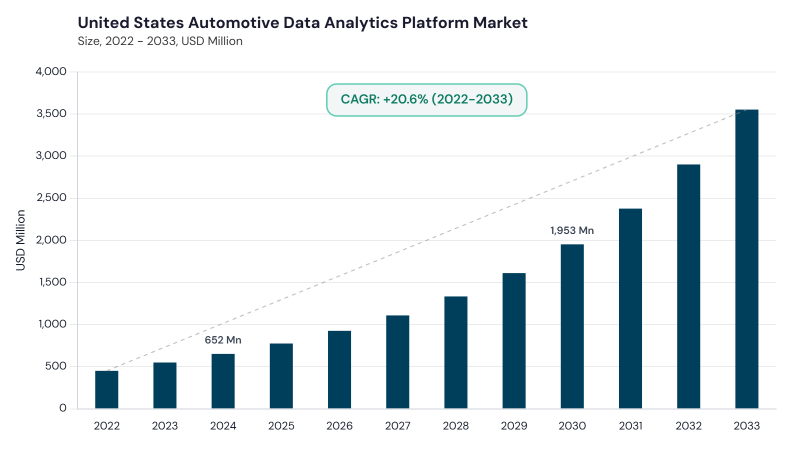
Automotive data analytics platforms in North America evolved from basic telematics and post-sale diagnostic systems into integrated environments supporting real-time vehicle, fleet, manufacturing, and customer intelligence. Growth in connected vehicles, onboard sensors, cloud computing, and large-scale data processing enabled the transition from reactive maintenance toward predictive analytics and operational optimization. AI and machine learning further expanded platform capabilities across sensor fusion, autonomous vehicle telemetry, driver behavior, and supply-chain analysis. The market now supports multi-source data integration across OEMs, suppliers, insurers, fleets, dealerships, and mobility providers.
Electrification, connected vehicles, AI, cloud adoption, and regulatory requirements are reshaping regional platform development. Growing electric vehicle adoption is increasing demand for battery health, range, charging, and energy-management analytics, while connected ecosystems generate expanding volumes of structured and unstructured data. AI, machine learning, edge computing, and 5G are improving predictive maintenance and real-time decision-making. At the same time, data privacy, cybersecurity, interoperability, and regulatory reporting requirements are encouraging stronger governance and secure data-sharing frameworks.
Based on Data Type, the market is segmented into Structured Data and Unstructured Data. The Structured Data market dominated the North America Automotive Data Analytics Platform Market by Data Type in 2025, and would continue to be a dominant market till 2033; thereby, achieving a market value of USD 2.3 billion by 2032, growing at a CAGR of 21.1 % during the forecast period. The Unstructured Data market is expected to witness a CAGR of 23.3% during (2026 - 2033).
Structured Data supports predictive maintenance, fleet management, warranty analysis, vehicle diagnostics, and operational optimization because standardized formats enable rapid processing and integration. Increasing connected vehicle and IoT deployment is expanding structured datasets related to battery health, vehicle performance, software status, and regulatory compliance. Unstructured Data includes video, images, voice inputs, sensor streams, service notes, and other complex information requiring AI, computer vision, and natural language processing. Its importance is increasing with ADAS, autonomous driving, smart infotainment, and advanced manufacturing inspection applications.
Based on Vehicle Type, the market is segmented into Non-autonomous Vehicles and Autonomous Vehicles. The Non-autonomous Vehicles market dominated the North America Automotive Data Analytics Platform Market by Vehicle Type in 2025, and would continue to be a dominant market till 2033; thereby, achieving a market value of USD 2.5 billion by 2032, growing at a CAGR of 21.7 % during the forecast period. The Autonomous Vehicles market is expected to witness a CAGR of 22.6% during (2026 - 2033).
Non-autonomous vehicle analytics support vehicle health monitoring, predictive maintenance, fuel efficiency, driver behavior, fleet operations, insurance applications, and connected services across passenger and commercial fleets. Cloud-based platforms help manage large distributed datasets while improving vehicle utilization and service efficiency. Autonomous Vehicles generate highly complex information from cameras, radar, LiDAR, positioning systems, and other sensors, requiring advanced analytics for perception, sensor fusion, simulation, validation, and decision monitoring. Edge-cloud architectures are increasingly important for processing safety-critical data with low latency.
Based on Component, the market is segmented into Software and Service. The Software market dominated the North America Automotive Data Analytics Platform Market by Component in 2025, and would continue to be a dominant market till 2033; thereby, achieving a market value of USD 2.7 billion by 2032, growing at a CAGR of 21.6 % during the forecast period. The Service market is expected to witness a CAGR of 22.9% during (2026 - 2033).
Software enables collection, integration, processing, visualization, and interpretation of automotive data across connected vehicles, manufacturing operations, fleets, dealerships, and supply chains. AI, machine learning, cloud platforms, and predictive algorithms are increasing software sophistication and supporting software-defined vehicle environments. Service includes consulting, system integration, deployment, customization, training, technical support, data migration, and managed analytics. Demand for services is rising as automotive organizations address legacy-system integration, cloud migration, cybersecurity, regulatory compliance, and increasingly complex analytics environments.
Based on Deployment, the market is segmented into Cloud and On-premise. Cloud platforms support real-time data ingestion, large-scale storage, AI analytics, connected vehicle services, predictive maintenance, fleet management, and geographically distributed automotive operations. Subscription and scalable deployment models also reduce infrastructure requirements while enabling continuous platform upgrades.
On-premise deployment remains relevant for proprietary engineering information, sensitive vehicle records, manufacturing data, autonomous vehicle validation, and workloads requiring tighter infrastructure control. Hybrid architectures are increasingly combining cloud scalability with on-premise or edge processing for security, latency, and compliance needs.
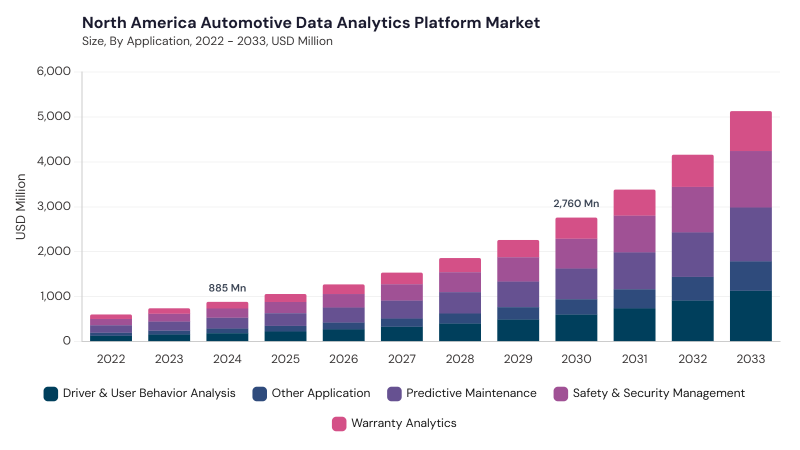
Based on Application, the market is segmented into Predictive Maintenance, Safety & Security Management, Driver & User Behavior Analysis, Warranty Analytics, and Other Application. Predictive Maintenance combines sensor information, telematics, repair histories, and AI models to identify potential component failures before breakdowns occur. Safety & Security Management supports vehicle monitoring, anomaly detection, cybersecurity, ADAS, and risk assessment, while Driver & User Behavior Analysis enables telematics-based scoring, fleet safety, personalization, and insurance applications.
Warranty Analytics helps identify recurring defects, evaluate component reliability, improve claims management, and control after-sales costs. Other Application includes supply-chain optimization, inventory planning, customer intelligence, EV energy analysis, mobility optimization, product development, and regulatory monitoring.
Free Valuable Insights: The Global Automotive Data Analytics Platform Market will hit USD 15.3 Billion billion by 2033, at a CAGR of 22.7%
Based on Country, the market is segmented into US, Canada, Mexico, and Rest of North America. The US market dominated the North America Automotive Data Analytics Platform Market by Country in 2025, and would continue to be a dominant market till 2033; thereby, achieving a market value of USD 2.9 billion by 2032, growing at a CAGR of 21.2 % during the forecast period. The Canada market is expected to witness a CAGR of 24.1% during (2026 - 2033). Additionally, The Mexico market is expected to witness a CAGR of 23.3% during (2026 - 2033).
Across North America, automotive analytics adoption is being shaped by connected vehicles, AI, electrification, cloud infrastructure, data interoperability, and cybersecurity requirements. The US is advancing AI-enabled analytics, vehicle-data monetization, cloud platforms, interoperable data frameworks, and secure connected-vehicle ecosystems, while Canada is emphasizing AI-IoT integration, dealership analytics, real-time processing, localized solutions, and stronger data security. Mexico is expanding analytics across vehicle manufacturing, EV production, predictive supply-chain management, IoT-enabled factories, and localized cloud infrastructure. Rest of North America is progressing through AI, edge analytics, software-defined vehicles, fleet intelligence, secure data integration, and scalable cloud-based platforms.

By Data Type
By Component
By Vehicle Type
By Deployment
By Application
By Country
Set to reach $4.1 Billion by 2032, growing at 22% CAGR during 2026-2033.
The US leads with $2.9 billion by 2032, growing at 21.2% CAGR during the forecast period.
Rising enterprise cloud adoption and AI-driven workloads are the main catalysts.
Structured Data reaches $2.3 billion by 2032, growing at 21.1% CAGR during the forecast period.
The Canada market is expected to witness a CAGR of 24.1% during 2026-2033.
Software component achieves $2.7 billion by 2032, growing at 21.6% CAGR during the forecast period.
Our team of dedicated experts can provide you with attractive expansion opportunities for your business.




 Unique Offerings