The sample copy of this report is available for access.
The North America AI Avatar Market is expected to reach USD 1961.4 million by 2032, growing at a CAGR of 31.6% during (2026 - 2033).
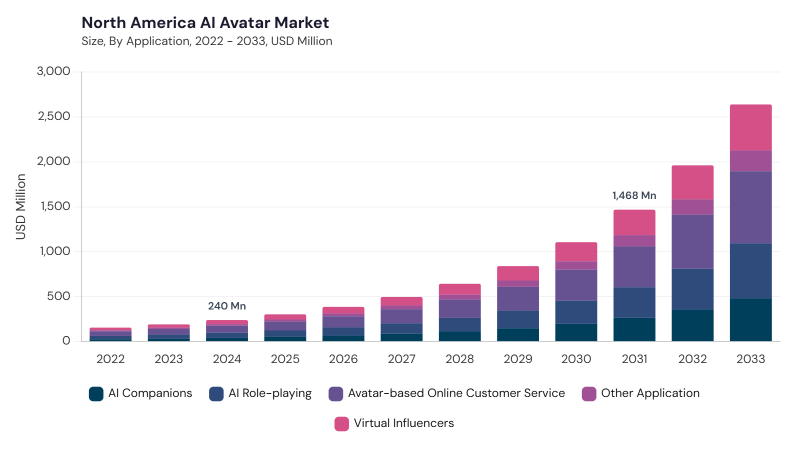
The North America AI Avatar Market evolved from basic graphical personas used primarily in gaming and virtual environments into sophisticated digital agents capable of realistic, responsive, and personalized interactions. Advances in artificial intelligence, machine learning, natural language processing, computer vision, speech synthesis, and deep learning transformed static avatars into dynamic digital entities with contextual and emotional capabilities. Expanding cloud and GPU infrastructure further improved real-time performance and scalability. AI avatars are now deployed across customer service, marketing, education, entertainment, healthcare, virtual collaboration, and immersive digital environments.
Generative AI, hyper-personalization, immersive digital experiences, enterprise automation, and responsible AI practices are shaping current market development. Businesses increasingly deploy avatars that adapt to user preferences, emotional cues, language, and interaction history while functioning across web, mobile, AR, VR, and enterprise environments. Multimodal AI, real-time rendering, affective computing, cloud infrastructure, and edge processing are strengthening avatar realism and responsiveness. At the same time, privacy, synthetic identity misuse, deepfake risks, transparency, consent management, and regulatory compliance are encouraging stronger governance and security frameworks.
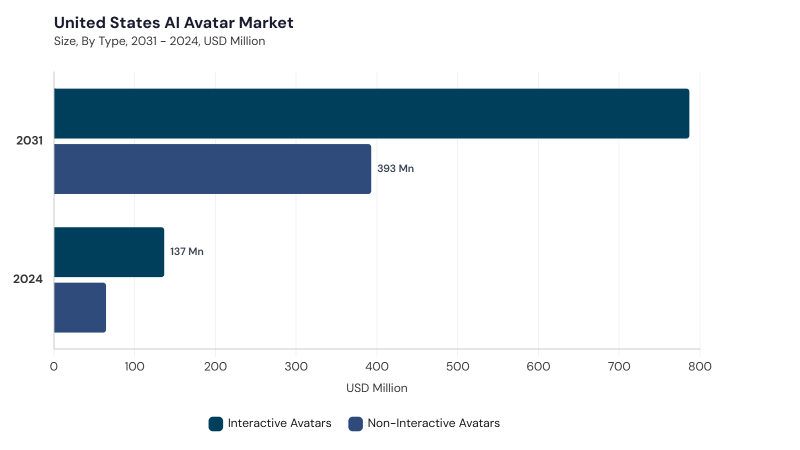
Based on Type, the market is segmented into Interactive Avatars and Non-Interactive Avatars. The Interactive Avatars market dominated the North America AI Avatar Market by Type in 2025, and would continue to be a dominant market till 2033; thereby, achieving a market value of USD 1306.9 million by 2032, growing at a CAGR of 31.2 % during the forecast period. The Non-Interactive Avatars market is expected to witness a CAGR of 32.3% during (2026 - 2033).
Interactive Avatars provide real-time communication through natural language processing, voice recognition, contextual understanding, gesture interpretation, and adaptive responses. They are increasingly used as virtual customer-service agents, learning assistants, digital brand representatives, interactive trainers, and personalized virtual assistants. Non-Interactive Avatars primarily provide scripted, visual, informational, or branding functions across websites, gaming platforms, digital events, and virtual environments. Their relatively lower computational requirements and simpler deployment make them suitable for organizations seeking digital representation without continuous conversational interaction.
Based on Platform, the market is segmented into Digital Humans, Stylized Avatars, and 3D & Metaverse Avatars. The Digital Humans market dominated the North America AI Avatar Market by Platform in 2025, and would continue to be a dominant market till 2033; thereby, achieving a market value of USD 884.2 million by 2032, growing at a CAGR of 30.9 % during the forecast period. The Stylized Avatars market is expected to witness highest CAGR of 32.2% during (2026 - 2033).
Digital Humans combine realistic human appearance, speech, gestures, conversational AI, and behavioral responses for customer service, healthcare, financial services, retail, entertainment, and virtual assistance. Stylized Avatars use artistic or animated visual formats and are increasingly adopted across gaming, social media, creator platforms, advertising, virtual influencers, and branded experiences because of their flexibility and customization potential. 3D & Metaverse Avatars support immersive virtual worlds, augmented reality, virtual reality, spatial computing, digital commerce, and enterprise collaboration, benefiting from advancements in motion capture, facial tracking, real-time rendering, and AI-generated animation.
Based on Application, the market is segmented into Avatar-based Online Customer Service, AI Role-playing, Virtual Influencers, AI Companions, and Other Application. Avatar-based Online Customer Service uses AI avatars as virtual receptionists, digital help-desk agents, interactive assistants, and customer-support representatives offering scalable and personalized engagement. AI Role-playing supports gaming, simulation, training, education, and scenario-based experiences requiring contextual and adaptive digital characters.
Virtual Influencers provide digitally controlled brand personalities for social media, advertising, fashion, entertainment, and content marketing. AI Companions focus on personalized interaction, emotional engagement, wellness support, and cognitive assistance, while Other Application includes virtual event hosting, remote collaboration, personalized advertising, and emerging immersive digital experiences.
Based on Verticals, the market is segmented into Media & Entertainment, Retail & E-commerce, BFSI, IT & Telecommunication, Education, Healthcare, Hospitality & Tourism, and Other Verticals. Media & Entertainment utilizes AI avatars for gaming, virtual influencers, content creation, interactive broadcasting, and digital storytelling, while Retail & E-commerce deploys virtual shopping assistants and personalized sales representatives. BFSI adopts avatars for customer service, financial guidance, claim support, and digitally assisted interactions, with strong emphasis on security and compliance.
IT & Telecommunication uses avatars for technical support and automated service delivery, while Education applies virtual tutors and interactive learning companions. Healthcare focuses on patient engagement, consultation support, wellness, and therapy adherence, whereas Hospitality & Tourism uses virtual concierges and travel assistants. Other Verticals include manufacturing, automotive, real estate, public services, and specialized enterprise applications.
Free Valuable Insights: The Global AI Avatar Market will hit USD 6988.8 Million billion by 2033, at a CAGR of 32.2%
Based on Country, the market is segmented into US, Canada, Mexico, and Rest of North America. The US market dominated the North America AI Avatar Market by Country in 2025, and would continue to be a dominant market till 2033; thereby, achieving a market value of USD 1566.5 million by 2032, growing at a CAGR of 30.8 % during the forecast period. The Canada market is expected to witness a CAGR of 35.4% during (2026 - 2033). Additionally, The Mexico market is expected to witness a CAGR of 33.9% during (2026 - 2033).
Across North America, AI avatar adoption is being shaped by generative AI, multimodal interaction, localization, enterprise automation, immersive technology, and stronger governance requirements. The US emphasizes hyper-personalized avatars, multimodal AI, neural rendering, secure deployment, and enterprise integration, while Canada focuses on culturally and linguistically adaptive avatars, ethical AI, cloud scalability, hybrid work, and immersive learning. Mexico is advancing affordable SME-oriented solutions, HR applications, localized Spanish-language interaction, nearshoring-supported infrastructure, and secure digital deployment, whereas Rest of North America emphasizes multilingual avatars, real-time generation, emotional intelligence, edge computing, cross-industry adoption, and culturally relevant digital experiences.

By Type
By Platform
By Application
By Vertical
By Country
Set to reach $1961.4 Million by 2032, growing at 31.6% CAGR during 2026-2033.
The US leads with $1566.5 million by 2032, growing at 30.8% CAGR during 2026-2033.
Rising enterprise cloud adoption and AI-driven workloads are the main catalysts.
Interactive Avatars will reach $1306.9 million by 2032, growing at 31.2% CAGR during 2026-2033.
Canada is expected to witness a CAGR of 35.4% during 2026-2033.
Digital Humans will reach $884.2 million by 2032, growing at 30.9% CAGR during 2026-2033.
Our team of dedicated experts can provide you with attractive expansion opportunities for your business.




 Unique Offerings