The sample copy of this report is available for access.
“Global AI Avatar Market to reach a market value of USD 6,988.77 Million by 2033 growing at a CAGR of 32.2%”
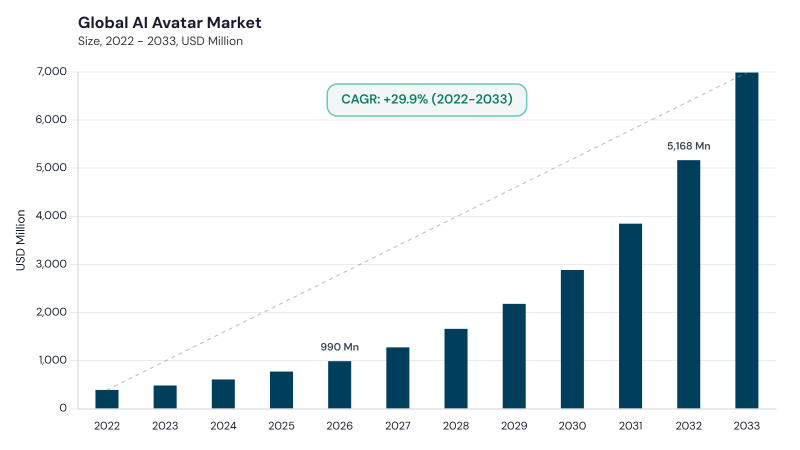
The Global AI Avatar Market is expected to reach USD 6988.8 million by 2033, growing at a CAGR of 32.2% during (2026 - 2033).
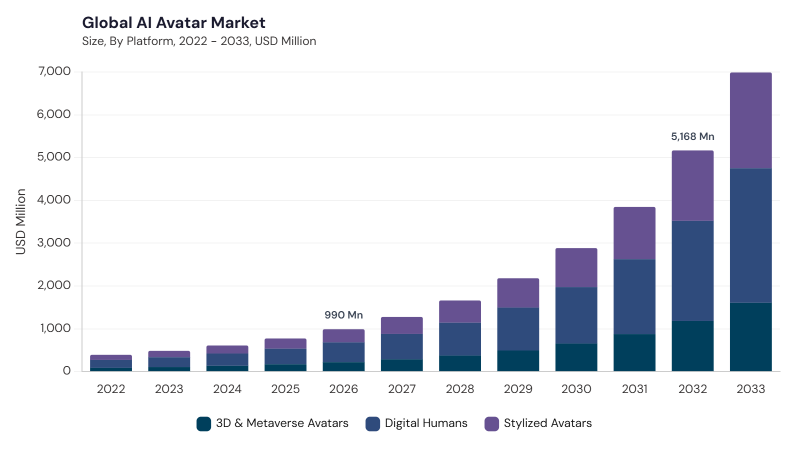
Growing demand for personalized digital experiences, automated customer engagement, virtual content creation, interactive communication, multilingual video generation, and cost-efficient digital production is accelerating adoption of AI avatars across media, entertainment, education, healthcare, retail, gaming, hospitality, BFSI, and enterprise applications. Advancements in generative AI, real-time animation, text-to-speech, facial synthesis, conversational AI, augmented reality, and virtual reality are further expanding market capabilities.
Growth in the AI Avatar Market is supported by the shift from traditional digital interfaces toward more human-like, personalized, and scalable interaction models. Enterprises are using AI avatars to automate customer engagement, reduce dependence on conventional video production, localize content across languages, and improve user experience across digital channels. At the same time, creators and brands are adopting avatars for social content, product demonstrations, virtual influencers, digital twins, and personalized video communication. Rising concerns around deepfakes, identity misuse, consent, and content provenance are also increasing demand for secure and responsible avatar platforms.
The competitive environment is innovation-led and generative-AI-driven, with specialized AI video platforms, digital human providers, enterprise avatar vendors, and conversational avatar developers competing across realism, customization, language support, latency, integration, pricing, and responsible AI governance. Companies are differentiating through digital twins, expressive full-body avatars, real-time conversational interfaces, avatar APIs, voice cloning, multilingual video translation, stock avatar libraries, and workflow integration. Future competition will increasingly depend on the ability to combine high visual fidelity with trust, consent management, watermarking, security controls, enterprise integration, and scalable content creation.
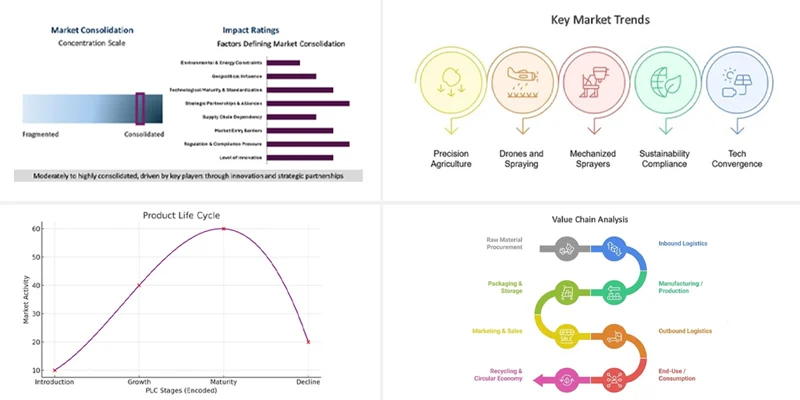

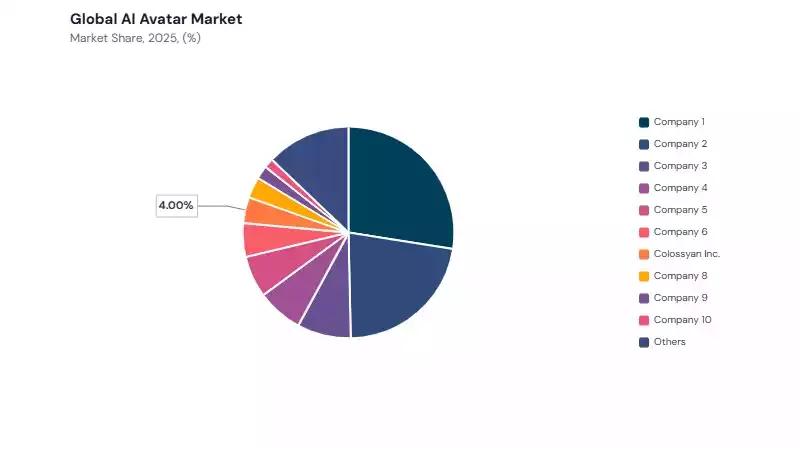
The global AI Avatar Market reflects a relatively consolidated and generative-AI-led competitive landscape, with specialized AI video platforms, digital-human solution providers, creator-focused tools, and conversational avatar developers competing across enterprise and consumer-facing use cases. Synthesia and HeyGen maintain strong leadership through enterprise video generation, digital presenter libraries, multilingual workflows, custom avatars, and scalable content creation. AKOOL, D-ID, Mirage, DeepBrain AI, Colossyan, Tavus, Hour One, and Vidnoz strengthen the market through real-time digital humans, conversational interfaces, digital twins, creator-led workflows, learning-focused avatars, APIs, and broad self-service video tools. Competitive positioning is increasingly shaped by realism, responsiveness, language localization, identity consistency, workflow integration, trust controls, and responsible synthetic-media deployment.
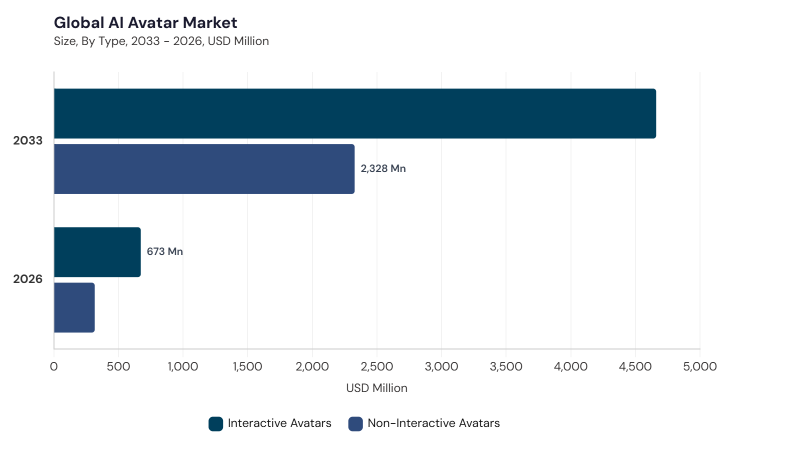
Based on Type, the market is segmented into Interactive Avatars and Non-Interactive Avatars. The Interactive Avatars market dominated the Global AI Avatar Market by Type in 2025, and would continue to be a dominant market till 2033; thereby, achieving a market value of USD 4660.9 million by 2033, growing at a CAGR of 31.8 % during the forecast period. The Non-Interactive Avatars market is expected to witness a CAGR of 33% during (2026 - 2033).
Interactive Avatars are gaining importance as enterprises and platforms seek real-time, conversational, and adaptive digital humans capable of responding to users through voice, text, facial behavior, and contextual understanding. These avatars support customer service, education, training, virtual assistance, sales engagement, healthcare communication, and digital companionship. Non-Interactive Avatars continue to serve scripted video production, branded content, virtual presenters, marketing campaigns, and informational digital representation. Both types are shaped by avatar realism, deployment cost, responsiveness, data governance, and the need to balance scalable automation with user trust.
Based on Platform, the market is segmented into Digital Humans, Stylized Avatars, and 3D & Metaverse Avatars. The Digital Humans market dominated the Global AI Avatar Market by Platform in 2025, and would continue to be a dominant market till 2033; thereby, achieving a market value of USD 3146.0 million by 2033, growing at a CAGR of 31.5 % during the forecast period. The Stylized Avatars market is expected to witness highest CAGR of 32.8% during (2026 - 2033).
Digital Humans focus on realistic appearance, speech, gestures, and behavioral response, making them suitable for customer engagement, virtual consulting, enterprise training, healthcare communication, and branded digital presentation. Stylized Avatars support creative, animated, and character-led experiences across gaming, social media, creator platforms, virtual influencers, and marketing campaigns. 3D & Metaverse Avatars are used in immersive environments, virtual worlds, AR/VR platforms, digital commerce, entertainment, and collaboration spaces. Platform adoption is influenced by visual realism, customization flexibility, computing requirements, interoperability, and the user experience expected in each environment.
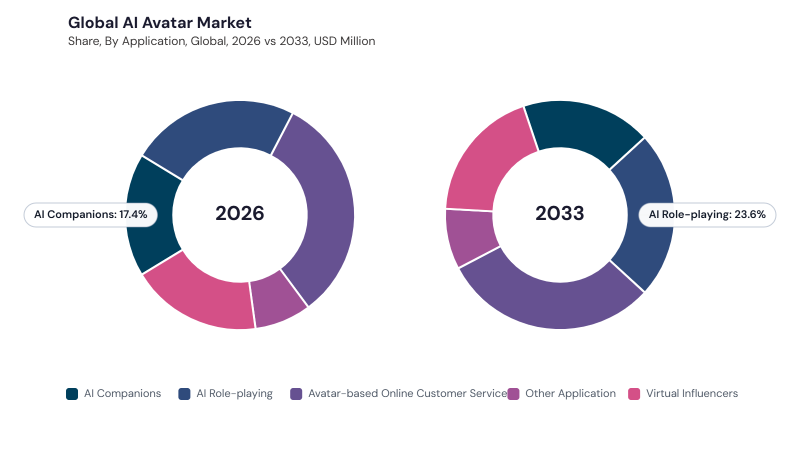
Based on Application, the market is segmented into Avatar-based Online Customer Service, AI Role-playing, Virtual Influencers, AI Companions, and Other Application. The Avatar-based Online Customer Service market dominated the Global AI Avatar Market by Application in 2025, and would continue to be a dominant market till 2033; thereby, achieving a market value of USD 2134.0 million by 2033, growing at a CAGR of 31.2 % during the forecast period. The AI Role-playing market is expected to witness a CAGR of 31.9% during (2026 - 2033). Additionally, The Virtual Influencers market is expected to witness highest CAGR of 32.7% during (2026 - 2033).
Avatar-based Online Customer Service is expanding as companies use virtual agents to offer responsive, branded, and scalable support across websites, apps, and digital channels. AI Role-playing supports gaming, simulation, training, education, storytelling, and scenario-based learning where adaptive characters improve immersion. Virtual Influencers are being used for social media campaigns, brand storytelling, lifestyle content, and controlled digital promotion. AI Companions support social interaction, wellness, personal assistance, and emotionally responsive engagement, while Other Application includes virtual events, HR assistants, tutoring, recruitment, enterprise communication, and specialized digital interaction use cases.
Based on Vertical, the market is segmented into Media & Entertainment, Retail & E-commerce, BFSI, IT & Telecommunication, Education, Healthcare, Hospitality & Tourism, and Other Verticals. The Media & Entertainment market dominated the Global AI Avatar Market by Vertical in 2025, and would continue to be a dominant market till 2033; thereby, achieving a market value of USD 1309.2 million by 2033, growing at a CAGR of 29.4 % during the forecast period. The Retail & E-commerce market is expected to witness a CAGR of 30.7% during (2026 - 2033). Additionally, The BFSI market is expected to witness highest CAGR of 31.5% during (2026 - 2033).
Media & Entertainment uses AI avatars for virtual influencers, gaming characters, synthetic video, digital presenters, and immersive content creation. Retail & E-commerce adopts avatars for virtual sales assistance, product demonstrations, personalized recommendations, and customer support. BFSI uses avatars for digital onboarding, financial guidance, service automation, and secure customer interaction, while IT & Telecommunication uses them for technical support, helpdesk automation, and user education. Education applies avatars as tutors, mentors, and training assistants; Healthcare uses them for patient engagement, telehealth support, mental wellness, and care guidance; Hospitality & Tourism uses them as virtual concierges, travel assistants, and multilingual service agents, while Other Verticals include real estate, public services, manufacturing, legal services, and enterprise workflows.
Free Valuable Insights: AI Avatar Market Size to reach $6988.8 Million by 2033
Region-wise, the AI Avatar Market is analyzed across North America, Europe, Asia Pacific, and LAMEA. The North America market dominated the Global AI Avatar Market by Region in 2025, and would continue to be a dominant market till 2033; thereby, achieving a market value of USD 2639.0 million by 2033, growing at a CAGR of 31.6 % during the forecast period. The Asia Pacific market is expected to witness a CAGR of 32.9% during (2026 - 2033). Additionally, The Europe market is expected to witness a CAGR of 31.9% during (2026 - 2033).
North America remains a major market due to strong generative AI investment, enterprise digital transformation, creator economy growth, advanced cloud infrastructure, and early adoption of AI video and digital-human platforms. Europe is shaped by demand for responsible AI, multilingual localization, immersive experiences, enterprise automation, and regulatory-compliant avatar deployment. Asia Pacific is expanding through gaming, social media, mobile-first content creation, e-commerce, digital education, and localized AI-avatar adoption across large consumer markets. LAMEA is gradually developing as digital transformation, online retail, remote services, AI education tools, and localized virtual engagement gain broader adoption.
| Report Attribute | Details |
|---|---|
| Market size value in 2026 | USD 989.9 million |
| Market size forecast in 2033 | USD 6988.8 million |
| Base Year | 2025 |
| Historical Period | 2022 to 2024 |
| Forecast Period | 2026 to 2033 |
| Revenue Growth Rate | CAGR of 32.2% from 2026 to 2033 |
| Number of Pages | 692 |
| Tables | 900 |
| Report Coverage | Market Trends, Revenue Estimation and Forecast, Segmentation Analysis, Regional and Country Breakdown, Competitive Landscape, Market Share Analysis, Company Profiling, Companies Strategic Developments, SWOT Analysis, Product Life Cycle Analysis, Value Chain Analysis, Market Consolidation Analysis, Key Customer Criteria, Pandemic Impact Analysis, and Winning Imperatives |
| Segments Covered | Type, Platform, Application, Vertical, and Geography |
| Country Scope |
|
| Companies Included | Synthesia; HeyGen; AKOOL; D-ID; Mirage; DeepBrain AI; Colossyan; Tavus; Hour One; Vidnoz |
By Type
By Platform
By Application
By Vertical
By Geography
The market is expected to reach USD 6988.8 million by 2033, with a 32.2% CAGR during 2026-2033.
The market is growing at a 32.2% CAGR during the forecast period (2026-2033).
Synthesia, HeyGen, AKOOL, D-ID, Mirage, DeepBrain AI, Colossyan, Tavus, Hour One, and Vidnoz are key players.
Rapid integration in digital communication and advancements in generative AI are key growth drivers.
North America is expected to dominate, driven by technological advancements and high adoption rates.
Advancements in real-time avatar synthesis technologies are contributing to market growth.
Our team of dedicated experts can provide you with attractive expansion opportunities for your business.








 Unique Offerings