The sample copy of this report is available for access.
The North America Aerial Work Platform Truck Market is expected to reach USD 6.9 billion by 2032, growing at a CAGR of 6% during (2026 – 2033).
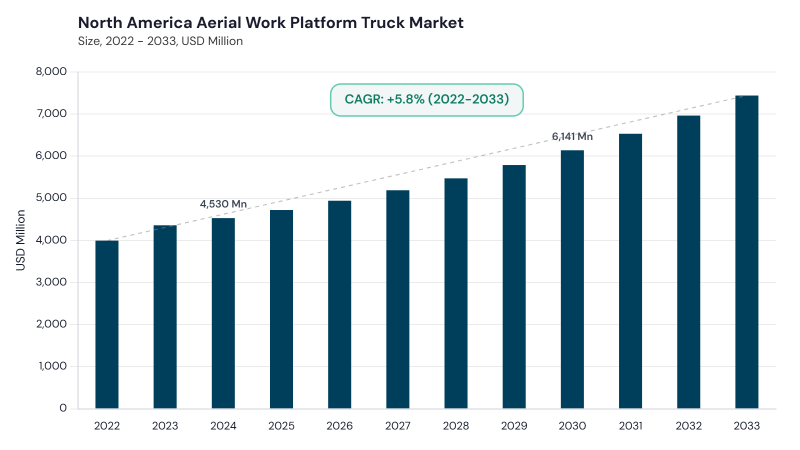
Growing requirements for safe elevated access in construction, utility maintenance, and infrastructure activities shaped the early development of aerial work platform trucks in North America. Initial equipment relied on basic truck-mounted hydraulic lifts before telescoping booms, articulating arms, stabilization systems, and improved load capacities expanded operational capabilities. Progress in hydraulic engineering and control technology enhanced maneuverability and worker safety in complex job environments.
Environmental priorities and digitally connected fleet operations are redefining equipment requirements throughout North American aerial access applications. Electric and hybrid platforms are gaining importance as fleet operators respond to emissions requirements, fuel costs, and sustainability objectives. IoT sensors, telematics, predictive maintenance, and real-time equipment monitoring are improving asset availability and operational safety. At the same time, demand for greater working heights, extended outreach, compact footprints, and multifunctional configurations is encouraging development of platforms suited to high-rise construction, urban utility work, emergency response, and other demanding elevated-access tasks.
Based on Product, the market is segmented into Boom Lifts, Scissor Lifts, Vertical Mast Lifts, and Personnel Portable Lifts. The Boom Lifts market dominated the North America Aerial Work Platform Truck Market by Product in 2025, and would continue to be a dominant market till 2033; thereby, achieving a market value of USD 2.9 billion by 2032, growing at a CAGR of 5.4 % during the forecast period. The Scissor Lifts market is expected to witness a CAGR of 6.4% during (2026 - 2033). Additionally, The Vertical Mast Lifts market is expected to witness highest CAGR of 6.9% during (2026 - 2033).
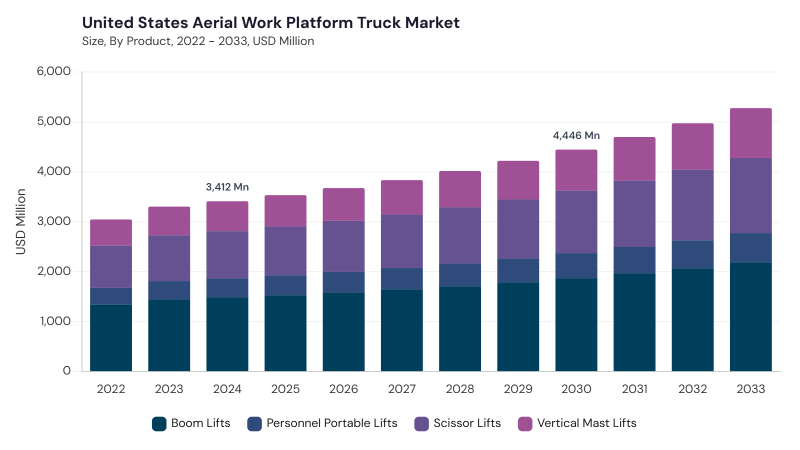
Boom Lifts lead due to their extended working height, horizontal outreach, and versatility across construction, utilities, and infrastructure maintenance. Scissor Lifts provide stable vertical elevation and higher platform capacity for warehouses, facility maintenance, and indoor construction. Vertical Mast Lifts address confined work areas through compact dimensions and maneuverability, while Personnel Portable Lifts support light-duty inspection, repair, and maintenance activities where portability, quick deployment, and operational simplicity are important.
Based on End-Use, the market is segmented into Construction, Telecommunication, Transport & Logistics, Government, and Other End-Use. Construction leads as commercial development, residential projects, renovation, and infrastructure modernization require safe and flexible access to elevated work areas. Telecommunication applications are supported by network deployment, fiber infrastructure, tower installation, and maintenance requirements.
Transport & Logistics uses aerial platforms for warehouse, airport, distribution center, and facility servicing, while Government deployment includes public infrastructure maintenance, utility services, municipal operations, and emergency response. Other End-Use covers manufacturing, energy, entertainment, facility management, and agriculture applications.
Free Valuable Insights: The Global Aerial Work Platform Truck Market will hit USD 21.4 Billion billion by 2033, at a CAGR of 6.6%
Based on Country, the market is segmented into US, Canada, Mexico, and Rest of North America. The US market dominated the North America Aerial Work Platform Truck Market by Country in 2025, and would continue to be a dominant market till 2033; thereby, achieving a market value of USD 4.9 billion by 2032, growing at a CAGR of 5.3 % during the forecast period. The Canada market is expected to witness a CAGR of 8% during (2026 - 2033). Additionally, The Mexico market is expected to witness a CAGR of 7.3% during (2026 - 2033).
The US reflects a mature aerial access environment where electrification, IoT-enabled telematics, intelligent controls, modular configurations, and advanced safety systems are increasingly influencing equipment development. Canadian demand is shaped by electric and low-emission platforms, digital fleet management, rental-oriented access models, strong safety requirements, and equipment suited to varied climatic conditions. Mexico is progressing through cleaner powertrains, telematics-based monitoring, compact platform designs, and localized service capabilities supporting construction, utilities, and communications activities. Rest of North America is increasingly influenced by hybrid and electric technologies, predictive maintenance, advanced stability systems, connected fleet solutions, and regulatory emphasis on safer elevated work operations.

By Product
By End-Use
By Country
Set to reach $6.9 Billion by 2032, growing at 6% CAGR during 2026-2033.
The US leads with $4.9 billion by 2032, growing at a CAGR of 5.3% during the forecast period.
Boom Lifts dominate, reaching $2.9 billion by 2032 with a 5.4% CAGR during the forecast period.
Scissor Lifts are expected to grow at a 6.4% CAGR during 2026-2033.
Canada is expected to witness a CAGR of 8% during 2026-2033.
Vertical Mast Lifts are expected to witness the highest CAGR of 6.9% during 2026-2033.
Our team of dedicated experts can provide you with attractive expansion opportunities for your business.




 Unique Offerings