The sample copy of this report is available for access.
The LAMEA Aerial Work Platform Truck Market is expected to reach USD 1531.7 million by 2029, growing at a CAGR of 8.1% during (2026 – 2033).
Evolving construction practices and increasingly complex infrastructure requirements have gradually transformed elevated-access equipment across Latin America, the Middle East, and Africa. Early applications relied largely on basic forklift and crane adaptations before hydraulic technology and truck-mounted configurations improved mobility, working height, and load-handling capability. Greater attention to operator ergonomics, electronic controls, and safety standards subsequently encouraged specialized platform development. Hybrid powertrains, advanced control systems, and customized configurations now support applications across construction, utilities, industrial maintenance, and infrastructure projects operating under widely varying terrain and climatic conditions.
Changing procurement priorities throughout LAMEA increasingly favor cleaner propulsion, digital equipment intelligence, and application-specific adaptability. Electric and hybrid platforms are becoming more relevant as sustainability requirements and emissions considerations influence fleet modernization. IoT-enabled monitoring, remote controls, telemetry, and predictive maintenance are strengthening equipment utilization while supporting safer operations. At the same time, the region’s varied urban, rural, industrial, and off-road environments are encouraging modular platforms, enhanced mobility features, and localized configurations capable of addressing different infrastructure conditions and regulatory requirements.
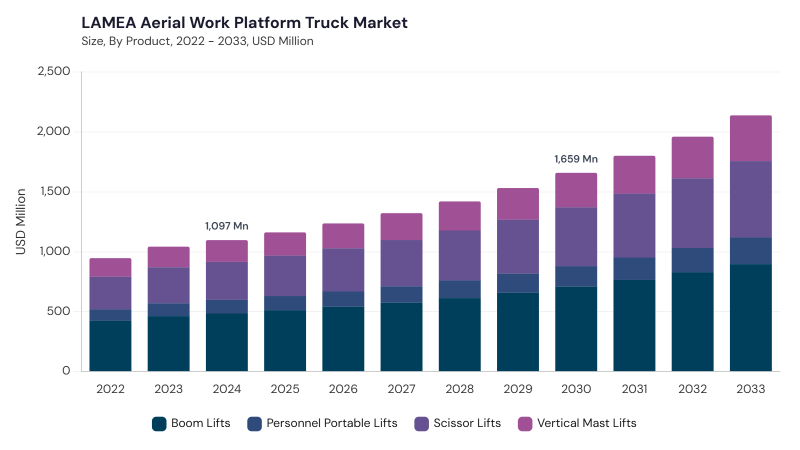
Based on Product, the market is segmented into Boom Lifts, Scissor Lifts, Vertical Mast Lifts, and Personnel Portable Lifts. The Boom Lifts market dominated the LAMEA Aerial Work Platform Truck Market by Product in 2025, and would continue to be a dominant market till 2033; thereby, achieving a market value of USD 657.9 million by 2029, growing at a CAGR of 7.5 % during the forecast period. The Scissor Lifts market is expected to witness a CAGR of 8.5% during (2026 - 2033). Additionally, The Vertical Mast Lifts market is expected to witness highest CAGR of 9.1% during (2026 - 2033).
Boom Lifts are extensively suited to infrastructure development, oil & gas facilities, commercial construction, utility maintenance, bridges, and other applications requiring substantial vertical and horizontal outreach. Scissor Lifts provide stable vertical access in warehouses, manufacturing facilities, airports, and commercial buildings. Vertical Mast Lifts address confined spaces across healthcare facilities, retail complexes, industrial plants, and maintenance environments, while Personnel Portable Lifts serve offices, educational facilities, hotels, public buildings, and other light-duty inspection and installation activities.
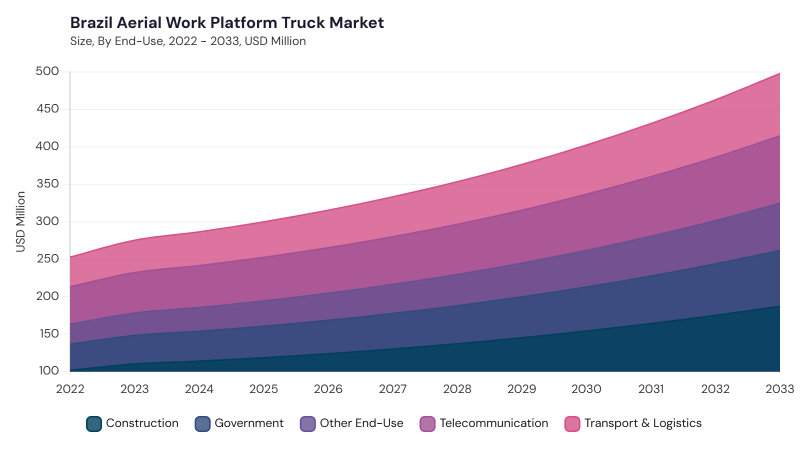
Based on End-Use, the market is segmented into Construction, Telecommunication, Transport & Logistics, Government, and Other End-Use. Construction demand is supported by urban infrastructure expansion, commercial real estate activity, transportation projects, and maintenance requirements where mechanized elevated access improves safety and productivity. Telecommunication applications benefit from mobile network expansion, fiber-optic deployment, and tower maintenance.
Transport & Logistics uses aerial platforms across warehouses, airports, ports, and related facilities, while Government deployment supports municipal infrastructure, street lighting, public utilities, and emergency response. Other End-Use extends to oil & gas, mining, event management, facility services, and other specialized applications requiring adaptable elevated-access equipment.
Free Valuable Insights: Aerial Work Platform Truck Market Size Worth USD 21.4 Billion billion by 2033
Based on Country, the market is segmented into Brazil, Argentina, UAE, Saudi Arabia, South Africa, Nigeria, and Rest of LAMEA. The Brazil market dominated the LAMEA Aerial Work Platform Truck Market by Country in 2025, and would continue to be a dominant market till 2033; thereby, achieving a market value of USD 376.4 million by 2029, growing at a CAGR of 6.7 % during the forecast period. The Argentina market is expected to witness a CAGR of 8.6% during (2026 - 2033). Additionally, The UAE market is expected to witness a CAGR of 7.1% during (2026 - 2033).
Brazil is progressing through electrification, multifunctional platform designs, and greater localization of manufacturing and support services, while Argentina is focusing on safety compliance, hybrid and electric powertrains, and maintenance-oriented solutions for cost-sensitive operations. The UAE is strengthening adoption through electric and hybrid fleet modernization, IoT-enabled monitoring, compact configurations, and designs suited to dense urban development and demanding climatic conditions. Saudi Arabia is emphasizing automation, remote controls, heat-resistant configurations, and sustainability-focused technologies aligned with large infrastructure and industrial projects. South Africa is adopting advanced safety features, telematics, electric and hybrid platforms, and localized service support across construction, mining, and infrastructure applications. Nigeria is developing through digital monitoring, advanced safety systems, localized assembly, telematics, and equipment adapted to uneven terrain.

By Product
By End-Use
By Country
Set to reach $1531.7 Million by 2029, growing at 8.1% CAGR during 2026-2033.
Brazil leads with $376.4 million by 2029, growing at 6.7% CAGR during the forecast period.
Boom Lifts segment dominates, reaching $657.9 million by 2029, at 7.5% CAGR during the forecast period.
Scissor Lifts segment to grow at 8.5% CAGR during 2026-2033.
The UAE market is expected to witness a CAGR of 7.1% during 2026-2033.
Vertical Mast Lifts market is expected to witness the highest CAGR of 9.1% during 2026-2033.
Our team of dedicated experts can provide you with attractive expansion opportunities for your business.




 Unique Offerings