The sample copy of this report is available for access.
The LAMEA Rack-Scale GPU Infrastructure Market is expected to reach USD 1250.0 million by 2029, growing at a CAGR of 35% during (2026 – 2033).
The LAMEA Rack-Scale GPU Infrastructure Market originated from the increasing need for high-performance computing solutions across Latin America, the Middle East, and Africa. Early adoption was limited by financial constraints and fragmented data center infrastructure, but GPU acceleration gradually gained relevance for large-scale data processing and AI workloads. The transition from single-unit GPUs to rack-scale systems enabled modular deployment, improved resource sharing, and scalable compute capacity. Advances in containerization, virtualization, disaggregated hardware, and software orchestration strengthened adoption across enterprise and cloud environments.
The LAMEA Rack-Scale GPU Infrastructure Market is being shaped by AI workload expansion, hyperscale cloud growth, energy-efficient computing, hybrid cloud deployment, data sovereignty requirements, and edge computing adoption. Organizations are adopting rack-scale GPU infrastructure to support AI model training, inference, real-time analytics, high-performance computing, cybersecurity, smart cities, telecom networks, and industrial digitalization. Demand is supported by cloud service providers, enterprises, government and research institutions, telecommunications providers, and edge infrastructure operators. Providers are focusing on modular GPU systems, high-bandwidth networking, cooling optimization, intelligent power management, cloud-native orchestration, and localized support.
Based on End User, the market is segmented into Cloud Service Providers, Enterprises, Government and Research Institutions, Telecommunications Providers, and Edge Infrastructure Operators. The Cloud Service Providers market dominated the LAMEA Rack-Scale GPU Infrastructure Market by End User in 2025, and would continue to be a dominant market till 2033; thereby, achieving a market value of USD 631.0 million by 2029, growing at a CAGR of 34.1 % during the forecast period. The Enterprises market is expected to witness a CAGR of 35.3% during (2026 - 2033). The Edge Infrastructure Operators market is expected to witness a CAGR of 37.9% during (2026 - 2033).
Cloud Service Providers lead due to increasing investments in regional data centers, AI-enabled cloud services, GPU-accelerated computing, and scalable digital infrastructure across Latin America, the Middle East, and Africa. These providers require resilient, modular, and efficient GPU architectures to support AI training, analytics, rendering, and high-performance cloud workloads. Enterprises remain significant as manufacturing, banking, retail, energy, healthcare, and telecom sectors adopt GPU systems for predictive analytics, fraud detection, process automation, and product design simulations. Government and Research Institutions support scientific computing, cybersecurity, defense, and national AI strategies, while Telecommunications Providers and Edge Infrastructure Operators deploy GPU infrastructure for 5G, edge AI, IoT, smart cities, and low-latency digital services.
Based on Solution Type, the market is segmented into Compute Systems, Networking Systems, Cooling Systems, and Power Delivery Systems. The Compute Systems market dominated the LAMEA Rack-Scale GPU Infrastructure Market by Solution Type in 2025, and would continue to be a dominant market till 2033; thereby, achieving a market value of USD 803.9 million by 2029, growing at a CAGR of 34.5 % during the forecast period. The Networking Systems market is expected to witness a CAGR of 35.4% during (2026 - 2033). Additionally, The Cooling Systems market is expected to witness highest CAGR of 36.4% during (2026 - 2033).
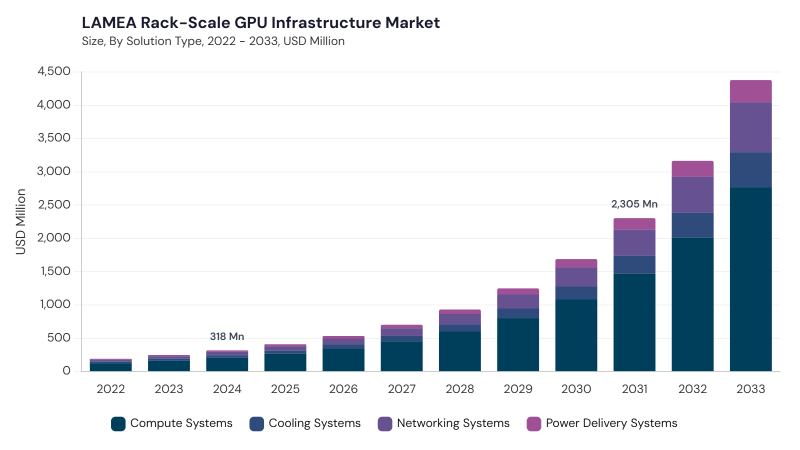
Compute Systems lead due to rising deployment of GPU-intensive infrastructure for AI applications, advanced analytics, scientific simulations, and high-performance computing across enterprise and cloud environments. These systems combine GPUs, CPUs, and integrated compute modules to deliver strong parallel processing for deep learning, inference, and real-time data workloads. Networking Systems remain significant as high-throughput interconnects, Ethernet, InfiniBand, NVLink, and software-defined networking support efficient communication between distributed GPU resources. Cooling Systems continue gaining importance as higher rack density increases thermal loads, while Power Delivery Systems support reliable energy supply, backup infrastructure, dynamic load balancing, and mission-critical uptime.
Based on Deployment Scale, the market is segmented into Cluster-Scale AI Factory, Multi-Rack Pod, and Single-Rack. The Cluster-Scale AI Factory market dominated the LAMEA Rack-Scale GPU Infrastructure Market by Deployment Scale in 2025, and would continue to be a dominant market till 2033; thereby, achieving a market value of USD 467.7 million by 2029, growing at a CAGR of 34.3 % during the forecast period. The Multi-Rack Pod market is expected to witness a CAGR of 35.2% during (2026 - 2033). Additionally, The Single-Rack market is expected to witness highest CAGR of 35.8% during (2026 - 2033).
Cluster-Scale AI Factory leads due to growing investments in hyperscale computing facilities, national AI initiatives, cloud infrastructure expansion, and high-throughput AI model training. These deployments aggregate large GPU resources across multiple racks to support deep learning, simulation, natural language processing, and large-scale analytics. Multi-Rack Pod remains significant as enterprises, regional cloud providers, and research organizations adopt modular infrastructure for distributed training, rendering, and scalable AI applications. Single-Rack deployments support compact GPU platforms for AI inference, engineering simulations, departmental computing, edge analytics, healthcare facilities, retail chains, and telecom edge nodes where space, cost, and deployment simplicity remain important.
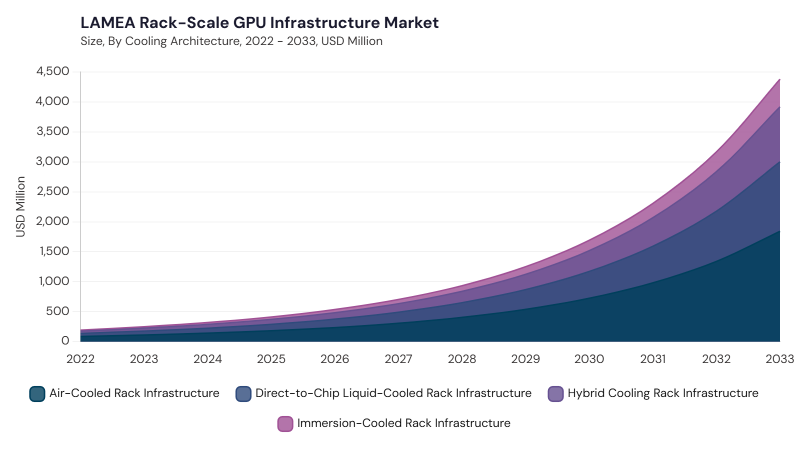
Based on Cooling Architecture, the market is segmented into Air-Cooled Rack Infrastructure, Direct-to-Chip Liquid-Cooled Rack Infrastructure, Hybrid Cooling Rack Infrastructure, and Immersion-Cooled Rack Infrastructure. Air-Cooled Rack Infrastructure leads due to cost-effectiveness, straightforward deployment, and compatibility with existing data center environments across enterprise and cloud facilities. This architecture remains relevant for low-to-moderate density deployments, early AI inference workloads, and facilities with limited modernization budgets.
Direct-to-Chip Liquid-Cooled Rack Infrastructure is gaining importance as operators seek better heat extraction, higher rack density, and improved energy performance for AI training and HPC workloads. Hybrid Cooling Rack Infrastructure supports gradual infrastructure modernization by combining air and liquid cooling, while Immersion-Cooled Rack Infrastructure is concentrated in advanced research facilities, pilot AI deployments, and next-generation data centers evaluating high-efficiency cooling technologies.
Free Valuable Insights: Rack-Scale GPU Infrastructure Market Size Worth USD 70.6 Billion billion by 2033
Based on Country, the market is segmented into Brazil, Argentina, UAE, Saudi Arabia, South Africa, Nigeria, and Rest of LAMEA. The UAE market dominated the LAMEA Rack-Scale GPU Infrastructure Market by Country in 2025, and would continue to be a dominant market till 2033; thereby, achieving a market value of USD 320.2 million by 2029, growing at a CAGR of 33.4 % during the forecast period. The Argentina market is expected to witness a CAGR of 36.3% during (2026 - 2033). Additionally, The Brazil market is expected to witness a CAGR of 34.1% during (2026 - 2033).
Brazil leads due to high-density AI infrastructure demand, data center expansion, localized power and thermal management, GPU virtualization, and growing AI adoption across finance, manufacturing, and research. Argentina supports market growth through modular GPU racks, hybrid deployment models, energy-efficient technologies, and increasing enterprise interest in scalable compute resources. The UAE contributes through government-led AI initiatives, data sovereignty requirements, onshore data centers, hybrid cloud infrastructure, and advanced cloud services. Saudi Arabia, South Africa, and Nigeria add momentum through digital transformation programs, smart city projects, energy-conscious GPU deployment, and localized AI infrastructure, while Rest of LAMEA benefits from edge AI, cloud adoption, modular GPU systems, and compliance-focused infrastructure.

By End User
By Solution Type
By Deployment Scale
By Cooling Architecture
By Country
Set to reach $1250.0 Million by 2029, growing at 35% CAGR during 2026-2033.
The UAE leads with $320.2 million by 2029, growing at 33.4% CAGR during the forecast period.
Rising demand from cloud service providers, reaching $631.0 million by 2029 at 34.1% CAGR.
Compute Systems will reach $803.9 million by 2029, growing at 34.5% CAGR during the forecast period.
Brazil is expected to witness a CAGR of 34.1% during 2026-2033.
The Single-Rack market is expected to witness the highest CAGR of 35.8% during 2026-2033.
Our team of dedicated experts can provide you with attractive expansion opportunities for your business.




 Unique Offerings