The sample copy of this report is available for access.
The Asia Pacific Rack-Scale GPU Infrastructure Market is expected to reach USD 9.1 billion by 2030, growing at a CAGR of 33.5% during (2026 – 2033).
The Asia Pacific Rack-Scale GPU Infrastructure Market originated from the growing computational demands of advanced AI, high-performance computing, and data-intensive applications across the region. Early development focused on modular GPU integration within data centers to overcome inefficiencies in conventional server architectures. As AI training, inference, and simulation workloads expanded, the market shifted from standalone GPU servers to rack-scale infrastructure with stronger scalability, workload distribution, and resource pooling. Generative AI advancement, sovereign AI investments, energy-efficiency needs, and data sovereignty requirements further accelerated adoption.
The Asia Pacific Rack-Scale GPU Infrastructure Market is being shaped by hyperscale data center growth, AI-as-a-Service, localized AI compute demand, energy-efficient GPU architectures, advanced cooling, and containerized GPU virtualization. Organizations are adopting rack-scale GPU infrastructure to support generative AI, deep learning, high-performance computing, cloud-native applications, smart city platforms, autonomous systems, and advanced analytics. Demand is supported by cloud service providers, enterprises, government and research institutions, telecommunications providers, and edge infrastructure operators. Providers are focusing on high-density GPU servers, ultra-high-speed interconnects, modular deployment models, liquid cooling, sovereign infrastructure, and software-defined GPU resource management.
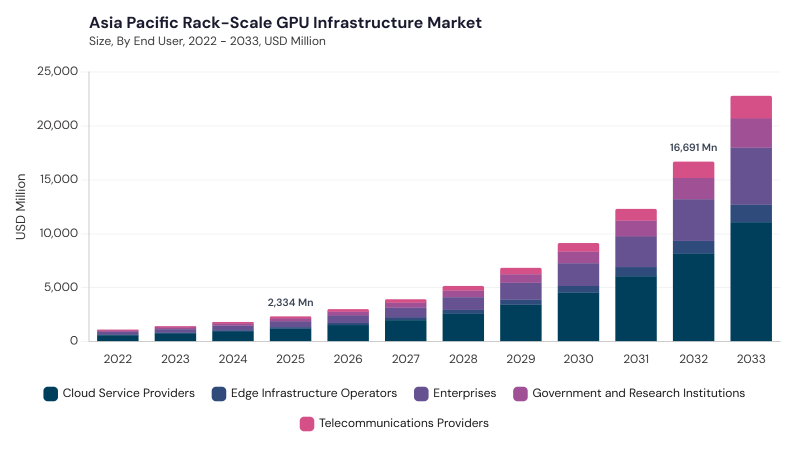
Based on End User, the market is segmented into Cloud Service Providers, Enterprises, Government and Research Institutions, Telecommunications Providers, and Edge Infrastructure Operators. The Cloud Service Providers market dominated the Asia Pacific Rack-Scale GPU Infrastructure Market by End User in 2025, and would continue to be a dominant market till 2033; thereby, achieving a market value of USD 4.5 billion by 2030, growing at a CAGR of 32.6 % during the forecast period. The Enterprises market is expected to witness a CAGR of 33.8% during (2026 - 2033). The Edge Infrastructure Operators market is expected to witness a CAGR of 35.7% during (2026 - 2033).
Cloud Service Providers lead due to rapid hyperscale data center expansion, AI cloud service investments, generative AI workloads, high-performance computing demand, and cloud-native application growth across China, Japan, South Korea, India, and Singapore. These providers require scalable GPU clusters, multi-tenant resource allocation, high-density racks, and intelligent orchestration tools. Enterprises remain significant as manufacturing, finance, healthcare, and retail organizations adopt GPU systems for AI automation, analytics, computer vision, and business intelligence. Government and Research Institutions use these systems for scientific research, climate modeling, semiconductor development, and national AI initiatives, while Telecommunications Providers and Edge Infrastructure Operators deploy GPU infrastructure for 5G, 6G, smart cities, localized AI inference, and latency-sensitive services.
Based on Solution Type, the market is segmented into Compute Systems, Networking Systems, Cooling Systems, and Power Delivery Systems. The Compute Systems market dominated the Asia Pacific Rack-Scale GPU Infrastructure Market by Solution Type in 2025, and would continue to be a dominant market till 2033; thereby, achieving a market value of USD 5.7 billion by 2030, growing at a CAGR of 33 % during the forecast period. The Networking Systems market is expected to witness a CAGR of 33.9% during (2026 - 2033). Additionally, The Cooling Systems market is expected to witness highest CAGR of 34.8% during (2026 - 2033).
Compute Systems lead due to increasing demand for high-density GPU servers that support AI model training, deep learning, inference, and advanced computational workloads. These systems integrate GPUs, CPUs, and compute modules to deliver dense parallel processing within rack-scale environments. Networking Systems remain significant as ultra-high-speed interconnects, NVLink, PCIe Gen5, 400GbE, Ethernet fabrics, and InfiniBand support efficient data movement across GPU clusters. Cooling Systems continue gaining traction as higher rack density increases demand for direct-to-chip, hybrid, and immersion cooling solutions, while Power Delivery Systems support resilient power distribution, intelligent load management, uptime, and energy optimization in AI-intensive computing environments.
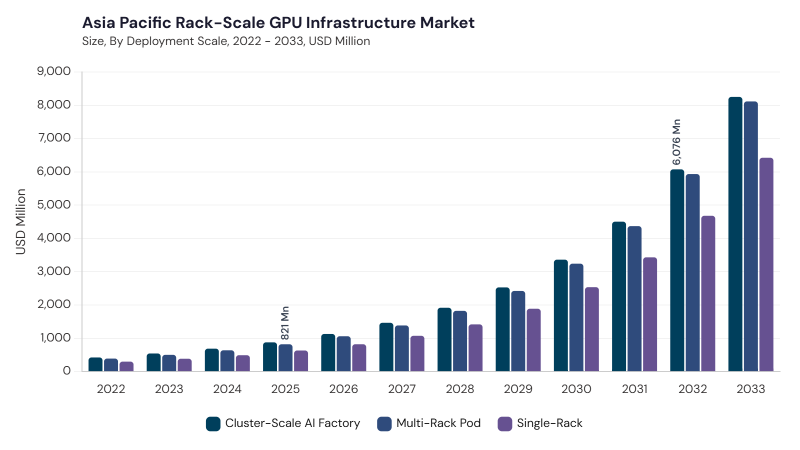
Based on Deployment Scale, the market is segmented into Cluster-Scale AI Factory, Multi-Rack Pod, and Single-Rack. The Cluster-Scale AI Factory market dominated the Asia Pacific Rack-Scale GPU Infrastructure Market by Deployment Scale in 2025, and would continue to be a dominant market till 2033; thereby, achieving a market value of USD 3.3 billion by 2030, growing at a CAGR of 32.8 % during the forecast period. The Multi-Rack Pod market is expected to witness a CAGR of 33.7% during (2026 - 2033). Additionally, The Single-Rack market is expected to witness highest CAGR of 34.1% during (2026 - 2033).
Cluster-Scale AI Factory leads due to large-scale AI development programs, foundation model investments, sovereign AI initiatives, supercomputing facilities, and hyperscale cloud expansion. These deployments integrate multiple GPU racks into large-scale systems capable of supporting massive AI training, advanced simulations, natural language processing, and high-performance computing. Multi-Rack Pod remains significant as enterprises, research organizations, and mid-size cloud providers require scalable GPU clusters with operational flexibility and lower deployment complexity. Single-Rack deployments support compact GPU environments for AI inference, software development, departmental computing, engineering simulations, edge workloads, and localized high-performance applications.
Based on Cooling Architecture, the market is segmented into Air-Cooled Rack Infrastructure, Direct-to-Chip Liquid-Cooled Rack Infrastructure, Hybrid Cooling Rack Infrastructure, and Immersion-Cooled Rack Infrastructure. Air-Cooled Rack Infrastructure leads due to widespread deployment across conventional data centers, ease of implementation, lower technical complexity, and compatibility with existing IT infrastructure. This architecture remains suitable for moderate GPU workloads, early deployments, and facilities prioritizing lower upfront costs.
Direct-to-Chip Liquid-Cooled Rack Infrastructure is gaining importance as higher GPU power densities require efficient chip-level heat removal and improved energy performance. Hybrid Cooling Rack Infrastructure supports data centers transitioning from air cooling to liquid-assisted systems, while Immersion-Cooled Rack Infrastructure is used in advanced AI laboratories, research centers, and next-generation hyperscale environments focused on ultra-high-density and sustainable computing.
Free Valuable Insights: Rack-Scale GPU Infrastructure Market is Predicted to reach USD 70.6 Billion billion by 2033, at a CAGR of 32.9%
Based on Country, the market is segmented into China, Japan, India, South Korea, Singapore, Malaysia, and Rest of Asia Pacific. The China market dominated the Asia Pacific Rack-Scale GPU Infrastructure Market by Country in 2025, and would continue to be a dominant market till 2033; thereby, achieving a market value of USD 3.1 billion by 2030, growing at a CAGR of 31.7 % during the forecast period. The Japan market is expected to witness a CAGR of 32.3% during (2026 - 2033). Additionally, The India market is expected to witness a CAGR of 34.6% during (2026 - 2033).
China leads due to large-scale GPU clusters, domestic AI infrastructure development, liquid cooling adoption, open rack formats, high-throughput networking, and demand for AI model training and inference. Japan supports market growth through high-density GPU racks, liquid cooling, AI management platforms, regulatory localization, and advanced enterprise cloud infrastructure. India is advancing through AI infrastructure investments, modular rack-scale deployment, sovereign compute demand, local data center partnerships, and energy-efficient cooling suited to its power ecosystem. South Korea, Singapore, and Malaysia add momentum through semiconductor ecosystem growth, high-density data centers, full-stack AI infrastructure, cloud service expansion, and sustainable computing, while Rest of Asia Pacific benefits from AI research, quantum simulation, localized production, and regional cloud integration.

By End User
By Solution Type
By Deployment Scale
By Cooling Architecture
By Country
Set to reach $9.1 Billion by 2030, growing at 33.5% CAGR during 2026-2033.
China leads with $3.1 billion by 2030, growing at 31.7% CAGR during the forecast period.
Rising demand from Cloud Service Providers, reaching $4.5 billion by 2030 at 32.6% CAGR.
Compute Systems will reach $5.7 billion by 2030, growing at 33% CAGR during the forecast period.
India market is expected to witness a CAGR of 34.6% during 2026-2033.
Single-Rack segment is expected to witness highest CAGR of 34.1% during 2026-2033.
Our team of dedicated experts can provide you with attractive expansion opportunities for your business.




 Unique Offerings