The sample copy of this report is available for access.
The LAMEA Partner Relationship Management Market is expected to reach USD 14.7 billion by 2029, growing at a CAGR of 16.1% during (2026 – 2033).
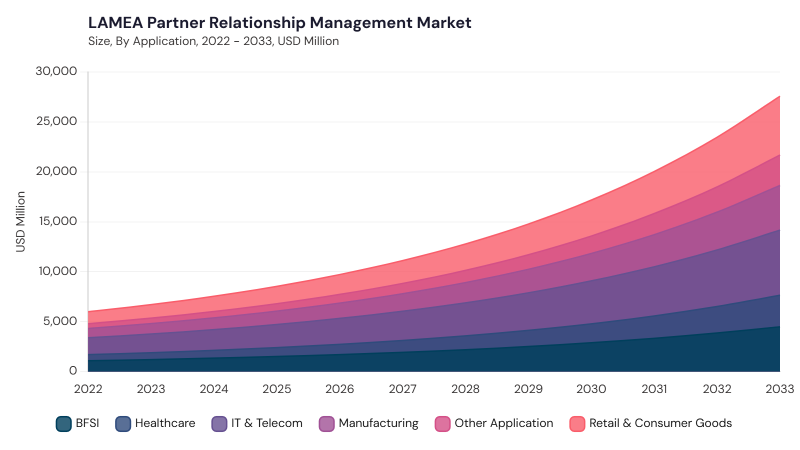
PRM adoption across Latin America, the Middle East, and Africa evolved from manual partner coordination and basic software tools used to track sales activities and channel interactions. Growing digital transformation encouraged enterprises to replace fragmented processes with cloud-enabled platforms supporting centralized partner onboarding, collaboration, and performance monitoring. Automation, mobile accessibility, analytics, and integration with CRM and ERP systems further expanded platform capabilities. This progression transformed PRM from a supporting channel tool into a broader framework for managing complex, geographically dispersed, and multi-tier partner ecosystems.
Market development across LAMEA is increasingly influenced by cloud adoption, AI-powered analytics, mobile accessibility, compliance requirements, and deeper enterprise-system integration. Organizations are emphasizing predictive partner performance, personalized engagement, automated workflows, centralized collaboration, and real-time channel visibility. Regulatory complexity across individual countries is increasing demand for governance, audit trails, secure data exchange, and configurable compliance capabilities. Vendors are also focusing on multilingual functionality, localized workflows, scalable infrastructure, and flexible deployment models suited to differing levels of digital maturity across the region.
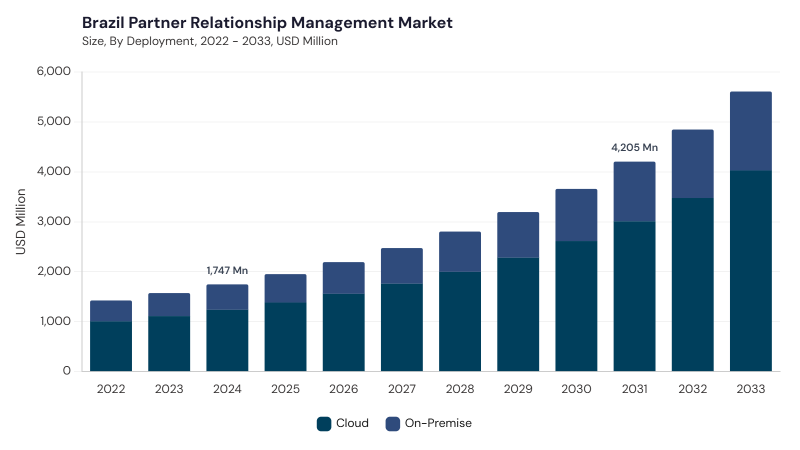
Based on Deployment, the market is segmented into Cloud and On-Premise. The Cloud market dominated the LAMEA Partner Relationship Management Market by Deployment in 2025, and would continue to be a dominant market till 2033; thereby, achieving a market value of USD 10.6 billion by 2029, growing at a CAGR of 16.2 % during the forecast period. The On-Premise market is expected to witness a CAGR of 15.6% during (2026 - 2033).
Cloud deployment leads as organizations accelerate digital transformation and seek scalable partner-management environments with lower infrastructure requirements. These platforms support centralized collaboration, real-time partner information, rapid deployment, automated updates, and integration with enterprise applications across geographically dispersed operations. On-Premise deployment remains relevant among enterprises requiring dedicated IT environments, stronger control over sensitive information, customized configurations, legacy-system integration, and compliance with industry-specific data governance requirements.
Based on Component, the market is segmented into Software and Services. The Software market dominated the LAMEA Partner Relationship Management Market by Component in 2025, and would continue to be a dominant market till 2033; thereby, achieving a market value of USD 9.6 billion by 2029, growing at a CAGR of 16.2 % during the forecast period. The Services market is expected to witness a CAGR of 15.9% during (2026 - 2033).
Software leads as enterprises increase adoption of automated partner onboarding, deal registration, incentive management, analytics dashboards, collaboration portals, and AI-enabled performance tools. Integration with CRM and ERP systems is strengthening the role of PRM software in channel operations and partner lifecycle management. Services support implementation, customization, system integration, consulting, training, technical assistance, migration, and ongoing optimization, particularly where organizations require localized support or operate across varied technology environments.
Based on Organization Size, the market is segmented into Large Enterprise and Small & Medium Enterprises. The Large Enterprise market dominated the LAMEA Partner Relationship Management Market by Organization Size in 2025, and would continue to be a dominant market till 2033; thereby, achieving a market value of USD 8.9 billion by 2029, growing at a CAGR of 15.7 % during the forecast period. The Small & Medium Enterprises market is expected to witness a CAGR of 16.6% during (2026 - 2033).
Large enterprises lead adoption due to extensive distributor networks, multi-country partner ecosystems, complex indirect sales operations, and higher requirements for integration, compliance, analytics, and automation. These organizations increasingly use PRM platforms to standardize partner workflows and improve channel visibility across diverse markets. Small & Medium Enterprises are benefiting from cloud-based and subscription-oriented solutions that simplify partner engagement, reduce infrastructure investment, provide modular capabilities, and support scalable business expansion.
Based on Application, the market is segmented into IT & Telecom, Retail & Consumer Goods, BFSI, Manufacturing, Healthcare, and Other Application. IT & Telecom leads due to expanding software, cloud, telecom, reseller, distributor, and system-integrator ecosystems requiring structured onboarding, deal management, and performance tracking. Retail & Consumer Goods uses PRM for distributor coordination, promotional execution, omnichannel collaboration, and retail partner management.
BFSI emphasizes broker, agent, fintech, and intermediary management with stronger compliance controls. Manufacturing relies on dealer and distributor coordination, while Healthcare focuses on distributors, medical suppliers, service partners, and regulatory documentation. Other Application includes education, logistics, energy, hospitality, construction, government programs, and professional services.
Free Valuable Insights: Partner Relationship Management Market Size Worth USD 287.0 Billion billion by 2033
Based on Country, the market is segmented into Brazil, Argentina, UAE, Saudi Arabia, South Africa, Nigeria, and Rest of LAMEA. The Brazil market dominated the LAMEA Partner Relationship Management Market by Country in 2025, and would continue to be a dominant market till 2033; thereby, achieving a market value of USD 3.1 billion by 2029, growing at a CAGR of 14.4 % during the forecast period. The Argentina market is expected to witness a CAGR of 16.7% during (2026 - 2033). Additionally, The UAE market is expected to witness a CAGR of 15.1% during (2026 - 2033).
Brazil demonstrates growing adoption of cloud platforms, AI-enabled analytics, omnichannel engagement, localization, and data-driven partner management. Argentina is advancing through cloud integration, AI-supported insights, CRM and ERP connectivity, and greater emphasis on scalable partner ecosystems. The UAE reflects mature adoption of cloud-enabled PRM, automation, AI-driven analytics, compliance-focused workflows, and integration with broader enterprise systems. Saudi Arabia is progressing through AI-enabled partner intelligence, cloud infrastructure, automation, localization, and stronger alignment with digital transformation initiatives.
South Africa is characterized by AI-enabled analytics, omnichannel partner engagement, localized solutions, cloud infrastructure, and increasing demand for secure digital collaboration. Nigeria is advancing through cloud-based platforms, mobile accessibility, business intelligence, analytics, and growing demand for scalable partner management among enterprises and SMEs. Rest of LAMEA reflects varying levels of digital maturity, with adoption shaped by localization, mobile-first access, cloud deployment, interoperability, AI-enabled automation, compliance requirements, and flexible partner engagement models.

By Deployment
By Component
By Organization Size
By Application
By Country
Set to reach $14.7 Billion by 2029, growing at 16.1% CAGR during 2026-2033.
Brazil leads with a market value of USD 3.1 billion by 2029, growing at 14.4% CAGR during the forecast period.
Cloud deployment will reach USD 10.6 billion by 2029, growing at a CAGR of 16.2% during the forecast period.
Software segment reaches USD 9.6 billion by 2029, growing at a CAGR of 16.2% during the forecast period.
The UAE market is expected to witness a CAGR of 15.1% during 2026-2033.
SMEs are expected to grow at a CAGR of 16.6% during 2026-2033.
Our team of dedicated experts can provide you with attractive expansion opportunities for your business.




 Unique Offerings