The sample copy of this report is available for access.
The Asia Pacific Partner Relationship Management Market is expected to reach USD 48.7 billion by 2030, growing at a CAGR of 15% during (2026 – 2033).
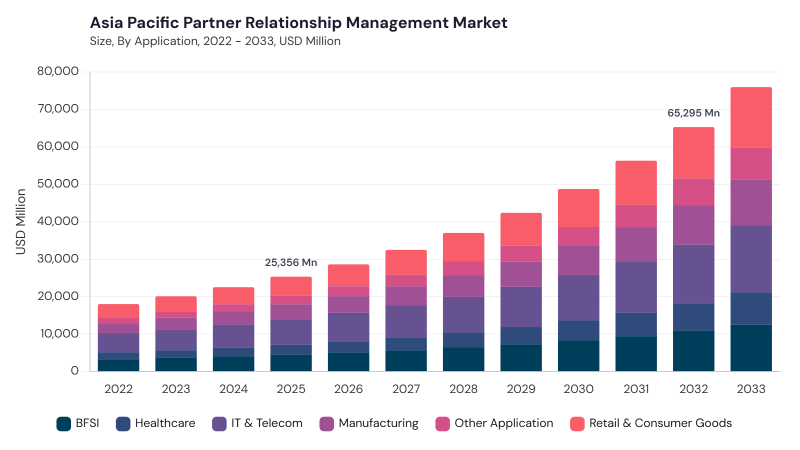
PRM adoption across Asia Pacific developed as enterprises required more structured methods to coordinate increasingly complex reseller, distributor, and technology-partner networks. Early systems replaced fragmented manual processes with centralized partner onboarding, lead distribution, communication, and campaign management capabilities. Cloud computing and SaaS delivery later improved scalability and real-time collaboration across geographically dispersed markets. Subsequent integration of analytics, automation, AI-driven insights, and mobile accessibility transformed PRM platforms into strategic systems supporting partner performance, personalized engagement, and broader ecosystem orchestration.
Market development across Asia Pacific is increasingly influenced by digital business models, omnichannel sales strategies, AI-enabled partner intelligence, cloud adoption, and stronger data governance requirements. Organizations are integrating PRM platforms with CRM, ERP, marketing automation, and analytics systems to improve visibility and operational coordination. AI and machine learning are supporting partner segmentation, predictive performance analysis, lead scoring, and personalized incentive programs. Localization, multilingual functionality, cybersecurity, regulatory compliance, mobile access, and scalable cloud infrastructure are also becoming important capabilities across diverse regional markets.
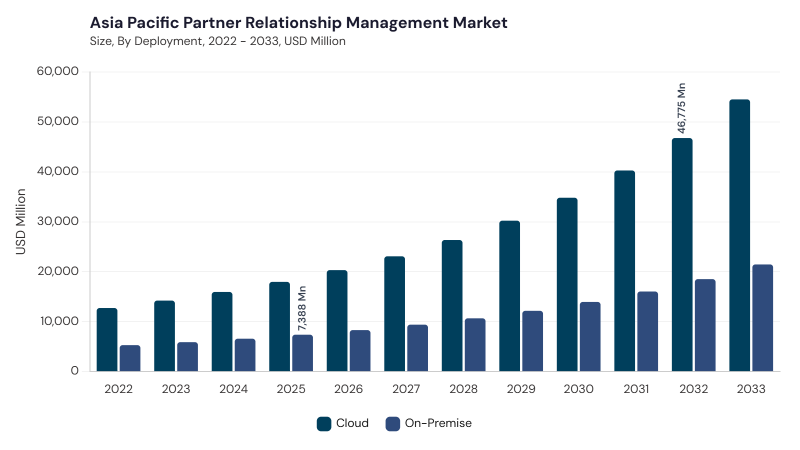
Based on Deployment, the market is segmented into Cloud and On-Premise. The Cloud market dominated the Asia Pacific Partner Relationship Management Market by Deployment in 2025, and would continue to be a dominant market till 2033; thereby, achieving a market value of USD 34.8 billion by 2030, growing at a CAGR of 15.1 % during the forecast period. The On-Premise market is expected to witness a CAGR of 14.5% during (2026 - 2033).
Cloud deployment leads as enterprises accelerate digitalization, adopt subscription-based applications, and expand partner collaboration across multiple countries. Cloud PRM platforms provide scalable infrastructure, rapid deployment, real-time data accessibility, automated updates, and integration with CRM, ERP, and marketing systems. On-Premise deployment remains relevant among organizations requiring enhanced data control, extensive customization, legacy-system compatibility, data residency, and stricter governance in highly regulated operating environments.
Based on Component, the market is segmented into Software and Services. The Software market dominated the Asia Pacific Partner Relationship Management Market by Component in 2025, and would continue to be a dominant market till 2033; thereby, achieving a market value of USD 31.5 billion by 2030, growing at a CAGR of 15.1 % during the forecast period. The Services market is expected to witness a CAGR of 14.7% during (2026 - 2033).
Software maintains a leading position through rising demand for partner portals, automated deal registration, incentive management, workflow automation, analytics dashboards, and AI-powered performance insights. Enterprises increasingly use these platforms to improve partner productivity and streamline indirect sales operations. Services support implementation, integration, customization, consulting, training, migration, technical assistance, and ongoing optimization, particularly where organizations operate across diverse technology environments and regulatory conditions.
Based on Organization Size, the market is segmented into Large Enterprise and Small & Medium Enterprises. The Large Enterprise market dominated the Asia Pacific Partner Relationship Management Market by Organization Size in 2025, and would continue to be a dominant market till 2033; thereby, achieving a market value of USD 29.3 billion by 2030, growing at a CAGR of 14.6 % during the forecast period. The Small & Medium Enterprises market is expected to witness a CAGR of 15.5% during (2026 - 2033).
Large enterprises lead adoption as multinational operations, extensive distributor networks, cross-border partnerships, and sophisticated channel programs require scalable partner management capabilities. These organizations increasingly prioritize automation, advanced analytics, enterprise integration, compliance controls, and multi-language functionality. Small & Medium Enterprises are benefiting from affordable cloud-based and SaaS solutions that provide simplified onboarding, essential partner collaboration tools, modular pricing, and scalable functionality without requiring significant infrastructure investment.
Based on Application, the market is segmented into IT & Telecom, Retail & Consumer Goods, BFSI, Manufacturing, Healthcare, and Other Application. IT & Telecom leads due to extensive software distribution networks, resellers, system integrators, cloud service partners, and complex technology ecosystems requiring scalable partner enablement. Retail & Consumer Goods focuses on distributor collaboration, omnichannel execution, promotions, and retailer management, while BFSI uses PRM for agents, brokers, and financial intermediaries with strong compliance requirements.
Manufacturing emphasizes dealer, distributor, service-partner, and supply chain coordination, whereas Healthcare focuses on secure engagement with pharmaceutical distributors, medical device suppliers, and healthcare partners. Other Application includes education, logistics, energy, hospitality, government-related ecosystems, and professional services.
Free Valuable Insights: Partner Relationship Management Market is Predicted to reach USD 287.0 Billion billion by 2033, at a CAGR of 14.3%
Based on Country, the market is segmented into China, Japan, India, South Korea, Singapore, Malaysia, and Rest of Asia Pacific. The China market dominated the Asia Pacific Partner Relationship Management Market by Country in 2025, and would continue to be a dominant market till 2033; thereby, achieving a market value of USD 13.7 billion by 2030, growing at a CAGR of 13 % during the forecast period. The Japan market is expected to witness a CAGR of 14.1% during (2026 - 2033). Additionally, The India market is expected to witness a CAGR of 15.6% during (2026 - 2033).
China demonstrates increasing adoption of AI-enabled analytics, cloud architectures, omnichannel partner engagement, and localized data governance capabilities. Japan reflects a mature environment supported by AI-driven enablement, mobile accessibility, advanced security, and integration with broader enterprise platforms. India is advancing through cloud adoption, integrated PRM-CRM-ERP environments, localized functionality, and increasing use of analytics and automation. South Korea is characterized by sophisticated digital infrastructure, AI-based partner intelligence, cloud-native architectures, and expanding cross-border partner ecosystems.
Singapore benefits from advanced digital infrastructure, strong ecosystem integration, AI-powered analytics, scalable cloud adoption, and an emphasis on compliance and regional connectivity. Malaysia is progressing through cloud adoption, omnichannel partner engagement, localized functionality, predictive analytics, and stronger data governance requirements. Rest of Asia Pacific reflects diverse levels of digital maturity, with demand centered on scalable SaaS platforms, mobile accessibility, automation, interoperability, localization, and AI-enabled partner performance management.

By Deployment
By Component
By Organization Size
By Application
By Country
Set to reach $48.7 Billion by 2030, growing at 15% CAGR during 2026-2033.
China leads with a market value of USD 13.7 billion by 2030, growing at a CAGR of 13% during the forecast period.
Rising enterprise cloud adoption, with the Cloud segment reaching USD 34.8 billion by 2030 at 15.1% CAGR.
The Software segment will achieve USD 31.5 billion by 2030, growing at a CAGR of 15.1% during the forecast period.
The India market is expected to witness a CAGR of 15.6% during 2026-2033.
The Large Enterprise segment will reach USD 29.3 billion by 2030, with a CAGR of 14.6% during the forecast period.
Our team of dedicated experts can provide you with attractive expansion opportunities for your business.




 Unique Offerings