The sample copy of this report is available for access.
The LAMEA OCP Rack Market is expected to reach USD 257.8 million by 2029, growing at a CAGR of 22.2% during (2026 - 2033).
The LAMEA OCP Rack Market originated from growing demand for open computing platforms within data center infrastructure across Latin America, the Middle East, and Africa. Early regional infrastructure relied heavily on proprietary rack solutions that limited flexibility, scalability, and cost efficiency. Over time, the global open hardware movement, cloud-service expansion, hyperscale data center development, component modularity, thermal management advances, power distribution improvements, local ecosystem support, telecom investment, and energy-efficiency regulations shifted the market from experimental and import-dependent deployment toward a more mature ecosystem with regional supply chains, localized services, and customized OCP rack solutions.
Current market growth is shaped by energy-efficiency pressure, modular infrastructure demand, cloud expansion, hyperscale development, and ecosystem collaboration across hardware vendors, system integrators, and hyperscale operators. Data center operators are increasingly adopting OCP racks with optimized airflow, intelligent power control, advanced thermal management, modular configurations, and support for edge and AI workloads. Demand is also rising for region-specific rack designs that address inconsistent power supply, tropical and arid climate conditions, data sovereignty requirements, remote monitoring, local compliance standards, and cost-sensitive infrastructure expansion.
Based on Component, the market is segmented into Rack Frames and Enclosures, Power Shelves, Cooling Components, Busbars and Power Distribution Components, and Other Component. The Rack Frames and Enclosures market dominated the LAMEA OCP Rack Market by Component in 2025, and would continue to be a dominant market till 2033; thereby, achieving a market value of USD 69.1 million by 2029, growing at a CAGR of 21.1 % during the forecast period. The Power Shelves market is expected to witness a CAGR of 21.9% during (2026 - 2033). The Other Component market is expected to witness a CAGR of 23.9% during (2026 - 2033).
Rack Frames and Enclosures remain the leading component as they provide mechanical support, structural integrity, modular scalability, space optimization, airflow management, durability, thermal protection, and OCP-compliant housing for servers, storage, and networking equipment. Power Shelves hold a substantial position through power supply units, power conversion, voltage regulation, energy-efficient operation, redundancy, hot-swappable designs, intelligent monitoring, and adaptive load balancing. Cooling Components maintain a considerable presence through fans, heat sinks, liquid cooling modules, airflow management accessories, blanking panels, aisle containment, eco-friendly refrigerants, and adaptive cooling suited to LAMEA’s varied climates. Busbars and Power Distribution Components hold a noteworthy role through efficient internal power flow, high-current support, modular electrical distribution, reduced losses, safety compliance, sensor-enabled monitoring, and compatibility with fluctuating voltage inputs. Other Component includes cable management accessories, mounting hardware, monitoring sensors, open-source firmware interfaces, control equipment, and site-specific infrastructure elements that improve installation, visibility, and operational reliability.
Based on Cooling Technology, the market is segmented into Air Cooling, Direct-to-Chip Liquid Cooling, Hybrid Cooling, Immersion Cooling, and Other Cooling Technology. The Air Cooling market dominated the LAMEA OCP Rack Market by Cooling Technology in 2025, and would continue to be a dominant market till 2033; thereby, achieving a market value of USD 100.3 million by 2029, growing at a CAGR of 21.4 % during the forecast period. The Direct-to-Chip Liquid Cooling market is expected to witness a CAGR of 22% during (2026 - 2033). Additionally, The Hybrid Cooling market is expected to witness highest CAGR of 22.9% during (2026 - 2033).
Air Cooling remains the leading cooling technology through fans, air handlers, ambient or conditioned airflow, intelligent airflow management, variable-speed fans, hot aisle/cold aisle containment, and compatibility with small to mid-sized data centers and moderate-heat workloads. Direct-to-Chip Liquid Cooling holds a substantial position through coolant delivery to CPUs and GPUs, cold plates, heat exchangers, higher rack-density support, AI and analytics workload cooling, reduced thermal gradients, and improved reliability in hot regional conditions. Hybrid Cooling maintains a considerable presence by combining air and liquid cooling, targeting hotspots while retaining existing air infrastructure, supporting phased modernization, modular retrofits, and dynamic thermal control. Immersion Cooling holds a noteworthy role through dielectric-fluid cooling, compact high-performance installations, reduced cooling infrastructure complexity, lower noise, near-zero PUE potential, and suitability for hyperscale or high-performance computing environments. Other Cooling Technology includes thermoelectric cooling, rear-door heat exchangers, advanced phase-change materials, alternative heat-transfer methods, and customized thermal systems suited to water availability, climate, energy cost, and facility differences across LAMEA.
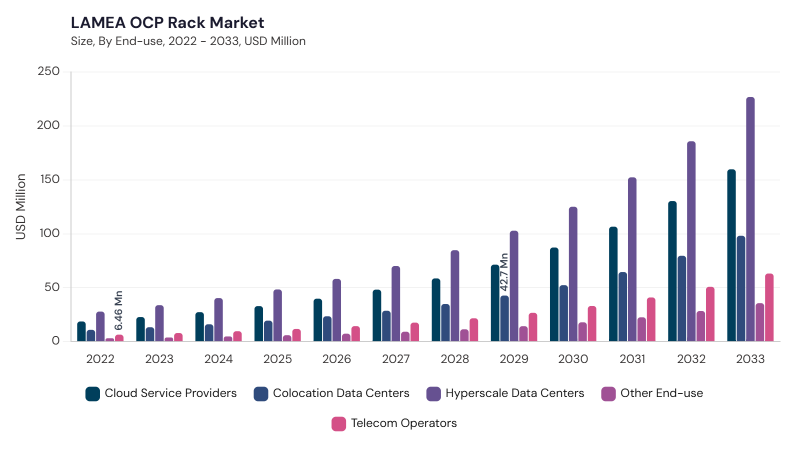
Based on End-use, the market is segmented into Hyperscale Data Centers, Cloud Service Providers, Colocation Data Centers, Telecom Operators, and Other End-use. Hyperscale Data Centers remain the leading end-use segment as OCP racks support massive compute and storage operations, scalable infrastructure, high-density deployments, big data, AI workloads, energy efficiency, modular hardware, rapid expansion, and streamlined maintenance. Cloud Service Providers hold a substantial position through public, private, and hybrid cloud infrastructure, multi-tenant environments, cloud management platforms, localized cloud capacity, containerization, microservices, rapid provisioning, and improved vendor flexibility.
Colocation Data Centers maintain a considerable presence through shared infrastructure, secure hosting, scalable compute and storage resources, carrier connectivity, flexible capacity, diverse hardware configurations, lower PUE, and future-proof modular deployments. Telecom Operators hold a noteworthy role through central offices, edge computing sites, network function virtualization, 5G rollout, fiber expansion, converged network computing, low-latency applications, and open-standard multi-vendor infrastructure. Other End-use includes government institutions, scientific research centers, large enterprises, financial institutions, energy companies, universities, secure private cloud installations, HPC environments, and specialized computing deployments.
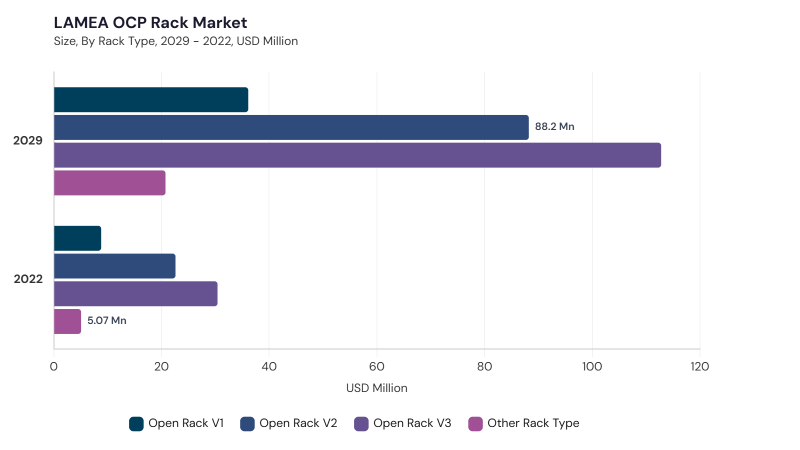
Based on Rack Type, the market is segmented into Open Rack V3, Open Rack V2, Open Rack V1, and Other Rack Type. Open Rack V3 remains the leading rack type as it supports high-density hyperscale environments, greater power delivery capacity, advanced thermal management, liquid cooling compatibility, improved airflow, modularity, interoperability, green data center initiatives, cloud expansion, edge workloads, and 5G infrastructure. Open Rack V2 holds a substantial position through established open-hardware design, improved airflow, moderate high-density support, stable deployment, broad hardware compatibility, cost-to-performance balance, and suitability for incremental infrastructure upgrades.
Open Rack V1 maintains a considerable presence through legacy deployments, foundational OCP design principles, basic modularity, earlier cloud and hyperscale use, cost-sensitive environments, and slower replacement cycles. Other Rack Type includes custom configurations, vendor-specific modifications, hybrid racks integrating legacy elements, ruggedized deployments, micro data center racks, industrial IoT formats, and locally adapted racks designed around power quality, space constraints, environmental conditions, and specialized infrastructure needs.
Free Valuable Insights: OCP Rack Market Size Worth USD 7683.9 Million billion by 2033
Based on Country, the market is segmented into Brazil, Argentina, UAE, Saudi Arabia, South Africa, Nigeria, and Rest of LAMEA. The Brazil market dominated the LAMEA OCP Rack Market by Country in 2025, and would continue to be a dominant market till 2033; thereby, achieving a market value of USD 63.3 million by 2029, growing at a CAGR of 20.6 % during the forecast period. The Argentina market is expected to witness a CAGR of 23.6% during (2026 - 2033). Additionally, The UAE market is expected to witness a CAGR of 20.4% during (2026 - 2033).
Brazil is shaped by sustainability, rising energy costs, edge computing, 5G deployments, vendor-neutral infrastructure, local climatic customization, renewable energy compatibility, and intelligent monitoring, while Argentina reflects localized manufacturing, supply-chain resilience, advanced cooling, modular architecture, global OCP collaboration, domestic assembly, and environment-specific rack design. The UAE is supported by energy-efficient cooling, liquid cooling, edge data centers, smart-city infrastructure, data sovereignty, hardware-level security, remote monitoring, and climate-adapted OCP solutions, whereas Saudi Arabia is driven by Vision 2030, cloud adoption, energy-efficient high-density racks, liquid cooling, airflow optimization, localization, dust resistance, and intelligent power distribution. South Africa is advancing through scalable cloud infrastructure, energy-efficiency needs, hybrid cooling, AI and big data workloads, local support ecosystems, IoT-based monitoring, and predictive maintenance. Nigeria is influenced by broadband expansion, FTTH deployment, modular rack designs, smart rack technologies, remote management, local assembly, heat dissipation, and corrosion-resistant customization, while Rest of LAMEA is shaped by hyperscale data center growth, sustainability regulation, renewable energy integration, edge computing, ruggedized rack deployment, modular cooling, power management, and regional service localization.

By Component
By Cooling Technology
By End-use
By Rack Type
By Country
Set to reach $257.8 Million by 2029, growing at 22.2% CAGR during 2026-2033.
Brazil leads with a market value of $63.3 million by 2029, growing at a 20.6% CAGR during 2026-2033.
Rising demand for Rack Frames and Enclosures, projected to hit $69.1 million by 2029 at 21.1% CAGR during 2026-2033.
Air Cooling will reach $100.3 million by 2029, with a 21.4% CAGR during 2026-2033.
The UAE market is expected to grow at a 20.4% CAGR during 2026-2033.
Hybrid Cooling is expected to witness the highest CAGR of 22.9% during 2026-2033.
Our team of dedicated experts can provide you with attractive expansion opportunities for your business.




 Unique Offerings
