The sample copy of this report is available for access.
The Asia Pacific OCP Rack Market is expected to reach USD 1239.9 million by 2030, growing at a CAGR of 21.3% during (2026 - 2033).
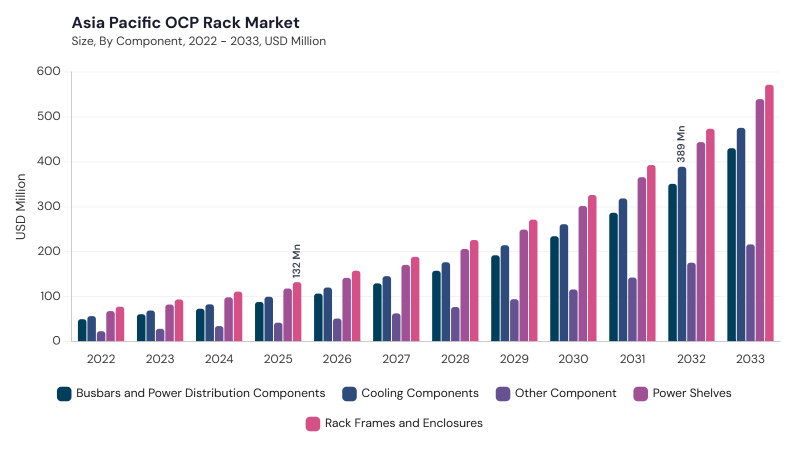
The Asia Pacific OCP Rack Market originated from the broader movement to redesign data center hardware around open-source standards, modularity, interoperability, and efficiency. Early adoption was driven by major technology companies and hyperscale data center operators seeking cost-effective and standardized infrastructure for cloud computing and AI workloads. Over time, advanced thermal management, flexible power distribution, customizable mounting options, data center build-outs in China, India, and Southeast Asia, edge computing integration, and government-backed digital economy initiatives shifted the market toward a balance of global OCP standardization and localized infrastructure customization.
Current market growth is shaped by energy efficiency priorities, AI and high-performance computing workloads, secure infrastructure requirements, data sovereignty pressure, and regional customization needs. Data center operators are increasingly adopting OCP racks with optimized airflow, liquid cooling support, GPU-ready configurations, high-density storage compatibility, flexible rack architectures, and localized compliance features. Demand is also rising for AI-driven monitoring, predictive maintenance, modular power management, secure integration, and tailored OCP rack solutions that address Asia Pacific’s diverse climatic, regulatory, and infrastructure conditions.
Based on Component, the market is segmented into Rack Frames and Enclosures, Power Shelves, Cooling Components, Busbars and Power Distribution Components, and Other Component. The Rack Frames and Enclosures market dominated the Asia Pacific OCP Rack Market by Component in 2025, and would continue to be a dominant market till 2033; thereby, achieving a market value of USD 326.3 million by 2030, growing at a CAGR of 20.2 % during the forecast period. The Power Shelves market is expected to witness a CAGR of 21% during (2026 - 2033). The Other Component market is expected to witness a CAGR of 22.8% during (2026 - 2033).
Rack Frames and Enclosures remain the leading component as they provide physical housing, modularity, scalability, high-density deployment support, airflow efficiency, cable management, and compatibility with AI, cloud, and telecom workloads. Power Shelves hold a substantial position through power conversion, rack-level power distribution, battery backup support, modular scalability, high-density power delivery, monitoring tools, and resilient energy management. Cooling Components maintain a considerable presence through fans, heat exchangers, liquid cooling systems, airflow accessories, two-phase cooling, AI workload heat removal, and sustainability-aligned thermal control. Busbars and Power Distribution Components hold a noteworthy role through copper and aluminum busbars, distribution units, connectors, compact power layouts, low-loss electrical delivery, scalable power support, and improved safety. Other Component includes cable management accessories, monitoring sensors, mounting kits, security modules, intelligent sensor arrays, connectivity elements, and rack-level monitoring components.
Based on Cooling Technology, the market is segmented into Air Cooling, Direct-to-Chip Liquid Cooling, Hybrid Cooling, Immersion Cooling, and Other Cooling Technology. The Air Cooling market dominated the Asia Pacific OCP Rack Market by Cooling Technology in 2025, and would continue to be a dominant market till 2033; thereby, achieving a market value of USD 475.2 million by 2030, growing at a CAGR of 20.5 % during the forecast period. The Direct-to-Chip Liquid Cooling market is expected to witness a CAGR of 21.1% during (2026 - 2033). Additionally, The Hybrid Cooling market is expected to witness highest CAGR of 21.9% during (2026 - 2033).
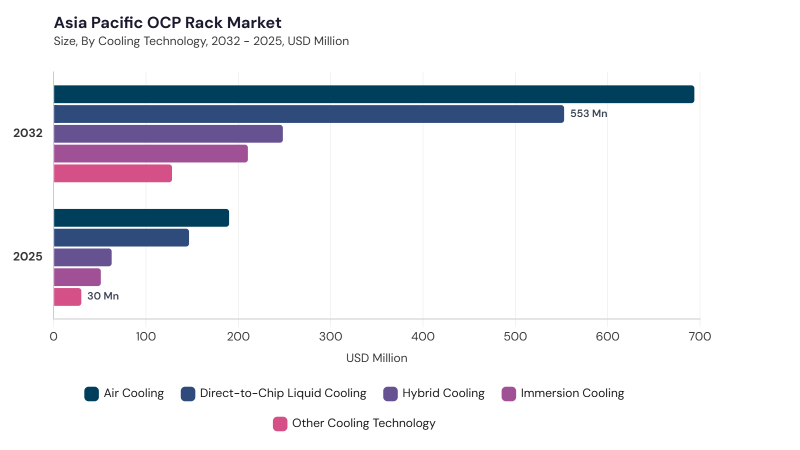
Air Cooling remains the leading cooling technology through fans, heat exchangers, airflow management, energy-efficient fan designs, enhanced filtration, humidity control, hot aisle containment, and compatibility with conventional and moderate-density workloads. Direct-to-Chip Liquid Cooling holds a substantial position through processor-level coolant circulation, cold plate design, localized heat extraction, AI-focused deployments, hyperscale data centers, supercomputing, and reduced dependence on traditional air cooling. Hybrid Cooling maintains a considerable presence by combining air and liquid methods, adapting to variable workload intensity, enabling phased cooling upgrades, supporting real-time temperature monitoring, and improving operational resilience. Immersion Cooling holds a noteworthy role through dielectric-fluid heat absorption, high-density computing support, reduced mechanical airflow, lower water and energy use, and adoption in advanced AI, research, and edge computing environments. Other Cooling Technology includes thermoelectric cooling, rear-door heat exchangers, alternative phase-change methods, localized hotspot management, and niche thermal optimization approaches.
Based on End-use, the market is segmented into Hyperscale Data Centers, Cloud Service Providers, Colocation Data Centers, Telecom Operators, and Other End-use. Hyperscale Data Centers remain the leading end-use segment as OCP racks support cloud platforms, big data analytics, AI workloads, high-density computing, advanced cooling, power optimization, modular open-standard hardware, and scalable infrastructure expansion. Cloud Service Providers hold a substantial position through public, private, and hybrid cloud infrastructure, multi-tenant architectures, virtualization, edge services, regional data hubs, containerization, microservices, and software-defined infrastructure.
Colocation Data Centers maintain a considerable presence through third-party data housing, interconnection services, standardized modular systems, multi-vendor equipment support, carrier-neutral capacity, regional connectivity, data localization compliance, and remote management. Telecom Operators hold a noteworthy role through mobile broadband, 5G rollouts, edge computing nodes, network function virtualization, compact rack deployment, energy efficiency, and distributed low-latency processing. Other End-use includes government facilities, research institutions, financial services, enterprise IT, universities, manufacturers, secure data storage, scientific computing, and specialized workloads.
Based on Rack Type, the market is segmented into Open Rack V3, Open Rack V2, Open Rack V1, and Other Rack Type. Open Rack V3 remains the leading rack type as it supports enhanced thermal optimization, simplified cable management, high-density server deployments, advanced accelerators, AI workloads, sustainability goals, power efficiency, and future-ready cloud or edge infrastructure. Open Rack V2 holds a substantial position through mature deployment, mechanical robustness, simplified hardware installation, power distribution standardization, cost-efficiency, OCP compliance, and compatibility with existing server environments.
Open Rack V1 maintains a considerable presence through legacy systems, retrofit projects, maintenance demand, replacement parts, incremental capacity expansion, and cost-effective continuation of earlier OCP infrastructure. Other Rack Type includes vendor-specific adaptations, purpose-built edge racks, hybrid rack variants, retrofitted proprietary racks, specialized security formats, environmental controls, and customized platforms for telecom, enterprise, industrial IoT, and research applications.
Free Valuable Insights: OCP Rack Market is Predicted to reach USD 7683.9 Million billion by 2033, at a CAGR of 20.7%
Based on Country, the market is segmented into China, Japan, India, South Korea, Singapore, Malaysia, and Rest of Asia Pacific. The China market dominated the Asia Pacific OCP Rack Market by Country in 2025, and would continue to be a dominant market till 2033; thereby, achieving a market value of USD 470.5 million by 2030, growing at a CAGR of 19.7 % during the forecast period. The Japan market is expected to witness a CAGR of 20.6% during (2026 - 2033). Additionally, The India market is expected to witness a CAGR of 22% during (2026 - 2033).
China is shaped by localized manufacturing, domestic supply-chain resilience, high-density energy-efficient designs, edge computing, IoT, 5G applications, and domestic component integration, while Japan reflects sustainability, compact edge-oriented racks, seismic resistance, electromagnetic compatibility, localized testing, and AI-driven thermal management. India is supported by energy-efficiency regulation, Make in India localization, domestic assembly, AI and IoT-enabled rack monitoring, data sovereignty, and scalable rack infrastructure. South Korea is advancing through cloud adoption, 5G infrastructure, edge data centers, local manufacturing, high-humidity customization, IoT sensors, and liquid cooling integration, whereas Singapore is influenced by tropical-climate data center optimization, energy-efficient OCP racks, direct liquid cooling, hot aisle containment, edge computing, and vendor-neutral infrastructure. Malaysia is progressing through hyperscale data center expansion, cloud computing, AI workloads, local OCP assembly, supply-chain localization, and energy-efficient rack designs, while Rest of Asia Pacific is shaped by open hardware standardization, energy-efficient designs, AI and 5G workloads, modular rack engineering, local integrators, telecom partnerships, and regional customization.

By Component
By Cooling Technology
By End-use
By Rack Type
By Country
Set to reach $1239.9 Million by 2030, growing at 21.3% CAGR during 2026-2033.
China leads with $470.5 million by 2030, growing at 19.7% CAGR during 2026-2033.
Rising demand for efficient cooling technologies like Air Cooling, expected to reach $475.2 million by 2030.
Rack Frames and Enclosures to achieve $326.3 million by 2030, growing at 20.2% CAGR during 2026-2033.
India market is expected to witness a CAGR of 22% during 2026-2033.
Hybrid Cooling is expected to witness the highest CAGR of 21.9% during 2026-2033.
Our team of dedicated experts can provide you with attractive expansion opportunities for your business.




 Unique Offerings
