The sample copy of this report is available for access.
The LAMEA Mega Data Center Market is expected to reach USD 1.9 billion by 2029, growing at a CAGR of 5.9% during (2026 – 2033).
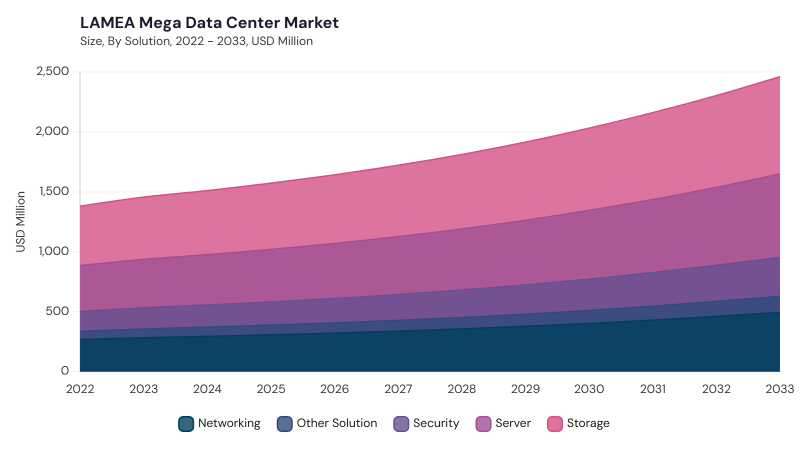
The LAMEA Mega Data Center Market developed from fragmented digital infrastructure that primarily served local enterprise, telecom, and government data requirements across Latin America, the Middle East, and Africa. Early facilities were smaller in scale and mostly supported basic hosting, colocation, and storage needs, with limited use of advanced automation or high-efficiency cooling. Over time, internet penetration, mobile connectivity, e-commerce, streaming, cloud computing, and government digitization increased demand for larger and more reliable infrastructure. The market moved toward hyperscale and mega data center models as global technology firms and regional providers expanded local capacity to reduce latency and meet sovereignty needs.
The LAMEA Mega Data Center Market is being shaped by cloud adoption, AI workloads, digital economy expansion, hybrid cloud demand, edge computing, and sustainability-led infrastructure planning. Operators are investing in renewable energy integration, advanced cooling systems, AI-enabled facility management, cybersecurity frameworks, modular designs, and regional interconnection capabilities. Demand is supported by fintech growth, e-commerce, telecom expansion, smart city projects, public-sector modernization, digital banking, streaming platforms, and enterprise cloud migration. Providers are also adapting facilities to local climate, power availability, regulatory requirements, and data residency priorities across diverse regional markets.
Based on Data Center Type, the market is segmented into Self-Build and Colocation. The Self-build market dominated the LAMEA Mega Data Center Market by Data Center Type in 2025, and would continue to be a dominant market till 2033; thereby, achieving a market value of USD 1.1 billion by 2029, growing at a CAGR of 5.7 % during the forecast period. The Colocation market is expected to witness a CAGR of 6.3% during (2026 - 2033).
Self-Build leads due to demand from large enterprises, government bodies, financial institutions, telecom operators, and hyperscale firms that require direct control over security, compliance, infrastructure design, and mission-critical workloads. These facilities support banking transactions, sovereign cloud environments, healthcare data, public-sector platforms, cloud services, AI workloads, and strategic digital infrastructure. Colocation remains important as SMEs, multinational enterprises, cloud providers, and digital service firms seek scalable capacity without owning full mega facilities. Demand for colocation is supported by lower upfront investment, hybrid cloud adoption, disaster recovery needs, interconnection services, edge expansion, and growing cloud consumption across Brazil, UAE, Saudi Arabia, South Africa, Nigeria, and other regional hubs.
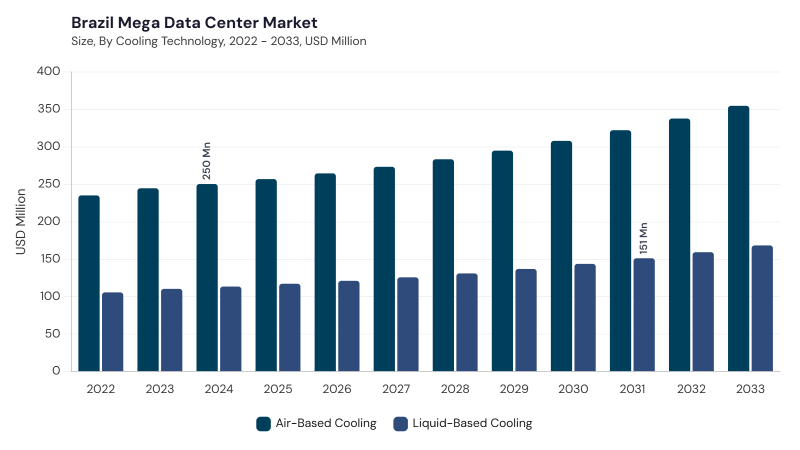
Based on Cooling Technology, the market is segmented into Air-Based Cooling and Liquid-Based Cooling. The Air-Based Cooling market dominated the LAMEA Mega Data Center Market by Cooling Technology in 2025, and would continue to be a dominant market till 2033; thereby, achieving a market value of USD 1.3 billion by 2029, growing at a CAGR of 5.8 % during the forecast period. The Liquid-Based Cooling market is expected to witness a CAGR of 6.4% during (2026 - 2033).
Air-Based Cooling leads due to its lower initial investment, operational familiarity, compatibility with existing facilities, and broad adoption across moderate-density data center environments. Operators use air handlers, chillers, precision cooling units, airflow management, containment systems, and variable-speed equipment to maintain thermal stability while controlling operating costs. Liquid-Based Cooling is gaining momentum as AI workloads, high-density servers, and hyperscale campuses increase heat management requirements across warm and power-sensitive markets. Direct-to-chip cooling, immersion cooling, and rear-door heat exchangers are becoming more relevant for green data center projects, high-performance computing, energy optimization, reduced cooling footprints, and long-term sustainability targets.
Based on Solution, the market is segmented into Storage, Server, Networking, Security, and Other Solution. Server solutions lead due to growing demand for compute capacity across cloud platforms, AI workloads, enterprise applications, fintech systems, e-commerce platforms, telecom services, and high-performance processing environments. Adoption is supported by modular server designs, GPU-enabled clusters, energy-efficient processors, virtualization-ready systems, and scalable compute architectures for multi-tenant and mission-critical workloads.
Storage remains significant as enterprises, governments, and cloud providers manage increasing volumes of structured and unstructured data under local data residency and disaster recovery requirements. Networking, Security, and Other Solution areas add demand through high-speed switches, SDN platforms, encryption, access control, cybersecurity tools, DCIM software, UPS systems, power distribution, cooling systems, automation tools, and backup solutions.
Free Valuable Insights: Mega Data Center Market Size Worth USD 36.0 Billion billion by 2033
Based on Country, the market is segmented into Brazil, Argentina, UAE, Saudi Arabia, South Africa, Nigeria, and Rest of LAMEA. The Brazil market dominated the LAMEA Mega Data Center Market by Country in 2025, and would continue to be a dominant market till 2033; thereby, achieving a market value of USD 432.1 million by 2029, growing at a CAGR of 4.4 % during the forecast period. The Argentina market is expected to witness a CAGR of 7.5% during (2026 - 2033). Additionally, The UAE market is expected to witness a CAGR of 5.1% during (2026 - 2033).
Brazil leads due to its role as a major Latin American digital infrastructure hub, supported by cloud adoption, telecom expansion, financial services demand, hyperscale interest, and renewable energy opportunities. Argentina supports market growth through energy-resource advantages, digital infrastructure modernization, AI workload potential, and stronger alignment between public policy and private-sector investment. The UAE contributes through advanced digital government programs, AI-ready infrastructure, hyperscale campus development, regional cloud demand, and strong positioning as a Middle East technology hub. Saudi Arabia, South Africa, and Nigeria add momentum through Vision-led infrastructure development, cloud adoption, telecom growth, financial digitization, edge computing, and localized data hosting needs, while Rest of LAMEA benefits from broader digital inclusion and cloud-led modernization.

By Data Center Type
By Cooling Technology
By Solution
By Country
Set to reach $1.9 Billion by 2029, growing at 5.9% CAGR during 2026-2033.
Brazil leads with a market value of USD 432.1 million by 2029, growing at a CAGR of 4.4% during the forecast period.
Rising demand for Air-Based Cooling, reaching USD 1.3 billion by 2029, with a CAGR of 5.8% during the forecast period.
Self-Build segment to achieve USD 1.1 billion by 2029, growing at a CAGR of 5.7% during the forecast period.
The UAE market is expected to witness a CAGR of 5.1% during 2026-2033.
The Liquid-Based Cooling segment is expected to witness a CAGR of 6.4% during 2026-2033.
Our team of dedicated experts can provide you with attractive expansion opportunities for your business.




 Unique Offerings