The sample copy of this report is available for access.
The Asia Pacific Mega Data Center Market is expected to reach USD 9.7 billion by 2030, growing at a CAGR of 5% during (2026 – 2033).
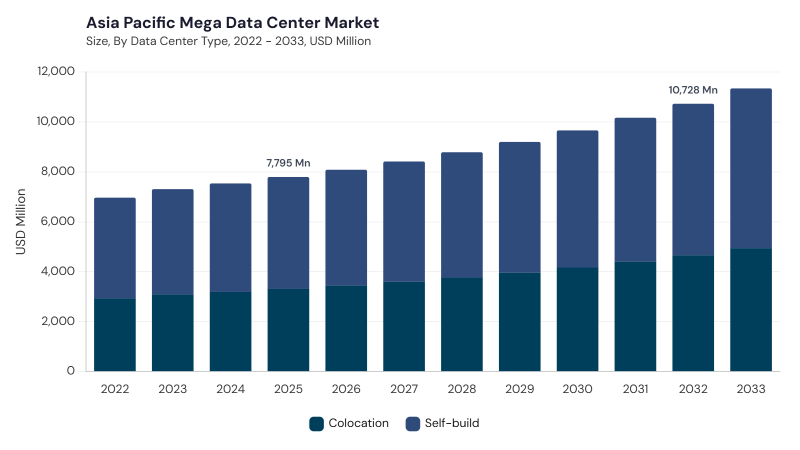
The Asia Pacific Mega Data Center Market emerged from the region’s early expansion of internet access, mobile connectivity, cloud hosting, and enterprise data storage needs. Initially, data center activity was concentrated in advanced urban hubs, where colocation facilities supported telecom operators, enterprises, and early digital service providers. Over time, cloud computing, virtualization, fiber optic networks, e-commerce, smartphone adoption, and enterprise digitization expanded the need for large-scale infrastructure. The market shifted toward hyperscale and mega facilities as AI, big data analytics, streaming, financial technology, and cloud-native applications generated heavier workloads.
The Asia Pacific Mega Data Center Market is being shaped by cloud migration, AI and high-performance computing workloads, data sovereignty rules, edge computing, and sustainability-focused infrastructure development. Operators are investing in AI-ready campuses, renewable power sourcing, modular builds, high-density servers, liquid cooling, advanced networking, and automated facility management. Demand is supported by digital banking, e-commerce, 5G rollout, smart cities, enterprise hybrid cloud, online gaming, video streaming, public-sector digitization, and regional cloud expansion. Providers are also expanding beyond traditional hubs into secondary cities to improve latency, manage land and power constraints, and meet local data hosting requirements.
Based on Data Center Type, the market is segmented into Self-Build and Colocation. The Self-build market dominated the Asia Pacific Mega Data Center Market by Data Center Type in 2025, and would continue to be a dominant market till 2033; thereby, achieving a market value of USD 5.5 billion by 2030, growing at a CAGR of 4.7 % during the forecast period. The Colocation market is expected to witness a CAGR of 5.3% during (2026 - 2033).
Self-Build leads due to strong investments by hyperscalers, cloud service providers, telecom companies, and large enterprises that require direct control over infrastructure, data security, power architecture, and workload performance. These facilities are designed to support AI training, AI inference, cloud platforms, financial transactions, streaming services, machine learning, and large-scale enterprise applications. Colocation remains important as enterprises seek scalable capacity without owning and operating large facilities. Demand for colocation is supported by hybrid cloud, disaster recovery, interconnection services, low-latency access, 5G infrastructure, data residency compliance, and flexible expansion across markets such as Singapore, Japan, Australia, India, and Malaysia.
Based on Cooling Technology, the market is segmented into Air-Based Cooling and Liquid-Based Cooling. The Air-Based Cooling market dominated the Asia Pacific Mega Data Center Market by Cooling Technology in 2025, and would continue to be a dominant market till 2033; thereby, achieving a market value of USD 6.6 billion by 2030, growing at a CAGR of 4.8 % during the forecast period. The Liquid-Based Cooling market is expected to witness a CAGR of 5.3% during (2026 - 2033).
Air-Based Cooling leads due to its lower upfront complexity, broad installed base, compatibility with existing HVAC systems, and continued use in moderate-density data center environments. Operators are improving air cooling through hot aisle and cold aisle containment, airflow optimization, variable-speed fans, economizers, and AI-based thermal monitoring. Liquid-Based Cooling is gaining relevance as AI workloads, GPUs, TPUs, and high-density racks increase heat generation beyond the limits of traditional cooling. Direct liquid cooling, immersion cooling, and rear-door heat exchangers are becoming important for hyperscale campuses, compact sites, energy efficiency, lower PUE, and sustainability-focused facility design across power-constrained Asia Pacific markets.
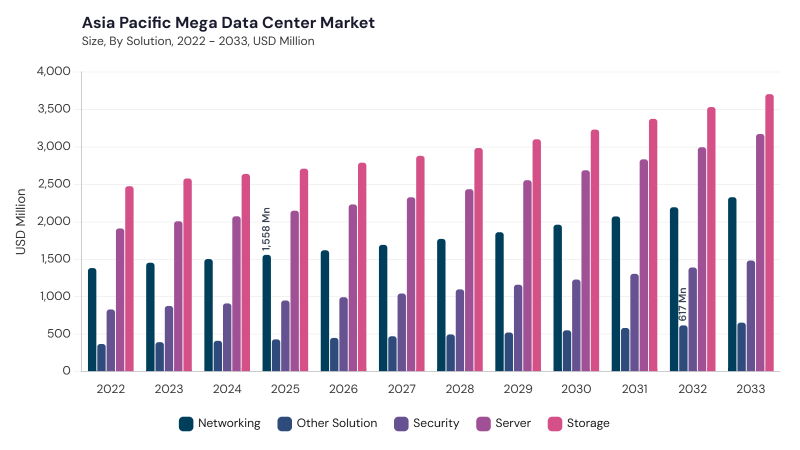
Based on Solution, the market is segmented into Storage, Server, Networking, Security, and Other Solution. Server solutions lead due to rapid growth in cloud computing, AI workloads, virtualization, edge computing, enterprise applications, streaming platforms, and high-performance processing needs. Demand is rising for GPU-enabled servers, TPU-based architectures, modular server platforms, ARM-based processors, telemetry systems, and power-efficient compute configurations.
Storage remains significant as cloud providers, enterprises, and governments manage large volumes of structured and unstructured data under rising data sovereignty and retention requirements. Networking, Security, and Other Solution areas add demand through high-speed switches, routers, optical interconnects, SDN platforms, zero-trust security, encryption, access control, UPS systems, PDUs, cooling systems, environmental monitoring, and facility management software.
Free Valuable Insights: Mega Data Center Market is Predicted to reach USD 36.0 Billion billion by 2033, at a CAGR of 4.5%
Based on Country, the market is segmented into China, Japan, India, South Korea, Singapore, Malaysia, and Rest of Asia Pacific. The China market dominated the Asia Pacific Mega Data Center Market by Country in 2025, and would continue to be a dominant market till 2033; thereby, achieving a market value of USD 2.7 billion by 2030, growing at a CAGR of 3.2 % during the forecast period. The Japan market is expected to witness a CAGR of 4.2% during (2026 - 2033). Additionally, The India market is expected to witness a CAGR of 5.6% during (2026 - 2033).
China leads due to hyperscale cloud growth, AI infrastructure expansion, 5G deployment, cybersecurity requirements, data localization policies, and strong domestic digital platforms. Japan supports market growth through advanced telecom infrastructure, AI-ready facilities, sustainability priorities, renewable energy initiatives, and strong demand from enterprises and cloud providers. India is advancing through cloud migration, digital public infrastructure, data localization needs, e-commerce growth, AI adoption, and expansion of data center capacity into new regional hubs. South Korea, Singapore, and Malaysia add momentum through semiconductor ecosystems, connectivity advantages, sovereign data hosting, colocation demand, and green infrastructure investments, while Rest of Asia Pacific benefits from digital transformation and edge-enabled growth.

By Data Center Type
By Cooling Technology
By Solution
By Country
Set to reach $9.7 Billion by 2030, growing at 5% CAGR during 2026-2033.
China leads, achieving $2.7 billion by 2030 with a 3.2% CAGR during the forecast period.
Rising enterprise cloud adoption and AI-driven workloads are the main catalysts.
Self-build segment to reach $5.5 billion by 2030, with a 4.7% CAGR during the forecast period.
India market is expected to witness a 5.6% CAGR during 2026-2033.
Air-Based Cooling to reach $6.6 billion by 2030, growing at a 4.8% CAGR during the forecast period.
Our team of dedicated experts can provide you with attractive expansion opportunities for your business.




 Unique Offerings