The sample copy of this report is available for access.
The LAMEA Laboratory Information Management System Market would witness market growth of 8.1% CAGR during the forecast period (2026-2033) attaining a market value of USD 531.8 million by 2028.
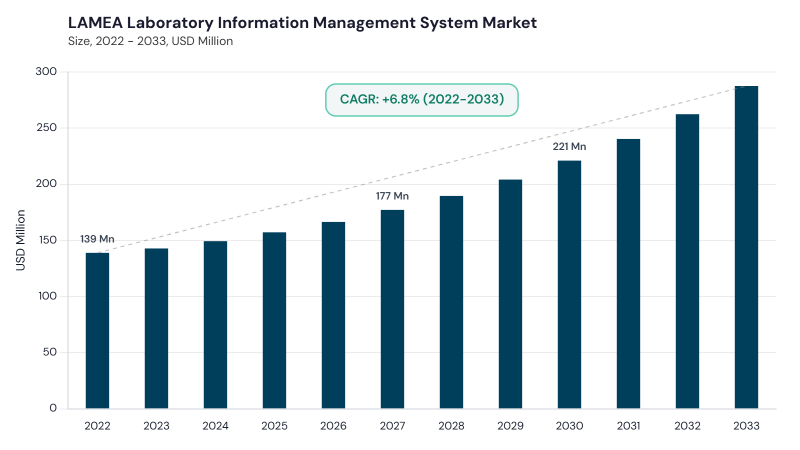
Brazil dominated the LAMEA Laboratory Information Management System Market by country in 2025 and is expected to remain the leading market through 2033, reaching USD 52.4 million by 2033. Brazil and the UAE led the regional market with shares of 22.2% and 11.1% in 2025. Argentina is projected to witness a CAGR of 9.5% during 2026-2033, and South Africa is expected to grow at 9.4%, indicating strong growth opportunities across a broader regional base beyond the leading market.
The LAMEA LIMS market developed out of the region’s early digital transformation efforts in laboratory operations, where many environments initially depended on manual processes and disconnected systems. Early LIMS adoption focused on basic workflow documentation, sample tracking, and quality-control support, but expansion was gradual because infrastructure readiness and technology budgets varied widely across countries. Over time, more laboratories began moving toward automated data handling and stronger process control as testing complexity increased. This shift widened the role of LIMS across public health, industrial, research, and environmental settings. The market today reflects a blend of foundational modernization and growing appetite for more advanced informatics capabilities.
LAMEA is increasingly shaped by the use of AI and machine learning to improve workflow efficiency, anomaly detection, and decision support within laboratory environments. The region is also seeing stronger movement toward cloud-based deployment as internet infrastructure improves and laboratories look for lower-cost, more scalable digital tools. Suppliers are responding with configurable software architectures, localized support models, and broader partnership activity to fit diverse country needs. Competitive differentiation often depends on practical deployment, integration support, and the ability to meet uneven maturity levels across laboratory systems. That makes the market both high-growth and execution-sensitive for vendors.
Based on Deployment Mode, the market is segmented into On-Premise, Cloud-Based, and Web-Based. The On-Premise segment dominated the LAMEA market in 2025 and is expected to reach USD 117.5 million by 2033, growing at a CAGR of 7.6% during the forecast period. Web-Based is projected to grow at 8.5%, slightly ahead of Cloud-Based at 8.4%, making lighter deployment models the faster-growing options. On-Premise continues to lead because many laboratories still prefer direct control while building core digital capability. Faster expansion in Web-Based and Cloud-Based models reflects the region’s search for accessible, scalable, and less infrastructure-heavy solutions.
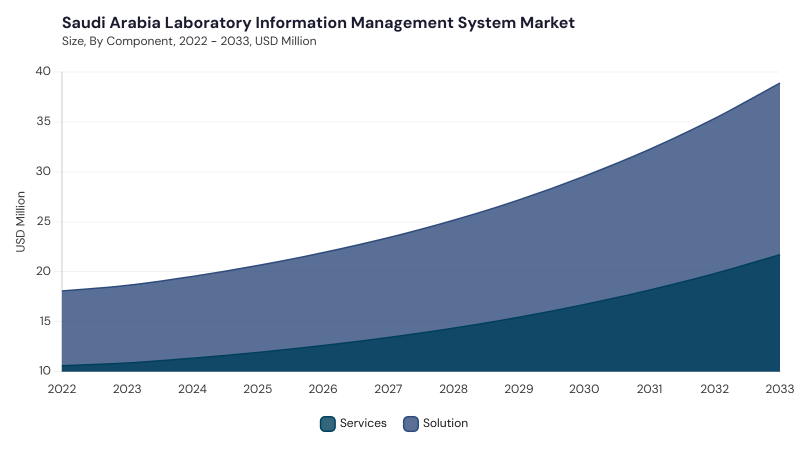
Based on Component, the market is segmented into Services and Solution. The Services segment dominated the LAMEA market in 2025 and is expected to reach USD 160.0 million by 2033, growing at a CAGR of 7.6% during the forecast period. The Solution segment is expected to grow faster at 8.8%, showing stronger momentum in software modernization. Services hold the lead because implementation, training, and adaptation remain critical in markets where laboratory digital maturity can vary significantly. The faster pace in Solution indicates that buyers are moving beyond basic adoption and investing in more capable platform functionality.
Based on End Use Industry, the market is segmented into Life Sciences, Contract Research Organizations (CROs), Chemical Industry, Food & Beverage and Agriculture, Environmental Testing Laboratories, Oil & Gas and Petrochemical Industry, and Other Industries. Life Sciences dominated the LAMEA market in 2025 and is expected to reach USD 101.4 million by 2033, growing at a CAGR of 6.8% during the forecast period. Chemical Industry is anticipated to record the highest CAGR at 8.7%, reflecting wider digitization needs in industrial and process-driven laboratories. Life Sciences remains the largest user base because of regulatory sensitivity and the need for structured sample and data control. Faster growth in industrial segments shows the market broadening into more diverse testing environments.
Free Valuable Insights: Laboratory Information Management System Market Size Worth USD 3,170.6 Million billion by 2033
Brazil remains the leading country market in LAMEA because it combines the region’s broadest demand base with a steady push toward more structured laboratory modernization. Laboratories in the country are increasingly under pressure to improve traceability, reduce manual work, and support more consistent data handling across pharmaceutical, environmental, food, and research settings. That creates room for platforms that can balance compliance, configuration flexibility, and implementation practicality. Cloud-linked models are becoming more relevant as laboratories seek scalable tools with lower infrastructure burden, but service support still plays a major role in adoption. Brazil therefore stands out not only for market size, but also for its influence on how LIMS vendors shape their regional delivery models.

By Deployment Mode
By Component
By End Use Industry
By Country
Market will grow at 8.1% CAGR during the forecast period (2026-2033).
Brazil dominates with 22.2% market share in 2025 and will reach $52.4 million by 2033.
Growing life sciences sector and expanding contract research organizations fuel regional demand.
On-premise deployment led the market in 2025 across the region.
UAE holds second place with 11.1% market share in 2025.
Services segment dominated the market in 2025 and maintains leadership through 2033.
Our team of dedicated experts can provide you with attractive expansion opportunities for your business.




 Unique Offerings