The sample copy of this report is available for access.
“Global Laboratory Information Management System Market to reach a market value of USD 3,170.6 million by 2033 growing at a CAGR of 6.4%”
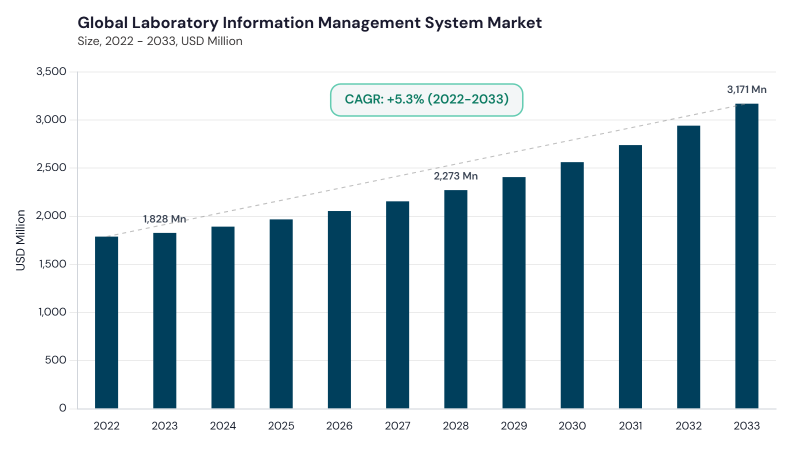
The Global Laboratory Information Management System Market size is expected to reach USD 3,170.6 million by 2033, rising at a market growth of 6.4% CAGR during the forecast period.
LIMS adoption is being supported by the need for compliant, connected, and more automated laboratory environments across regulated industries. Demand remains anchored in laboratories that need stronger traceability, faster workflows, and reliable data handling at scale. The laboratory information management system market has moved from basic sample logging and digital record keeping into a broader laboratory informatics layer that supports sample tracking, workflow coordination, data capture, and compliance management. Laboratories across biopharmaceutical, clinical, environmental, chemical, and food testing settings are using LIMS as a core operating system rather than a standalone software utility.
Leading vendors are centering their market strategy on AI-enabled product upgrades, broader cloud and SaaS delivery models, and partnerships that improve instrument connectivity and data interoperability. Expansion efforts are also becoming more regionalized, with firms localizing deployment support, strengthening ecosystem ties, and widening their footprint in high-growth laboratory markets through acquisitions and service-led scale-up.
Adoption has widened as laboratories handle larger data volumes, more connected instruments, and stricter audit expectations. Alongside software platforms, the market includes implementation, customization, training, and maintenance services that help laboratories fit LIMS into complex operating environments and regulated quality systems.

The market shows a highly consolidated structure. The top ten companies collectively account for approximately 82.6% of global revenue, leaving 17.4% with other providers. LabWare leads with around 19.5% share, followed by LabVantage Solutions, which reflects the weight of specialized LIMS expertise, long-standing customer relationships, and the importance of validated platforms in regulated environments.
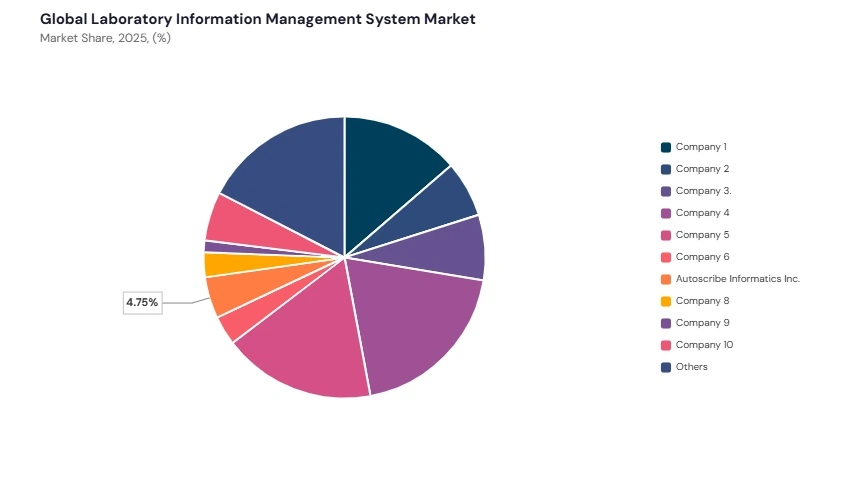
Thermo Fisher Scientific holds roughly 13.7%, while Siemens AG and Abbott Laboratories represent the next competitive tier. Mid-tier and niche participants such as Illumina, Autoscribe Informatics, LabLynx, Labworks LLC, and Accelerated Technology Laboratories continue to compete through specialization, flexibility, and targeted industry focus. Future share movement is likely to be shaped by cloud migration, AI-led analytics, stronger interoperability, and the ability to support multi-system laboratory ecosystems.
By deployment mode, the market is segmented into On-Premise, Cloud-Based, and Web-Based. The On-Premise segment led the market in 2025 and is expected to maintain its lead through 2033, supported by laboratories that prioritize control, validation depth, and close alignment with internal IT and compliance policies. Even so, Cloud-Based and Web-Based models are expanding steadily as laboratories seek lower infrastructure burdens, easier upgrades, and stronger support for distributed teams and multi-site collaboration.
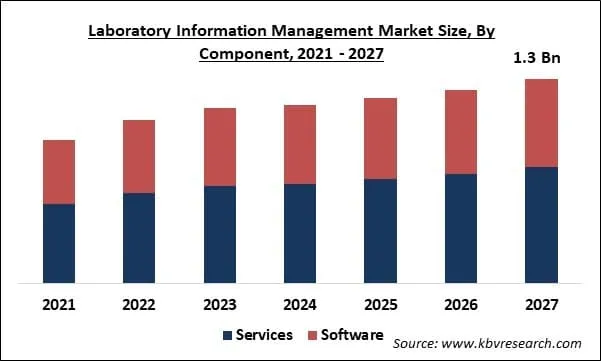
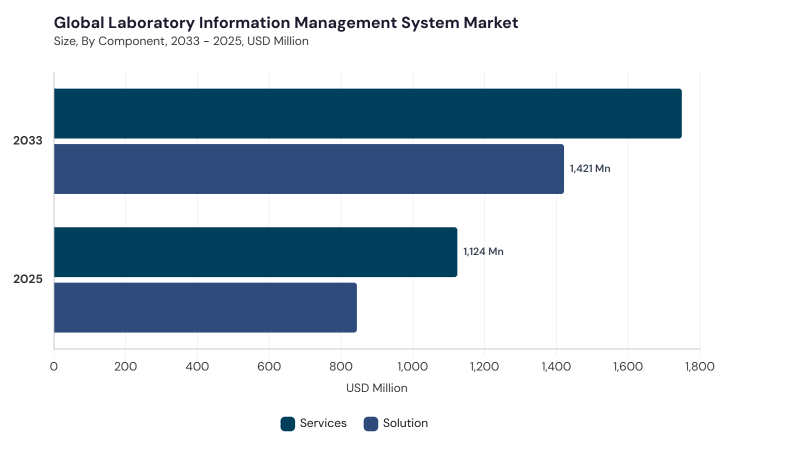
Based on component, the market is divided into Solution and Services. Services held the leading position in 2025 and are expected to remain the dominant component through 2033 because LIMS projects often require implementation planning, workflow customization, validation, training, and ongoing support. The Solution segment is expected to grow faster, reflecting increased investment in core software capabilities such as analytics, automation, interoperability, and configurable data management functions.
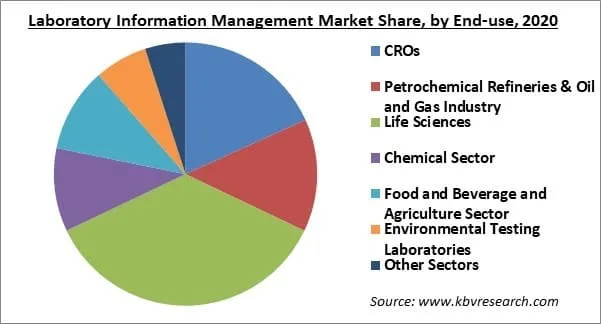
By end-use industry, the market covers Life Sciences, Contract Research Organizations (CROs), Chemical Industry, Food & Beverage and Agriculture, Environmental Testing Laboratories, Oil & Gas and Petrochemical Industry, and Other Industries. Life Sciences remained the leading segment in 2025 due to heavy regulatory oversight, complex sample workflows, and sustained digital investment across pharmaceutical and biotechnology laboratories. At the same time, Chemical Industry is expected to register the fastest growth, showing how industrial and quality testing environments are becoming more dependent on structured, compliant, and analytics-ready laboratory systems.
The market is competitive but concentrated, with established LIMS specialists and broader laboratory technology companies competing on workflow depth, regulatory readiness, and the ability to manage high-volume data environments. AI-assisted analytics, automation support, and cloud-native deployment are becoming important points of differentiation as laboratories look for systems that improve productivity without weakening traceability.
Integration and interoperability remain central buying criteria. Vendors are expected to connect smoothly with analytical instruments, electronic laboratory notebooks, enterprise systems, and external data environments, which makes platform flexibility and implementation capability as important as the core software itself.
Commercial positioning also varies by region and customer type. Some suppliers target enterprise laboratories with highly configurable platforms and broader service engagement, while others use subscription-based and modular pricing to attract smaller or multi-site laboratories moving toward digital modernization.
| Report Attribute | Details |
|---|---|
| Market Size value in 2026 | USD 2055.3 million |
| Market size forecast in 2033 | USD 3,170.6 million |
| Base Year | 2025 |
| Historical period | 2022-2024 |
| Forecast Period | 2026-2033 |
| Revenue Growth Rate | 6.4% CAGR during 2026-2033 |
| Number of Pages | 493 |
| Tables | 660 |
| Report Coverage | Revenue forecast, market trends, drivers, restraints, opportunities, challenges, competition analysis, market share analysis, and regional insights |
| Segments Covered | By Deployment Mode, By Component, By End Use Industry, and Segmentation by Geography |
| Regional Scope | North America, Europe, Asia Pacific, and LAMEA |
| Country Scope | North America (US, Canada, Mexico, and Rest of North America); Europe (Germany, UK, France, Russia, Spain, Italy, and Rest of Europe); Asia Pacific (Japan, China, India, South Korea, Singapore, Malaysia, and Rest of Asia Pacific); LAMEA (Brazil, Argentina, UAE, Saudi Arabia, South Africa, Nigeria, and Rest of LAMEA) |
| Companies Included | LabWare, LabVantage Solutions, Thermo Fisher Scientific, Siemens AG, Abbott Laboratories, Illumina, Autoscribe Informatics, LabLynx, Labworks LLC, Accelerated Technology Laboratories |
By Deployment Mode
By Component
By End Use Industry
By Geography
The market will reach USD 3,170.6 million by 2033, growing at 6.4% CAGR during the forecast period.
Cloud-based LIMS platforms are expanding rapidly, boosting market accessibility and scalability across laboratories.
Key regions include North America (US, Canada, Mexico), Europe (Germany, UK), representing major market territories.
North America dominates with the US, Canada, and Mexico forming the largest regional market segment.
Integrative automation with AI workflows and stringent regulatory compliance requirements fuel adoption across laboratory operations.
Market valuation will hit USD 3,170.6 million by 2033 according to KBV Research projections.
Our team of dedicated experts can provide you with attractive expansion opportunities for your business.








 Unique Offerings