The sample copy of this report is available for access.
The LAMEA Drug Discovery Platforms Market is expected to reach USD 409.32 Million by 2029, growing at a CAGR of 17.1% during 2026 - 2033.
The LAMEA Drug Discovery Platforms Market has evolved from conventional laboratory-based research methodologies toward an advanced ecosystem supported by artificial intelligence (AI), machine learning (ML), bioinformatics, and high-throughput screening technologies. Historically, pharmaceutical research across Latin America, the Middle East, and Africa depended largely on manual biochemical assays, academic research institutions, and imported technologies. However, growing investments in biotechnology infrastructure, increasing healthcare innovation initiatives, and stronger collaboration between pharmaceutical companies, research organizations, and technology providers have accelerated the modernization of drug discovery processes. Today, the market is increasingly characterized by integrated computational platforms capable of supporting target identification, lead optimization, molecular modeling, and predictive analytics.
Based on Drug Type, the market is segmented into Small Molecule and Large Molecule. The Small Molecule market dominated the LAMEA Drug Discovery Platforms Market by Drug Type in 2025, and would continue to be a dominant market till 2033; thereby, achieving a market value of USD 302.06 Million by 2029, growing at a CAGR of 16.8 % during the forecast period.The Large Molecule market is expected to witness a CAGR of 18% during (2026 - 2033).
Small molecule drug discovery platforms account for the larger market share owing to their long-established role in pharmaceutical development, lower manufacturing complexity, and broad therapeutic applicability across chronic and infectious diseases. These platforms extensively utilize computational chemistry, virtual screening, and high-throughput screening technologies to accelerate compound identification and optimization. Large molecule platforms are witnessing rapid growth with increasing focus on biologics, monoclonal antibodies, recombinant proteins, peptides, and cell-based therapies. The expansion of biologics research, supported by advances in protein engineering, genomics, and AI-assisted molecular design, continues to strengthen demand for sophisticated biologics discovery platforms across the LAMEA region.
Based on End Use, the market is segmented into Biopharmaceutical Companies, CROs/CDMOs, and Academic & Research Institutes. Biopharmaceutical companies represent the leading end-use segment due to substantial investments in pharmaceutical research, precision medicine, and pipeline expansion. These organizations increasingly deploy integrated AI-powered discovery platforms to improve productivity, reduce development timelines, and enhance candidate selection. CROs and CDMOs continue gaining prominence as pharmaceutical companies increasingly outsource discovery, screening, and preclinical research to improve operational flexibility and cost efficiency. Academic and research institutes also contribute significantly by conducting early-stage discovery, biomarker research, and translational medicine projects, often collaborating with government agencies and industry partners to advance innovative therapeutic development.
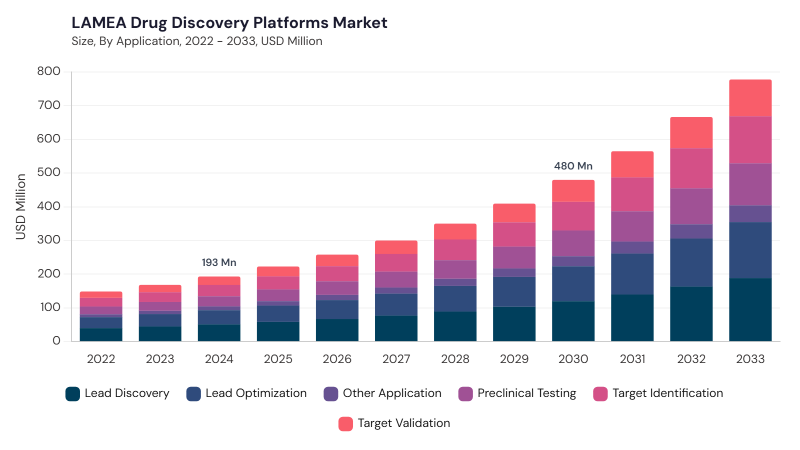
Based on Application, the market is segmented into Lead Discovery, Lead Optimization, Target Identification, Preclinical Testing, Target Validation, and Other Applications. The Lead Discovery market dominated the LAMEA Drug Discovery Platforms Market by Application in 2025, and would continue to be a dominant market till 2033; thereby, achieving a market value of USD 103.30 Million by 2029, growing at a CAGR of 15.9 % during the forecast period. The Lead Optimization market is expected to witness a CAGR of 16.7% during (2026 - 2033).
Lead discovery remains the dominant application owing to increasing adoption of virtual screening, computational chemistry, and AI-assisted molecular modeling technologies that significantly accelerate compound identification. Lead optimization continues to gain momentum through predictive ADMET analysis, molecular simulations, and AI-driven candidate refinement. Target identification and target validation platforms are expanding rapidly as pharmaceutical companies integrate genomics, proteomics, and systems biology into drug development workflows.
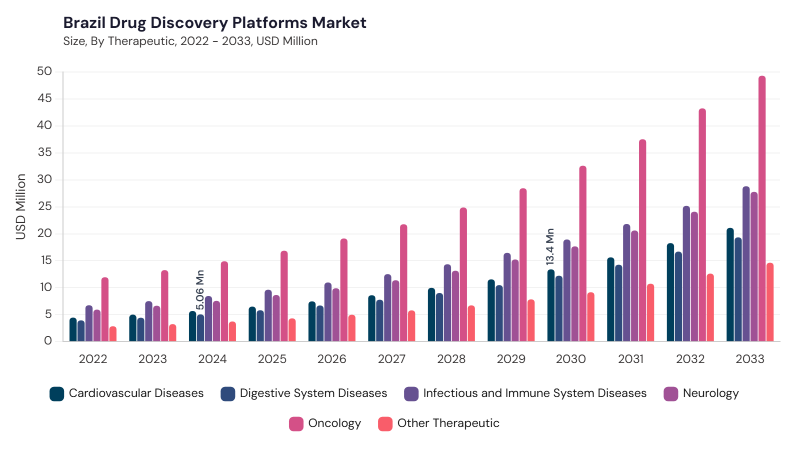
Based on Therapeutic Area, the market is segmented into Oncology, Infectious & Immune System Diseases, Neurology, Cardiovascular Diseases, Digestive System Diseases, and Other Therapeutic Areas. Oncology represents the largest therapeutic segment owing to rising cancer incidence, increasing investment in precision oncology, and growing utilization of AI-powered molecular profiling and biomarker discovery platforms. Infectious and immune system diseases remain highly significant due to the continued prevalence of tuberculosis, malaria, HIV, and emerging infectious diseases across several LAMEA countries. Neurology, cardiovascular diseases, and digestive system diseases are witnessing increasing research investments driven by the rising burden of chronic illnesses and aging populations. Other therapeutic areas, including rare diseases, metabolic disorders, dermatology, and genetic disorders, continue expanding as personalized medicine and genomics-based drug discovery become increasingly adopted.
Free Valuable Insights: Drug Discovery Platforms Market Size Worth USD 9,879.2 Million billion by 2033
Based on Country, the market is segmented into Brazil, Argentina, UAE, Saudi Arabia, South Africa, Nigeria, and Rest of LAMEA. The Brazil and UAE led the LAMEA Drug Discovery Platforms Market by Country with a market share of 23.2% and 13.6% in 2025.The South Africa market is expected to witness a CAGR of 18.2% during throughout the forecast period.
Brazil represents the largest market in Latin America, supported by expanding pharmaceutical research, biotechnology investments, and increasing AI adoption in drug discovery. Argentina continues strengthening its pharmaceutical innovation ecosystem through academic-industry collaborations and computational biology research. The UAE and Saudi Arabia are rapidly emerging as biotechnology innovation hubs through substantial investments under national healthcare transformation initiatives, AI-driven pharmaceutical research, and biotechnology infrastructure development. South Africa remains a major contributor due to its established biomedical research ecosystem and focus on infectious disease research. Nigeria is witnessing growing adoption of digital drug discovery platforms driven by healthcare modernization and biotechnology development.

By Drug Type
By Application
By End Use
By Therapeutic Area
By Country
Set to reach $409.32 Million by 2029, growing at 17.1% CAGR during 2026-2033.
Brazil and UAE lead with market shares of 23.2% and 13.6% in 2025, respectively.
The Small Molecule segment will reach $302.06 Million by 2029 at a 16.8% CAGR during 2026-2033.
Lead Discovery segment will achieve $103.30 Million by 2029, growing at a 15.9% CAGR during 2026-2033.
South Africa is expected to witness a CAGR of 18.2% throughout the forecast period.
Large Molecule segment is expected to witness an 18% CAGR during 2026-2033.
Our team of dedicated experts can provide you with attractive expansion opportunities for your business.




 Unique Offerings