The sample copy of this report is available for access.
“Global Drug Discovery Platforms Market to reach a market value of USD 9879.16 Million by 2033 growing at a CAGR of 14.8%”
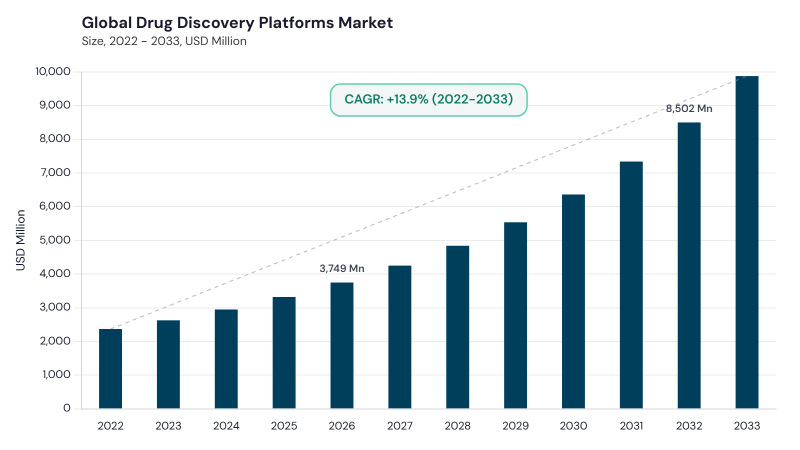
The Global Drug Discovery Platforms Market is expected to reach USD 9,879.2 Million by 2033, growing at a CAGR of 14.8% during 2026 - 2033.
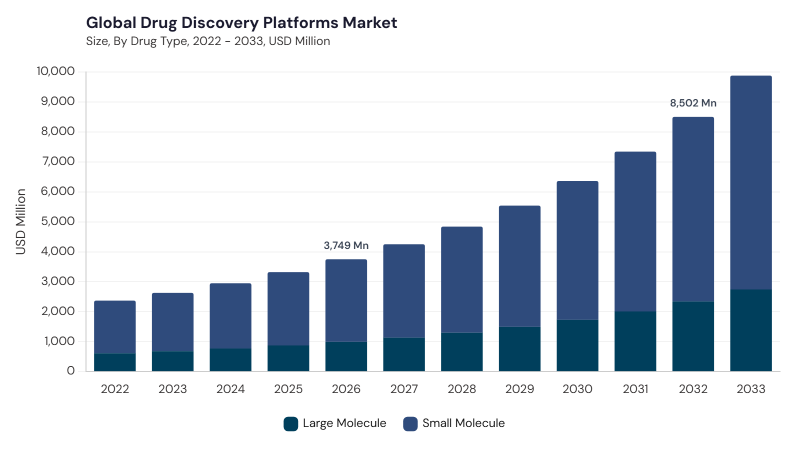
The Global Drug Discovery Platforms Market has evolved from conventional laboratory-based pharmacological research methods that relied heavily on trial-and-error experimentation, biochemical assays, and manual compound screening. Early drug discovery processes were labor-intensive, time-consuming, and characterized by high attrition rates. The emergence of bioinformatics, computational chemistry, high-throughput screening (HTS), genomics, proteomics, and cheminformatics transformed the market by enabling data-driven target identification and lead optimization. Over the past decade, advancements in artificial intelligence (AI), machine learning (ML), cloud computing, multi-omics analytics, and automation technologies have further revolutionized drug discovery platforms.
The market is witnessing robust growth due to increasing pharmaceutical R&D expenditure, rising adoption of AI-enabled drug discovery technologies, growing demand for precision medicine, expansion of biologics pipelines, and the need to improve R&D productivity. Organizations are increasingly investing in cloud-based collaborative platforms, predictive analytics, and automated discovery workflows to shorten development cycles and reduce costs. Furthermore, growing interest in drug repurposing, rare disease therapeutics, and personalized medicine continues to create significant opportunities for advanced drug discovery platforms globally.
The Drug Discovery Platforms Market is characterized by a moderately fragmented yet innovation-intensive competitive environment consisting of AI-driven drug discovery companies, computational chemistry providers, biosimulation vendors, bioinformatics firms, life science software companies, and scientific informatics providers. Competition is primarily centered on predictive accuracy, AI capabilities, platform scalability, cloud integration, workflow automation, and multi-omics analytics. Companies increasingly invest in generative AI, molecular simulations, knowledge graphs, high-throughput screening technologies, and integrated research ecosystems to strengthen their market positions. Strategic collaborations among pharmaceutical companies, technology vendors, academic institutions, and research organizations continue to shape competitive dynamics across the industry.
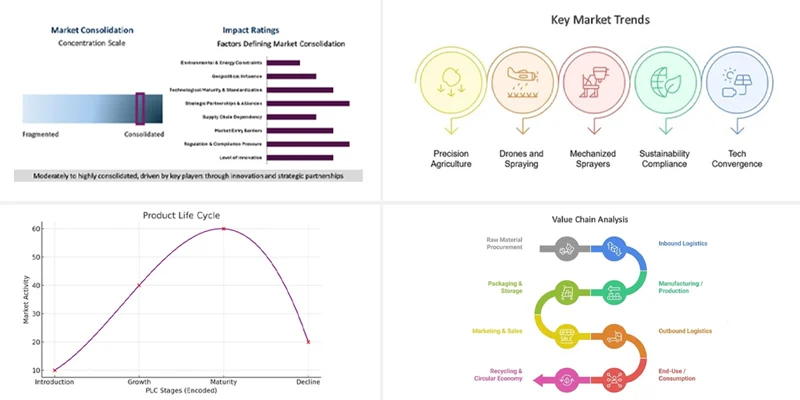

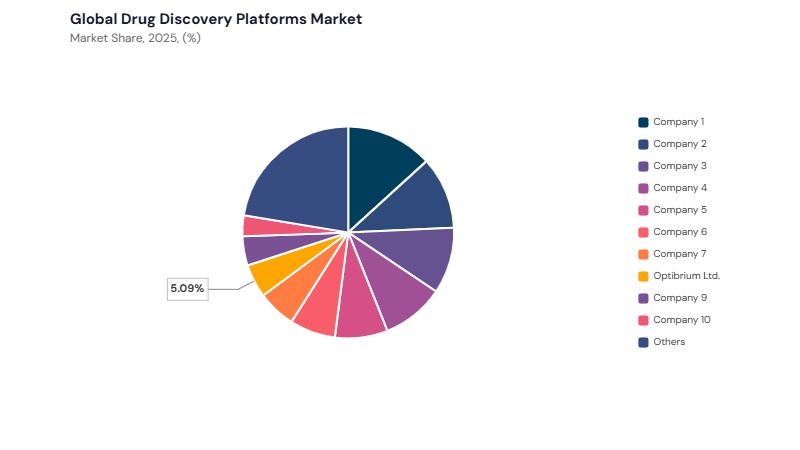
The Drug Discovery Platforms Market exhibits a moderately consolidated structure where the top ten companies collectively account for approximately 77.62% of global market revenue. Schrödinger leads the market with a 13.24% share, followed by Certara and Dassault Systèmes. Other major participants include Thermo Fisher Scientific, Merck KGaA, Insilico Medicine, Genedata, Optibrium, HitGen, and Relay Therapeutics. Competition increasingly revolves around AI-driven discovery capabilities, computational chemistry, biosimulation, bioinformatics, cloud-based scientific research platforms, and integrated pharmaceutical R&D ecosystems. The convergence of artificial intelligence, computational biology, molecular simulations, and multi-omics analytics continues to reshape competitive dynamics globally.
Based on Drug Type, the market is segmented into Small Molecule and Large Molecule. The Small Molecule market dominated the Global Drug Discovery Platforms Market by Drug Type in 2025, and would continue to be a dominant market till 2033; thereby, achieving a market value of USD 7137.8 Million by 2033, growing at a CAGR of 14.6 % during the forecast period. The Large Molecule market is expected to witness a CAGR of 15.6% during (2026 - 2033).
Small Molecule platforms account for the dominant share due to extensive utilization in traditional pharmaceutical development, high-throughput screening, computational chemistry, and structure-based drug design applications. Large Molecule platforms are experiencing strong growth driven by increasing development of biologics, monoclonal antibodies, peptides, recombinant proteins, cell therapies, and gene therapies. The growing adoption of protein engineering, bioinformatics, and advanced biologics discovery technologies continues to strengthen demand for large molecule discovery platforms.
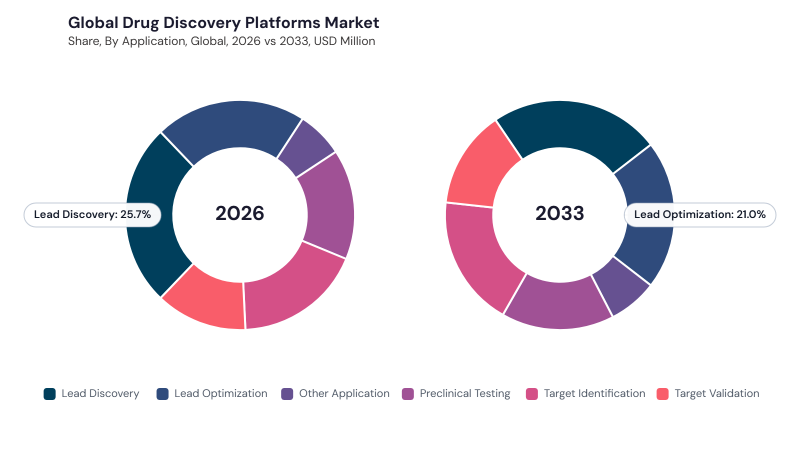
Based on Application, the market is segmented into Lead Discovery, Lead Optimization, Target Identification, Preclinical Testing, Target Validation, and Other Applications. The Lead Discovery market dominated the Global Drug Discovery Platforms Market by Application in 2025, and would continue to be a dominant market till 2033; thereby, achieving a market value of USD 2371.4 Million by 2033, growing at a CAGR of 13.7 % during the forecast period. The Lead Optimization market is expected to witness a CAGR of 14.6% during (2026 - 2033).
Lead Discovery represents a major segment due to extensive deployment of virtual screening, high-throughput screening, and AI-enabled compound identification technologies. Lead Optimization continues to gain importance through predictive modeling and medicinal chemistry applications. Target Identification and Target Validation are witnessing increased adoption driven by genomics, proteomics, CRISPR-based research, and precision medicine initiatives. Preclinical Testing platforms continue to benefit from increasing use of AI-assisted toxicology prediction and organ-on-chip technologies.
Based on End Use, the market is segmented into Biopharmaceutical Companies, CROs/CDMOs, and Academic & Research Institutes. The Biopharmaceutical Companies market dominated the Global Drug Discovery Platforms Market by End Use in 2025, and would continue to be a dominant market till 2033; thereby, achieving a market value of USD 5111.9 Million by 2033, growing at a CAGR of 14.3 % during the forecast period. The CROs/CDMO market is expected to witness a CAGR of 15.4% during (2026 - 2033). The Academic and Research Institutes market is expected to witness a CAGR of 15.5% during (2026 - 2033).
Biopharmaceutical Companies account for the largest market share due to extensive investment in R&D, drug pipeline expansion, and AI-enabled drug development initiatives. CROs/CDMOs represent a rapidly growing segment as pharmaceutical companies increasingly outsource discovery and development activities. Academic and Research Institutes continue to play a vital role in target discovery, biomarker identification, and translational research initiatives that support future pharmaceutical innovation.
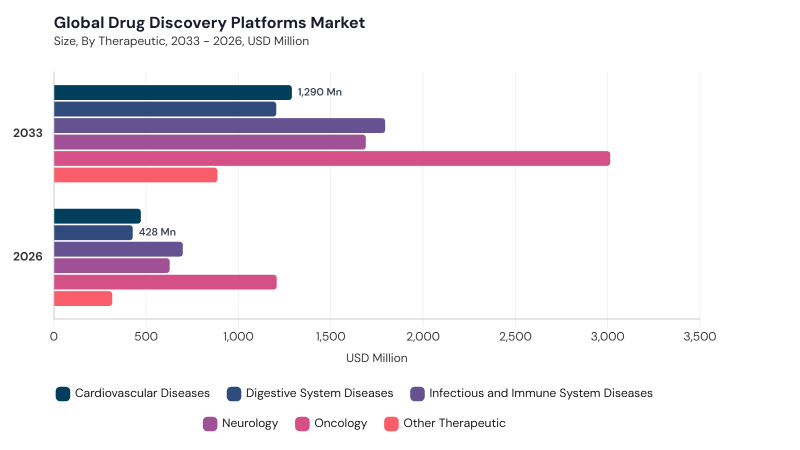
Based on Therapeutic Area, the market is segmented into Oncology, Infectious & Immune System Diseases, Neurology, Cardiovascular Diseases, Digestive System Diseases, and Other Therapeutic Areas. Oncology remains the largest segment owing to extensive cancer research, immuno-oncology advancements, precision medicine initiatives, and increasing demand for targeted therapies. Infectious & Immune System Diseases continue to benefit from growing antimicrobial resistance concerns and emerging infectious disease threats. Neurology is witnessing strong growth driven by increasing investment in neurodegenerative disease therapies, while cardiovascular and digestive system disease research continues to generate substantial platform demand.
Free Valuable Insights: Drug Discovery Platforms Market Size to reach $9,879.2 Million by 2033
Region-wise, the Drug Discovery Platforms Market is analyzed across North America, Europe, Asia Pacific, and LAMEA. The North America market dominated the Global Drug Discovery Platforms Market by Region in 2025, and would continue to be a dominant market till 2033; thereby, achieving a market value of USD 3930.4 Million by 2033, growing at a CAGR of 14.2 % during the forecast period. The Europe market is expected to witness a CAGR of 14.4% during (2026 - 2033). Additionally, The Asia Pacific market is expected to witness a CAGR of 15.8% during (2026 - 2033).
North America dominates the market due to strong pharmaceutical R&D investments, widespread AI adoption, advanced biotechnology infrastructure, and the presence of leading platform providers. Europe remains a major market supported by strong academic research ecosystems, precision medicine initiatives, and regulatory support for digital health innovation. Asia Pacific is expected to witness the fastest growth due to increasing pharmaceutical manufacturing activities, expanding biotech ecosystems, rising healthcare investments, and government support for life sciences innovation. LAMEA is gradually emerging as a growth region driven by expanding healthcare infrastructure and pharmaceutical research initiatives.
Drug Discovery Platforms Market Coverage
| Report Attribute | Details |
|---|---|
| Market size value in 2026 | USD 3,749.3 Million |
| Market size forecast in 2033 | USD 9,879.2 Million |
| Base Year | 2025 |
| Historical Period | 2022 to 2024 |
| Forecast Period | 2026 to 2033 |
| Revenue Growth Rate | CAGR of 14.8% from 2026 to 2033 |
| Number of Pages | 738 |
| Tables | 870 |
| Report Coverage | Market Trends, Revenue Estimation and Forecast, Segmentation Analysis, Regional and Country Breakdown, Competitive Landscape, Market Share Analysis, Company Profiling, Companies Strategic Developments, SWOT Analysis, Product Life Cycle Analysis, Value Chain Analysis, Market Consolidation Analysis, Key Customer Criteria, COVID-19 Impact Analysis, and Winning Imperatives |
| Segments Covered | Drug Type, Application, End Use, Therapeutic Area, Region |
| Country Scope |
|
| Companies Included | Schrödinger, Inc., Certara, Inc., Dassault Systèmes SE, Thermo Fisher Scientific Inc., Merck KGaA, Insilico Medicine, Genedata AG, Optibrium Ltd., HitGen Inc., and Relay Therapeutics, Inc. |
By Drug Type
By Application
By End Use
By Therapeutic Area
By Geography
Expected to reach USD 9,879.2 Million by 2033, with a 14.8% CAGR during 2026-2033.
Lead Discovery segment dominates, growing at a 13.7% CAGR during 2026-2033.
Schrödinger, Inc., Certara, Inc., and Dassault Systèmes SE are leading companies.
North America leads, reaching USD 3,930.4 Million by 2033, with a 14.2% CAGR during 2026-2033.
AI-driven platforms and precision medicine adoption are key growth drivers.
Growing at a 14.8% CAGR during the forecast period (2026-2033).
Our team of dedicated experts can provide you with attractive expansion opportunities for your business.







 Unique Offerings