The sample copy of this report is available for access.
The LAMEA Disposable Cups Market is expected to reach USD 1727.8 million by 2029, growing at a CAGR of 4.7% during (2026 – 2033).
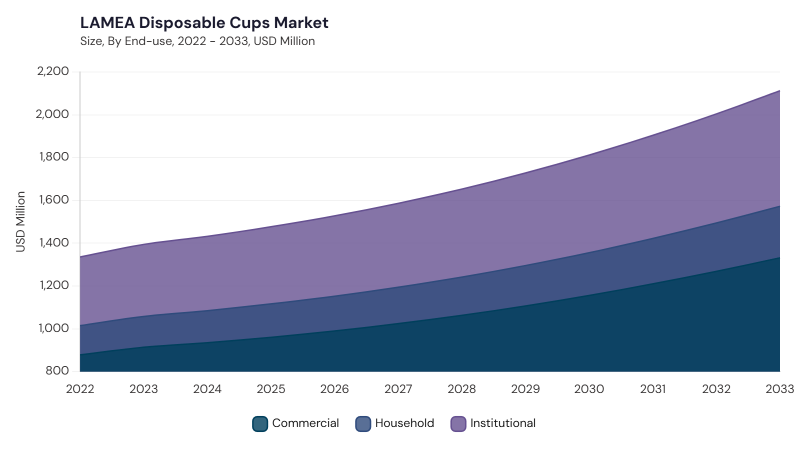
Disposable cup adoption across LAMEA developed alongside rising urbanization, expanding foodservice activity, and increasing demand for convenient and hygienic beverage solutions. Early consumption relied largely on basic plastic and paper cups, while improvements in coatings, laminations, and manufacturing processes gradually strengthened liquid resistance, heat performance, and product durability. Environmental concerns and regulatory pressure later encouraged greater use of biodegradable, compostable, and recyclable alternatives. The market has consequently evolved toward a broader product mix that combines affordability and functionality with growing emphasis on sustainable materials, localized production, and environmental compliance.
Current market development is being shaped by stronger demand for sustainable cups, customized packaging, and improved functionality across foodservice and hospitality channels. Manufacturers are increasingly adopting bio-based polymers, recyclable paper, digital printing, automation, and advanced coating technologies to enhance performance and differentiation. Rising café, restaurant, takeaway, tourism, and event-based consumption continues to support high-volume demand, while regulatory attention to single-use plastics is gradually reshaping material choices. Localization of manufacturing and supply networks is also gaining importance as companies seek greater cost efficiency, responsiveness, and resilience across diverse LAMEA markets.
Based on Product, the market is segmented into Paper, Plastic, and Other Product. The Paper market dominated the LAMEA Disposable Cups Market by Product in 2025, and would continue to be a dominant market till 2033; thereby, achieving a market value of USD 955.2 million by 2029, growing at a CAGR of 4.4 % during the forecast period. The Plastic market is expected to witness a CAGR of 5% during (2026 - 2033). The Other Product market is expected to witness a CAGR of 6% during (2026 - 2033).
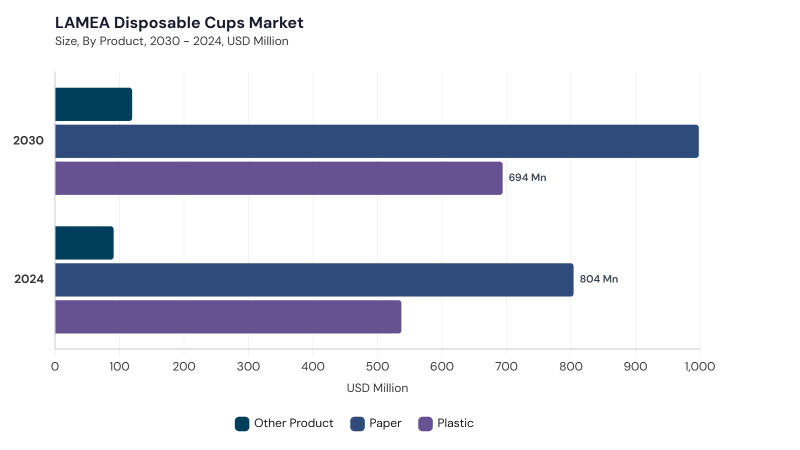
Paper cups are increasingly used across cafés, restaurants, offices, and takeaway beverage applications due to their suitability for hot and cold drinks and stronger alignment with sustainability objectives. Manufacturers are introducing recyclable paperboard, biodegradable coatings, and improved barrier technologies to enhance performance. Plastic cups remain important for cold beverages, outdoor consumption, entertainment venues, and price-sensitive applications because of their affordability, durability, and lightweight characteristics. Other Product includes bagasse-based, bamboo fiber, biodegradable bioplastics, and other bio-derived cup formats that are gradually gaining market acceptance among sustainability-focused users.
Based on End-use, the market is segmented into Commercial, Institutional, and Household. Commercial users require large volumes of durable, hygienic, and convenient cups capable of supporting diverse beverage formats while providing opportunities for branding and customization. Institutional demand is supported by hospitals, educational institutions, corporate offices, and government facilities where hygiene, operational efficiency, and bulk procurement remain important considerations.
Household demand continues through family gatherings, celebrations, outdoor events, and everyday convenience use, with growing environmental awareness gradually encouraging consumers to consider paper, biodegradable, and compostable alternatives.
Free Valuable Insights: Disposable Cups Market Size Worth USD 24.4 Billion billion by 2033
Based on Country, the market is segmented into Brazil, Argentina, UAE, Saudi Arabia, South Africa, Nigeria, and Rest of LAMEA. The Brazil market dominated the LAMEA Disposable Cups Market by Country in 2025, and would continue to be a dominant market till 2033; thereby, achieving a market value of USD 431.0 million by 2029, growing at a CAGR of 3.4 % during the forecast period. The Argentina market is expected to witness a CAGR of 5.9% during (2026 - 2033). Additionally, The UAE market is expected to witness a CAGR of 3.6% during (2026 - 2033).
Brazil and Argentina are strengthening biodegradable, recyclable, and customizable cup offerings alongside expanding food delivery and café consumption, while the UAE and Saudi Arabia are accelerating adoption of compostable and bio-based products under stronger environmental and hospitality-sector influence. South Africa is progressing through recyclable paper-based solutions, biodegradable coatings, and greater local production, whereas Nigeria is combining affordable disposable formats with growing interest in recyclable materials, customized printing, and local manufacturing. Rest of LAMEA is also moving toward plant-based materials, automated production, and more sustainable product designs.

By Product
By End-use
By Country
Set to reach $1727.8 Million by 2029, growing at 4.7% CAGR during 2026–2033.
Brazil leads with $431.0 million by 2029, growing at a CAGR of 3.4% during the forecast period.
The Paper segment will achieve $955.2 million by 2029, growing at a CAGR of 4.4% during the forecast period.
The Plastic segment is expected to witness a CAGR of 5% during 2026–2033.
The UAE market is expected to witness a CAGR of 3.6% during 2026–2033.
The Argentina market is expected to witness a CAGR of 5.9% during 2026–2033.
Our team of dedicated experts can provide you with attractive expansion opportunities for your business.




 Unique Offerings