The sample copy of this report is available for access.
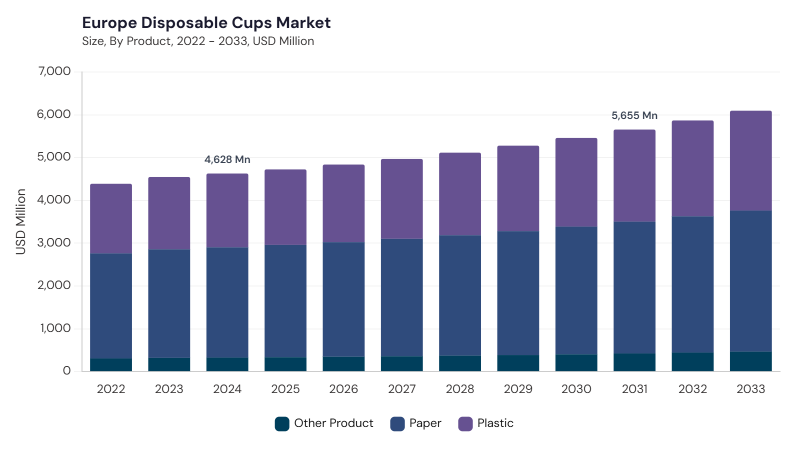
The Europe Disposable Cups Market is expected to reach USD 5.6 billion by 2031, growing at a CAGR of 3.4% during (2026 – 2033).
Disposable cup adoption across Europe developed with the expansion of urban foodservice, takeaway beverages, cafés, and convenience-oriented consumption. Early products were primarily made from paper and polystyrene, with manufacturing focused on affordability and mass production rather than environmental performance. Improvements in coated paper, plastic processing, barrier technologies, and high-volume manufacturing later broadened material choices and functional reliability. Rising regulatory pressure on single-use plastics subsequently transformed product development priorities, accelerating the transition toward recyclable fibers, compostable materials, plant-based plastics, and other sustainable alternatives.
Environmental regulation, consumer sustainability expectations, and continued growth in on-the-go beverage consumption are now shaping market direction. Manufacturers are increasingly investing in recyclable, biodegradable, and compostable cup formats while improving coatings, thermal insulation, printing quality, and product durability. Demand for transparent environmental claims and recognized sustainability certifications is also influencing procurement decisions across foodservice and institutional channels. At the same time, customized printing, premium designs, and multi-functional cup formats are helping suppliers combine environmental compliance with branding, convenience, and improved user experience.
Based on Product, the market is segmented into Paper, Plastic, and Other Product. The Paper market dominated the Europe Disposable Cups Market by Product in 2025, and would continue to be a dominant market till 2033; thereby, achieving a market value of USD 3.0 billion by 2031, growing at a CAGR of 3 % during the forecast period. The Plastic market is expected to witness a CAGR of 3.7% during (2026 - 2033). The Other Product market is expected to witness a CAGR of 4.3% during (2026 - 2033).
Paper cups are widely used across cafés, quick-service restaurants, takeaway outlets, and public events because of their suitability for hot and cold beverages, branding flexibility, and stronger alignment with sustainability objectives. Manufacturers are developing improved barrier coatings, renewable paperboard, and compostable or recyclable lining technologies to enhance environmental performance. Plastic cups continue to serve applications requiring durability, transparency, moisture resistance, and cost efficiency, although regulation is encouraging greater use of recyclable and bio-based materials. Other Product includes compostable fibers, bamboo, bagasse, PLA, PHA, and other bio-based cup alternatives that are gaining acceptance among environmentally focused customers.
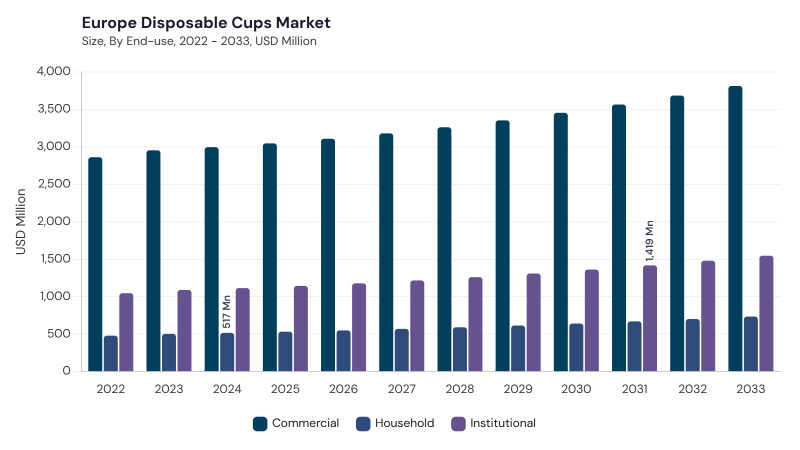
Based on End-use, the market is segmented into Commercial, Institutional, and Household. Commercial users increasingly require disposable cups that combine hygiene, reliable performance, brand customization, and regulatory compliance with sustainability requirements.
Institutional demand is supported by hospitals, schools, corporate offices, government facilities, and public establishments where bulk procurement, hygiene, environmental policies, and waste-management compatibility influence purchasing decisions. Household demand remains comparatively smaller but continues through social gatherings, outdoor recreation, family occasions, and convenience-based beverage consumption, with consumers gradually shifting toward paper, biodegradable, and plant-fiber products.
Free Valuable Insights: The Worldwide Disposable Cups Market is projected to reach USD 24.4 Billion billion by 2033, at a CAGR of 3.6%
Based on Country, the market is segmented into Germany, UK, France, Russia, Spain, Italy, and Rest of Europe. The Germany market dominated the Europe Disposable Cups Market by Country in 2025, and would continue to be a dominant market till 2033; thereby, achieving a market value of USD 1.0 billion by 2031, growing at a CAGR of 1.8 % during the forecast period. The UK market is expected to witness a CAGR of 2.4% during (2026 - 2033). Additionally, The France market is expected to witness a CAGR of 4.1% during (2026 - 2033).
Germany is emphasizing biodegradable materials, circular economy concepts, premium customization, and digitally enabled manufacturing, while the UK is accelerating compostable and recyclable formats alongside take-back and lifecycle initiatives. France continues to strengthen regulatory-driven adoption of bio-based and recycled materials, whereas Russia is gradually expanding biodegradable cup production and localized manufacturing capabilities. Spain is combining compostable materials with customized printing and circular economy initiatives, while Italy is advancing bio-based polymers, recycling programs, and technology-led manufacturing efficiency. Rest of Europe is also progressing through sustainable fibers, digital packaging, localized production, and hygienic single-use solutions.

By Product
By End-use
By Country
Set to reach $5.6 Billion by 2031, growing at 3.4% CAGR during 2026-2033.
Germany leads with a market value of USD 1.0 billion by 2031, growing at a CAGR of 1.8% during the forecast period.
The dominance of the paper product segment, reaching USD 3.0 billion by 2031, is a key growth driver.
The plastic segment will witness a CAGR of 3.7% during 2026-2033.
The UK market is expected to witness a CAGR of 2.4% during 2026-2033.
The France market is expected to witness a CAGR of 4.1% during 2026-2033.
Our team of dedicated experts can provide you with attractive expansion opportunities for your business.




 Unique Offerings