The sample copy of this report is available for access.
The LAMEA Data Encryption Market is expected to reach USD 2.5 Billion by 2029, growing at a CAGR of 12.5% during (2026 – 2033).
The LAMEA Data Encryption Market has developed from early security practices used to protect government communications, financial transactions, and confidential enterprise information into a broader data protection requirement across Latin America, the Middle East, and Africa. In the initial phase, encryption adoption was mainly limited to large organizations and regulated sectors that required basic protection for stored data and secure communication. As internet penetration, digital banking, cloud platforms, mobile applications, e-government services, and connected enterprise systems expanded across the region, encryption became more important for securing data across multiple environments. The market has gradually advanced from basic symmetric encryption toward asymmetric encryption, hybrid encryption models, hardware security modules, cloud encryption, key management systems, and emerging quantum-resistant approaches.
The current market is shaped by increasing cyber threats, cloud adoption, data sovereignty requirements, IoT expansion, digital payment growth, and rising awareness of privacy and cybersecurity risks. LAMEA markets are diverse in terms of infrastructure maturity, regulatory clarity, cybersecurity skills, and enterprise spending capacity, which creates demand for encryption solutions that are scalable, cost-efficient, localized, and easy to manage. Organizations are increasingly seeking encryption technologies that can protect data at rest, in transit, and in use across cloud, on-premises, mobile, telecom, banking, healthcare, public-sector, and industrial environments. Vendors are focusing on cloud-native encryption, AI-assisted key management, compliance-ready reporting, lightweight encryption for IoT devices, and flexible service models.
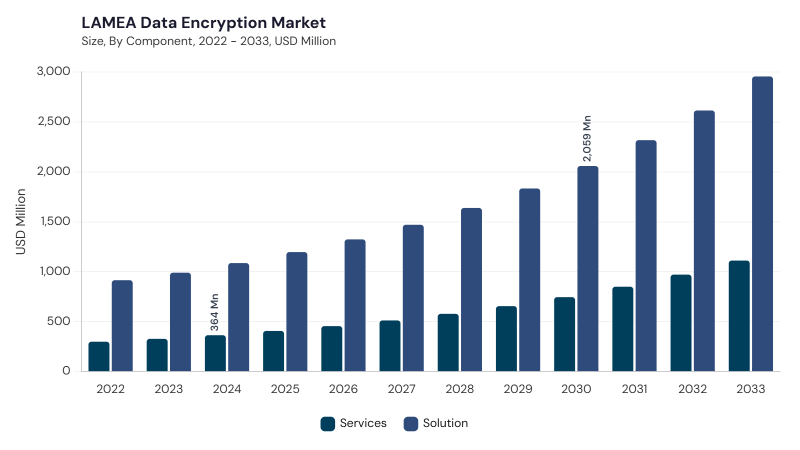
Based on Component, the market is segmented into Solutions and Services. The Solution market dominated the LAMEA Data Encryption Market by Component in 2025, and would continue to be a dominant market till 2033; thereby, achieving a market value of USD 1.8 Billion by 2029, growing at a CAGR of 12.2 % during the forecast period. The Services market is expected to witness a CAGR of 13.6% during (2026 - 2033).
Solutions hold the leading position as organizations across LAMEA increasingly require data-at-rest encryption, cloud encryption, network encryption, endpoint encryption, database encryption, application-level encryption, hardware security modules, and key management systems. These solutions are used to protect sensitive financial data, government records, customer information, healthcare data, telecom traffic, enterprise applications, and intellectual property. Demand is supported by digital banking, mobile payments, cloud-based business platforms, e-government systems, and connected infrastructure projects. Services are also gaining importance as many organizations require expert support for encryption strategy, consulting, implementation, integration, managed encryption, compliance advisory, risk assessment, and technical maintenance. The services segment is especially relevant where in-house cybersecurity skills are limited and businesses need guidance to deploy encryption effectively across developing digital environments.
Based on Deployment, the market is segmented into Cloud and On-Premises. The Cloud market dominated the LAMEA Data Encryption Market by Deployment in 2025, and would continue to be a dominant market till 2033; thereby, achieving a market value of USD 1.5 Billion by 2029, growing at a CAGR of 12.7 % during the forecast period. The On-premises market is expected to witness a CAGR of 12.3% during (2026 - 2033).
Cloud deployment leads the market as enterprises, financial institutions, telecom operators, healthcare providers, public-sector agencies, and digital businesses increasingly migrate workloads to public, private, hybrid, and multi-cloud environments. Cloud encryption helps protect data stored and processed in cloud platforms while supporting remote access, digital applications, SaaS tools, cloud databases, and distributed business operations. Its appeal is linked to scalability, lower upfront cost, automated key management, faster deployment, and compatibility with modern digital transformation programs. On-Premises deployment remains important for organizations that require direct control over encryption infrastructure, cryptographic keys, internal databases, and sensitive information. Government, defense, banking, oil and gas, healthcare, and large enterprises continue to use on-premises encryption where data sovereignty, regulatory compliance, legacy system integration, offline security, and reduced third-party exposure are major priorities.
Based on Organization Size, the market is segmented into Large Enterprises and Small & Medium-Sized Enterprises (SMEs). Large Enterprises represent the dominant organization size because they manage high volumes of sensitive data across multiple departments, data centers, cloud environments, branch locations, and regulated business functions. These organizations require strong encryption platforms with centralized key management, compliance reporting, endpoint protection, database encryption, cloud compatibility, and integration with broader cybersecurity frameworks.
Their demand is driven by higher cyber risk exposure, regulatory expectations, cloud migration, digital customer platforms, and the need to protect business-critical information. SMEs are adopting encryption more gradually as digital payments, cloud software, online customer interaction, and cyber risks increase. Many SMEs prefer cost-effective, subscription-based, easy-to-deploy, and managed encryption services that reduce technical burden. This segment is supported by cloud encryption, built-in platform security, endpoint encryption, and external service providers that help smaller businesses improve data protection without heavy internal investment.
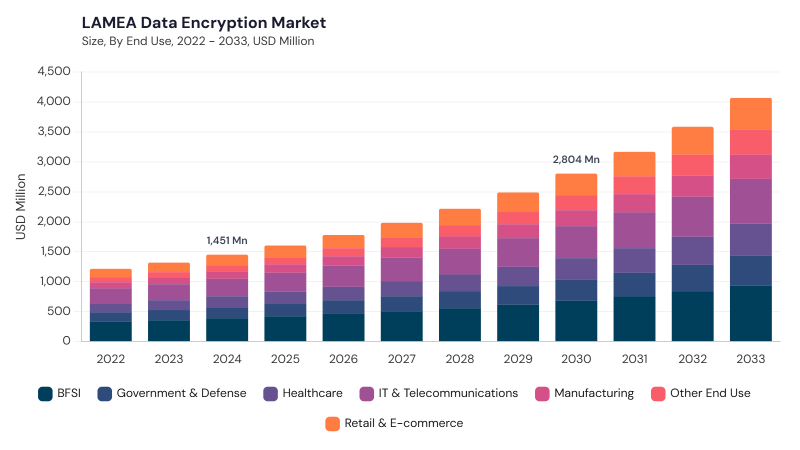
Based on End Use, the market is segmented into BFSI, IT & Telecommunications, Government & Defense, Healthcare, Retail & E-commerce, Manufacturing, and Other End Use. BFSI leads the market as banks, insurers, payment providers, fintech companies, and financial institutions require strong encryption to protect customer records, digital transactions, mobile banking data, payment gateways, online banking platforms, and internal financial systems. Encryption is essential for reducing fraud risks, meeting compliance needs, and building trust in digital financial services. IT & Telecommunications uses encryption to secure telecom networks, data centers, cloud services, customer data, managed services, 5G infrastructure, IoT communication, and enterprise connectivity.
Government & Defense relies on encryption for citizen records, classified communication, public-sector databases, military systems, and critical infrastructure protection. Healthcare uses encryption to secure electronic health records, hospital systems, telemedicine platforms, patient data, and medical IoT devices. Retail & E-commerce applies encryption to online payments, digital wallets, customer databases, checkout systems, and transaction records. Manufacturing uses encryption to protect intellectual property, industrial control systems, production data, connected machinery, and supply chain information, while other end uses include education, energy, transportation, media, and professional services.
Free Valuable Insights: The Global Data Encryption Market will hit USD 36.2 Billion billion by 2033, at a CAGR of 11.6%
Based on Country, the market is segmented into Brazil, Argentina, UAE, Saudi Arabia, South Africa, Nigeria, and Rest of LAMEA. The Brazil market dominated the LAMEA Data Encryption Market by Country in 2025, and would continue to be a dominant market till 2033; thereby, achieving a market value of USD 626.2 million by 2029, growing at a CAGR of 11.1 % during the forecast period. The Argentina market is expected to witness a CAGR of 14% during (2026 - 2033). Additionally, The UAE market is expected to witness a CAGR of 11.7% during (2026 - 2033).
Brazil remains the leading country market due to its growing digital economy, financial modernization, real-time payment systems, e-commerce expansion, data protection regulations, and rising demand for cloud-based encryption. Argentina is gaining traction through cloud adoption, regional privacy compliance, financial data protection, and increasing use of AI-enabled encryption management. The UAE shows strong potential due to advanced digital infrastructure, cloud adoption, smart government initiatives, AI-enabled cybersecurity, financial sector digitization, and strong demand for compliance-ready encryption. Saudi Arabia is advancing through Vision 2030-linked digital transformation, cloud hosting growth, data protection laws, government modernization, and demand for secure data residency. South Africa contributes through POPIA-led privacy compliance, banking sector security, data center expansion, cloud migration, and enterprise cybersecurity adoption. Nigeria is emerging through digital banking growth, cloud adoption, NDPR-related compliance needs, telecom expansion, and increasing awareness of encryption for protecting business and consumer data.

By Component
By Deployment
By Organization Size
By End Use
By Country
Set to reach USD 2.5 Billion by 2033, growing at 12.5% CAGR during 2026-2033.
Brazil leads with a market value of USD 626.2 million by 2029, growing at 11.1% CAGR during 2026-2033.
Cloud deployment dominates, reaching USD 1.5 Billion by 2029 at 12.7% CAGR during 2026-2033.
Solutions segment hits USD 1.8 Billion by 2029, growing at 12.2% CAGR during 2026-2033.
Argentina is expected to witness a CAGR of 14% during 2026-2033.
Services segment is expected to witness a CAGR of 13.6% during 2026-2033.
Our team of dedicated experts can provide you with attractive expansion opportunities for your business.




 Unique Offerings