The sample copy of this report is available for access.
The Asia Pacific Data Encryption Market is expected to reach USD 6.5 Billion by 2030, growing at a CAGR of 12.2% during (2026 – 2033).
The Asia Pacific Data Encryption Market has developed alongside the region’s rapid shift toward digital payments, mobile-first services, cloud platforms, e-commerce, connected devices, smart cities, and enterprise digital transformation. In the earlier stage, encryption adoption was mainly concentrated in banking, government, defense, and large enterprise environments where sensitive records, financial transactions, and confidential communication required protection. As internet penetration, mobile applications, cloud computing, and IoT usage expanded across the region, encryption moved beyond traditional security functions and became a broader requirement for protecting distributed data. The market gradually advanced from basic symmetric encryption to more sophisticated asymmetric encryption, public key infrastructure, hardware security modules, cloud encryption, and automated key management.
The regional market is currently shaped by strict data sovereignty rules, expanding hybrid cloud adoption, rising cyberattacks, AI-enabled fraud risks, growing digital financial activity, and wider use of identity-driven security models. Countries across Asia Pacific have different privacy laws, data residency requirements, and cybersecurity expectations, which makes localized encryption deployment highly important. Enterprises are seeking encryption platforms that can work across cloud, on-premises, multi-cloud, mobile, IoT, and edge environments while maintaining regulatory alignment and performance efficiency. Demand is also increasing for AI-assisted key management, hardware-based encryption, post-quantum readiness, privacy-enhancing technologies, tokenization, and encryption-as-a-service models.
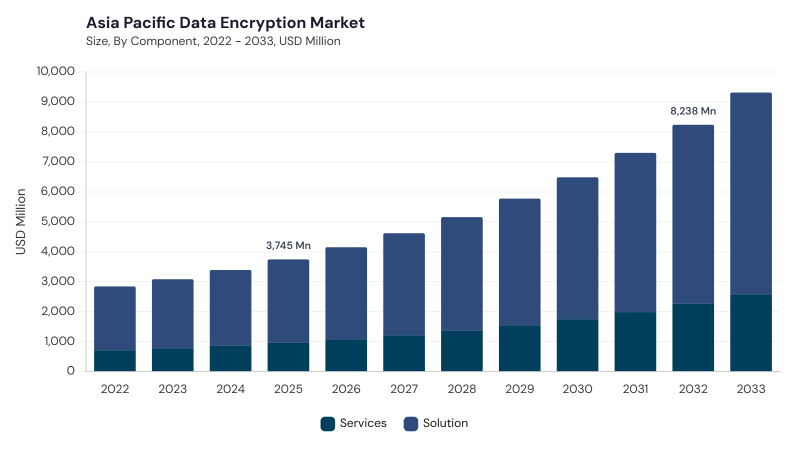
Based on Component, the market is segmented into Solutions and Services. The Solution market dominated the Asia Pacific Data Encryption Market by Component in 2025, and would continue to be a dominant market till 2033; thereby, achieving a market value of USD 4.7 Billion by 2030, growing at a CAGR of 11.9 % during the forecast period. The Services market is expected to witness a CAGR of 13.3% during (2026 - 2033).
Solutions hold the leading position as enterprises across Asia Pacific require encryption software, cloud encryption, database encryption, mobile encryption, network encryption, endpoint encryption, application-level encryption, hardware security modules, and key management systems to protect growing data volumes. These solutions are widely adopted across banking, telecom, government, healthcare, retail, manufacturing, and technology sectors as organizations secure financial transactions, customer records, digital identities, business communication, and cloud workloads. Services are also gaining importance because many businesses need expert assistance for encryption planning, deployment, compliance alignment, system integration, managed encryption, training, security assessment, and ongoing support. As cybersecurity maturity varies widely across the region, services help organizations implement encryption more effectively and manage complex environments involving cloud, legacy systems, mobile platforms, and local data protection rules.
Based on Deployment, the market is segmented into Cloud and On-Premises. The Cloud market dominated the Asia Pacific Data Encryption Market by Deployment in 2025, and would continue to be a dominant market till 2033; thereby, achieving a market value of USD 4.0 Billion by 2030, growing at a CAGR of 12.4 % during the forecast period. The On-premises market is expected to witness a CAGR of 12% during (2026 - 2033).
Cloud deployment leads the market as organizations across Asia Pacific increasingly shift applications, databases, digital services, customer platforms, and business workloads to public, private, hybrid, and multi-cloud environments. Cloud encryption supports secure storage, data transfer, SaaS usage, virtual workloads, digital payment platforms, cloud-native applications, and remote access systems. Its adoption is supported by scalability, faster deployment, centralized policy control, subscription-based models, and integration with identity and access management tools. On-Premises deployment remains important for sectors requiring direct control over encryption infrastructure, sensitive databases, cryptographic keys, and high-security workloads. Government, defense, healthcare, financial services, and large manufacturing organizations often prefer on-premises encryption where data sovereignty, internal governance, legacy system compatibility, low latency, and stronger key ownership are major priorities.
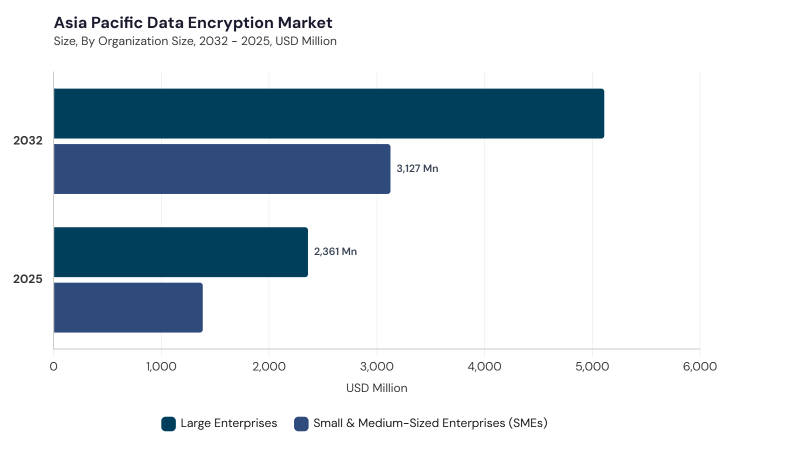
Based on Organization Size, the market is segmented into Large Enterprises and Small & Medium-Sized Enterprises (SMEs). Large Enterprises represent the leading organization size because they manage large volumes of sensitive information across multiple markets, business units, cloud systems, customer applications, internal databases, and compliance environments. These organizations require advanced encryption platforms that support hardware security modules, automated key management, end-to-end encryption, post-quantum readiness, identity integration, and consistent data protection across hybrid IT infrastructure.
SMEs are adopting encryption at a faster pace as e-commerce, digital payments, cloud tools, remote work, and customer data protection needs expand. Many SMEs prefer easy-to-use, affordable, subscription-based, and managed encryption solutions that require limited technical resources. This segment is supported by cloud encryption, built-in business application security, endpoint encryption, and managed service providers that help smaller organizations improve cybersecurity without heavy upfront investment.
Based on End Use, the market is segmented into BFSI, IT & Telecommunications, Government & Defense, Healthcare, Retail & E-commerce, Manufacturing, and Other End Use. BFSI leads the market because banks, insurers, fintech firms, payment processors, and investment companies handle highly sensitive financial data, customer identity records, transaction information, loan data, and digital payment details. Encryption is essential for securing mobile banking, online payments, card systems, customer onboarding, digital wallets, and financial communication. IT & Telecommunications uses encryption to protect large-scale data flows, telecom networks, cloud services, data centers, 5G infrastructure, enterprise platforms, and customer records.
Government & Defense relies on encryption for classified information, citizen records, public digital services, national security communication, and critical infrastructure protection. Healthcare adoption is driven by the need to secure electronic health records, telemedicine, diagnostic data, insurance information, and digital health platforms. Retail & E-commerce uses encryption for payment security, customer privacy, mobile wallets, online marketplaces, and transaction protection. Manufacturing applies encryption to secure intellectual property, smart factory data, IoT communication, production systems, and supply chain information, while other end uses include education, transportation, energy, media, and digital service industries.
Free Valuable Insights: The Global Data Encryption Market will hit USD 36.2 Billion billion by 2033, at a CAGR of 11.6%
Based on Country, the market is segmented into China, Japan, India, South Korea, Singapore, Malaysia, and Rest of Asia Pacific. The China market dominated the Asia Pacific Data Encryption Market by Country in 2025, and would continue to be a dominant market till 2033; thereby, achieving a market value of USD 1.8 Billion by 2030, growing at a CAGR of 10.3 % during the forecast period. The Japan market is expected to witness a CAGR of 11.5% during (2026 - 2033). Additionally, The India market is expected to witness a CAGR of 13% during (2026 - 2033).
China remains the leading country market due to its large digital economy, strong cybersecurity policy focus, domestic technology development, data protection regulations, internet platform security needs, and demand for encryption across cloud, IoT, big data, and financial systems. Japan contributes through mature cloud adoption, strong enterprise cybersecurity practices, financial data security, healthcare digitization, SaaS expansion, and growing interest in homomorphic and quantum-resistant encryption. India is gaining strong momentum through digital payments, cloud migration, e-governance, mobile banking, fintech growth, and regulatory demand linked to personal data protection. South Korea supports growth through advanced telecom infrastructure, blockchain-based security, semiconductor strength, data sovereignty requirements, and AI-enhanced encryption adoption. Singapore is progressing as a regional digital trust hub with strong demand for cloud encryption, AI-powered security, zero-trust architectures, and compliance-ready encryption platforms. Malaysia is developing through cloud adoption, ransomware protection, financial sector security, public-sector digitalization, and rising interest in quantum-safe encryption.

By Component
By Deployment
By Organization Size
By End Use
By Country
Set to reach USD 6.5 Billion by 2033, growing at 12.2% CAGR during 2026-2033.
China leads with USD 1.8 Billion by 2030, growing at 10.3% CAGR during 2026-2033.
Rising enterprise cloud adoption is a main catalyst, with cloud market hitting USD 4.0 Billion by 2030.
Solutions segment reaches USD 4.7 Billion by 2030, growing at 11.9% CAGR during 2026-2033.
India is expected to grow at 13% CAGR during 2026-2033.
Services segment is expected to witness a 13.3% CAGR during 2026-2033.
Our team of dedicated experts can provide you with attractive expansion opportunities for your business.




 Unique Offerings