The sample copy of this report is available for access.
The LAMEA Dark Fiber Market size is expected to reach USD 1,105.7 million by 2029, rising at a market growth of 15.1% CAGR during the forecast period (2026-2033).
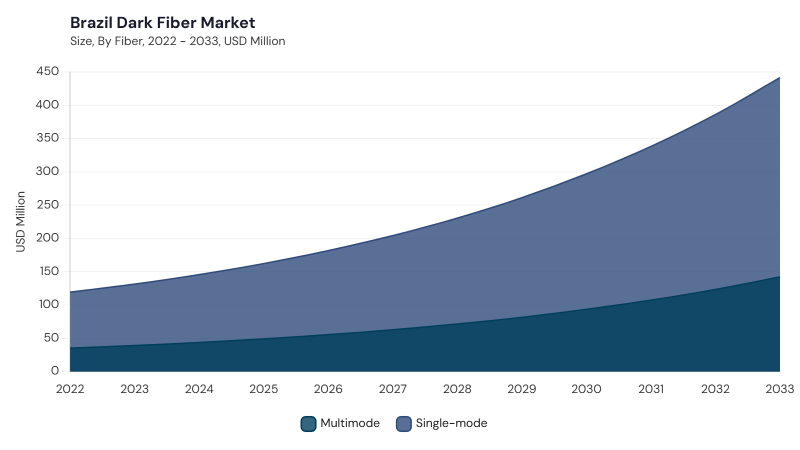
The Brazil market dominated the LAMEA Dark Fiber Market by Country in 2025 with a 24.9% revenue share and would continue to be a dominant market till 2029. The Saudi Arabia market is expected to witness a CAGR of 16.2% during (2026-2033). Additionally, the Nigeria market is expected to witness a CAGR of 16.8% during (2026-2033).
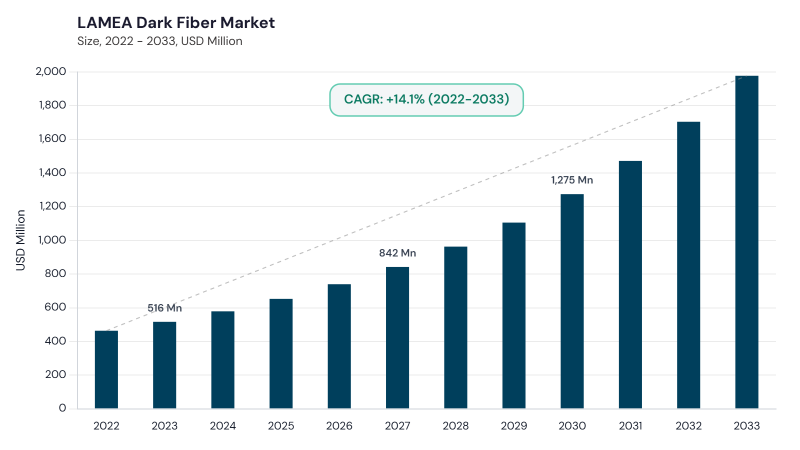
The LAMEA Dark Fiber Market is experiencing strong growth driven by increasing investments in telecom infrastructure modernization, rising demand for high-speed broadband connectivity, accelerating 5G deployment, and expanding hyperscale and colocation data center developments across Latin America, the Middle East, and Africa. Governments and telecom operators across Brazil, UAE, Saudi Arabia, South Africa, and Nigeria are expanding fiber backbone infrastructure to support digital transformation initiatives, smart city projects, cloud computing, and enterprise networking requirements.
Growing adoption of cloud services, increasing internet penetration, and rising demand for low-latency connectivity among enterprises and telecom operators are further supporting market expansion. The region is also witnessing increasing submarine cable deployments and intercity fiber connectivity projects, strengthening the adoption of dark fiber infrastructure.
Based on Fiber, the market is segmented into Single-mode and Multimode. The Single-mode segment dominated the LAMEA Dark Fiber Market by Fiber in 2025 and would continue to be a dominant segment till 2029; thereby, achieving a market value of USD 764.6 million by 2029. Meanwhile, the Multimode segment is expected to witness a CAGR of 16.0% during (2026-2033).
Based on Network, the market is segmented into Metro Network and Long-haul. The Metro Network segment acquired the largest revenue share of 62.6% in the LAMEA Dark Fiber Market by Network in 2025. The segment would continue to lead the market and reach USD 681.8 million by 2029. The Long-haul segment is expected to witness a CAGR of 15.8% during (2026-2033).
Based on Technology, the market is segmented into DWDM and CWDM. The DWDM segment dominated the LAMEA Dark Fiber Market by Technology in 2025 and would continue to be a dominant segment till 2029; thereby, achieving a market value of USD 703.3 million by 2029. The CWDM segment is expected to witness a CAGR of 15.7% during the forecast period.
Based on Application, the market is segmented into Telecom, Data Centers, Enterprise, and Government & Defense. The Telecom segment dominated the LAMEA Dark Fiber Market by Application in 2025 with a revenue share of 45.4%. The Telecom segment would continue to dominate and reach USD 491.6 million by 2029. The Enterprise segment is expected to witness the highest CAGR of 15.9% during (2026-2033). Additionally, the Government & Defense segment is expected to witness a CAGR of 16.0% during the forecast period.
Free Valuable Insights: Dark Fiber Market Size Worth USD 21,383.0 Million billion by 2033
Based on Country, the market is segmented into Brazil, Argentina, UAE, Saudi Arabia, South Africa, Nigeria, and Rest of LAMEA. Brazil continues to dominate the regional market due to strong telecom infrastructure investments, increasing deployment of fiber broadband networks, and growing demand for cloud connectivity services. The UAE and Saudi Arabia are emerging as key growth markets owing to smart city initiatives, rising hyperscale data center developments, and expanding digital transformation projects.

By Fiber
By Network
By Technology
By Application
By Country
Market will reach USD 1,105.7 million by 2029, growing at 15.1% CAGR during 2026-2033.
Brazil dominates with 24.9% revenue share in 2025 and will remain the leading market through 2029.
Expanding telecom infrastructure and growing data center investments fuel regional market growth.
Single-mode fiber leads the market in 2025 due to superior long-distance transmission capabilities.
Metro Network segment captured 62.6% revenue share, serving urban connectivity demands.
Telecom segment dominates the market as carriers expand network infrastructure across the region.
Our team of dedicated experts can provide you with attractive expansion opportunities for your business.




 Unique Offerings