The sample copy of this report is available for access.
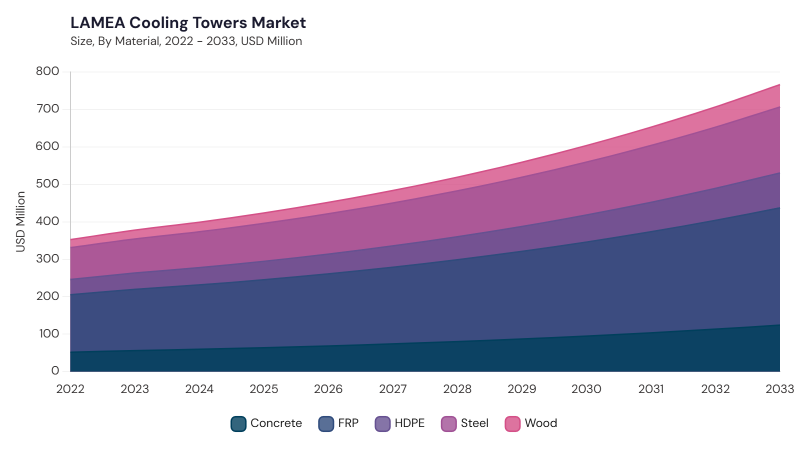
The LAMEA Cooling Tower Market is expected to reach USD 559.0 million by 2029, growing at a CAGR of 7.8% during (2026 – 2033).
The LAMEA Cooling Tower Market developed as industrial facilities, power plants, petrochemical units, and commercial infrastructure required reliable heat dissipation across Latin America, the Middle East, and Africa. Early cooling towers were largely mechanical draft systems using basic materials and manual operating methods. Over time, corrosion-resistant materials, modular construction, better airflow designs, and improved water-management practices expanded adoption across power generation, oil and gas, mining, and manufacturing. The market later moved toward automated and environmentally compliant systems as industries faced rising pressure to improve energy and water efficiency. Today, the market reflects a regionally diverse cooling infrastructure base shaped by harsh climates, industrial expansion, water scarcity, and localized engineering needs.
The current LAMEA Cooling Tower Market is shaped by oil and gas activity, mining and minerals processing, data center growth, smart monitoring, water conservation, and demand for durable systems in challenging environments. Operators are adopting variable frequency drives, optimized fans, corrosion-resistant materials, wastewater recycling, IoT sensors, and predictive maintenance tools to improve efficiency and reliability. In the Middle East, water scarcity and high cooling loads are increasing interest in hybrid and closed-circuit systems. Latin America and Africa are adding demand through resource-based industries, utilities, commercial construction, and digital infrastructure growth. These trends are moving the market toward customized, resilient, and efficiency-driven cooling tower solutions.
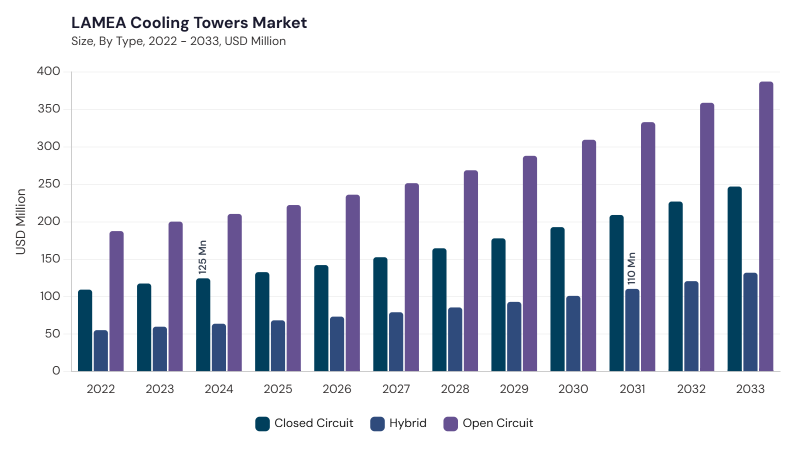
Based on Type, the market is segmented into Open Circuit, Closed Circuit, and Hybrid. The Open Circuit market dominated the LAMEA Cooling Tower Market by Type in 2025, and would continue to be a dominant market till 2033; thereby, achieving a market value of USD 288.1 million by 2029, growing at a CAGR of 7.3 % during the forecast period. The Closed Circuit market is expected to witness a CAGR of 8.2% during (2026 - 2033). The Hybrid market is expected to witness a CAGR of 8.7% during (2026 - 2033).
Open circuit cooling towers lead due to their economical operation, high heat rejection capability, and broad use across heavy industries, power facilities, manufacturing units, and commercial developments. These systems remain attractive where reliable cooling performance and lower initial cost are key priorities. Closed circuit towers are expanding as industries seek reduced fouling, improved process reliability, and better water utilization in mining, petrochemicals, food processing, and chemical applications. Hybrid systems remain the smallest segment, although water-scarce regions and sustainability-focused projects are gradually improving their adoption prospects.
Based on Application, the market is segmented into Industrial, HVAC, Power Generation, and Oil & Gas. The Industrial market dominated the LAMEA Cooling Tower Market by Application in 2025, and would continue to be a dominant market till 2033; thereby, achieving a market value of USD 158.6 million by 2029, growing at a CAGR of 6.9 % during the forecast period. The HVAC market is expected to witness a CAGR of 8% during (2026 - 2033). Additionally, The Power Generation market is expected to witness highest CAGR of 8.4% during (2026 - 2033).
Industrial applications lead due to expanding mining, metal processing, chemical production, manufacturing, and resource-based industries across Latin America and Africa. HVAC demand is increasing with commercial complexes, healthcare facilities, hospitality projects, mixed-use developments, and district cooling projects, particularly in Gulf countries. Power generation continues to support demand as electricity capacity and grid infrastructure expand to serve rising energy consumption. Oil and gas remains strategically important across the Middle East, Brazil, Nigeria, and South Africa, where cooling towers support refining, petrochemical, processing, and continuous plant operations.
Based on Material, the market is segmented into FRP, Steel, Concrete, HDPE, and Wood. FRP leads due to its corrosion resistance, lightweight structure, low maintenance needs, and ability to perform in humid, saline, dusty, and chemically demanding environments. Steel maintains a strong presence in large industrial plants, refinery projects, and energy facilities requiring heavy structural strength and high-capacity performance.
Concrete remains important for utility-scale power plants and permanent installations where long service life and stability are critical. HDPE is gaining recognition in municipal and industrial applications due to chemical resistance and easy installation, while wood is declining as modernization shifts demand toward advanced engineered materials.
Free Valuable Insights: Cooling Tower Market Size Worth USD 7.1 Billion billion by 2033
Based on Country, the market is segmented into Brazil, Argentina, UAE, Saudi Arabia, South Africa, Nigeria, and Rest of LAMEA. The Brazil market dominated the LAMEA Cooling Tower Market by Country in 2025, and would continue to be a dominant market till 2033; thereby, achieving a market value of USD 128.7 million by 2029, growing at a CAGR of 6.4 % during the forecast period. The Argentina market is expected to witness a CAGR of 8.6% during (2026 - 2033). Additionally, The UAE market is expected to witness a CAGR of 6.7% during (2026 - 2033).
Brazil leads due to industrial diversification, power generation demand, data center expansion, water reuse initiatives, and modernization of legacy cooling systems. Argentina supports demand through manufacturing, power facilities, sustainable cooling upgrades, and rising adoption of digital monitoring. The UAE contributes through petrochemical growth, district cooling, commercial infrastructure, smart controls, and water-efficient tower designs. Saudi Arabia, South Africa, and Nigeria add demand through oil and gas, mining, power generation, industrial parks, and infrastructure expansion, while Rest of LAMEA benefits from gradual industrial modernization and localized cooling tower adoption.

By Type
By Application
By Material
By Country
Set to reach $559.0 Million by 2029, growing at 7.8% CAGR during (2026 – 2033).
Brazil leads with a market value of USD 128.7 million by 2029, growing at a CAGR of 6.4% during the forecast period.
The Industrial segment leads with USD 158.6 million by 2029, growing at a CAGR of 6.9% during the forecast period.
Open Circuit segment will achieve USD 288.1 million by 2029, growing at a CAGR of 7.3% during the forecast period.
The Argentina market is expected to witness a CAGR of 8.6% during (2026 - 2033).
The Hybrid segment is expected to witness a CAGR of 8.7% during (2026 - 2033).
Our team of dedicated experts can provide you with attractive expansion opportunities for your business.




 Unique Offerings