The sample copy of this report is available for access.
“Global Cooling Tower Market to reach a market value of USD 7,129.28 Million by 2033 growing at a CAGR of 6.4%”
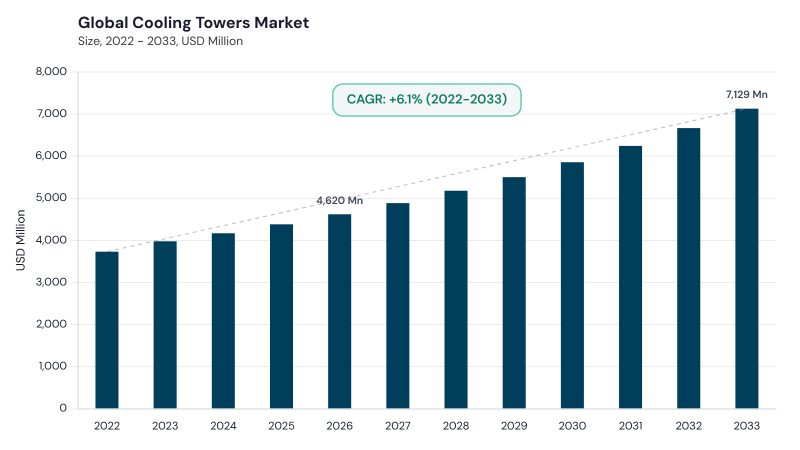
The Global Cooling Tower Market is expected to reach USD 7.1 billion by 2033, growing at a CAGR of 6.4% during (2026 - 2033).
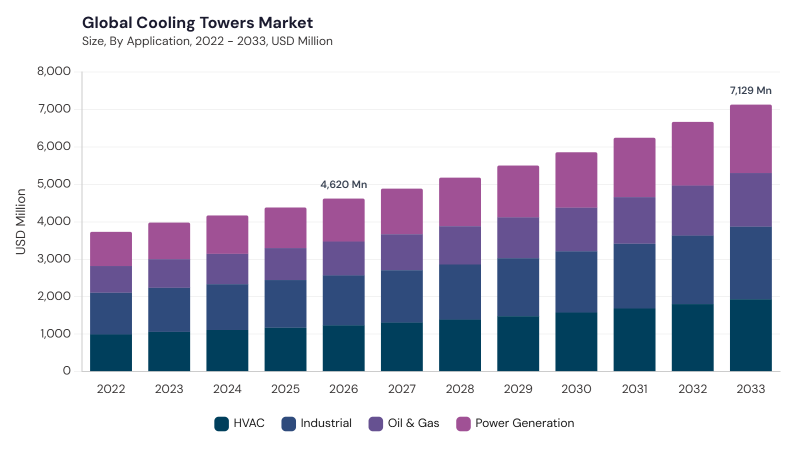
Cooling tower market is driven by increasing demand for efficient heat removal systems across HVAC, power generation, chemical processing, oil & gas, data center, and manufacturing applications. Industries are largely focusing on water conservation, operational efficiency, energy savings, and equipment reliability, which is supporting demand for advanced cooling tower systems. The market evolved in late 19th and early 20th centuries, when industrialization created the demand for effective heat dissipation in chemical production, manufacturing, and power generation.
Cooling tower market is expanding as industrial facilities, commercial buildings, data centers, and power plants continue to need reliable thermal management systems. Increasing demand for hybrid, closed-circuit, modular, and digitally monitored cooling towers is redefining product design. Predictive maintenance, smart monitoring, and sustainable water treatment are also becoming considerable elements for product demand. End users are largely prioritizing energy efficiency, water savings, lower lifecycle costs, and corrosion resistance.
Competitive landscape of the market is industrial infrastructure-driven, with thermal engineering companies, specialized cooling tower manufacturers, and heat rejection solution providers competing to position themselves ahead in the market. Market players are competing through corrosion-resistant materials, energy-efficient designs, digital monitoring, water conservation capabilities, hybrid cooling systems, and strong lifecycle service offerings.
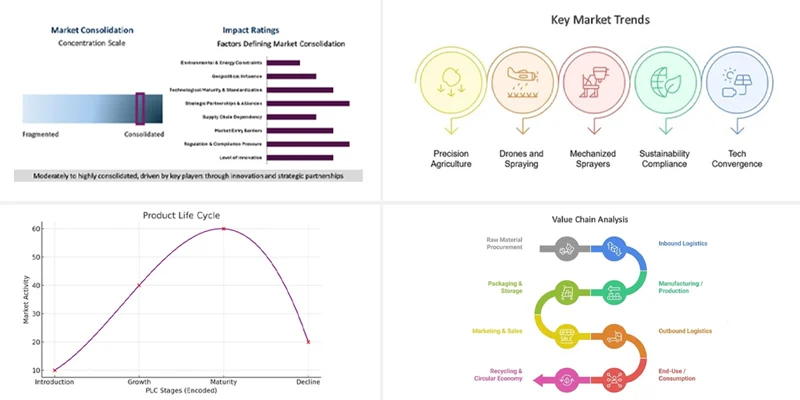

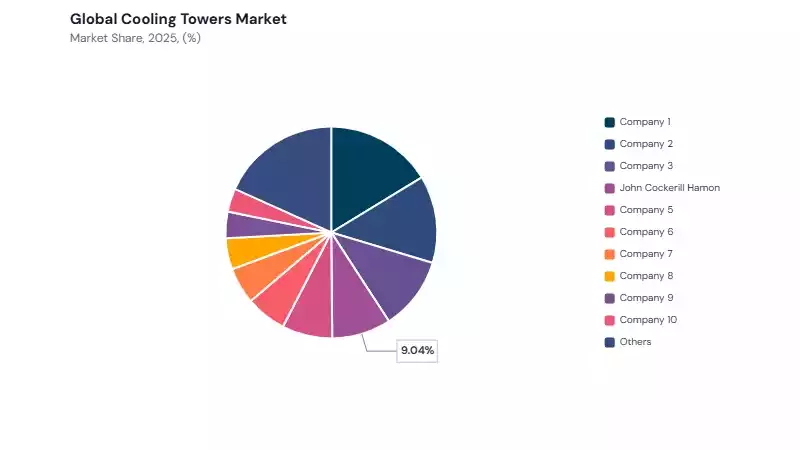
Cooling tower market represents moderately consolidated competitive landscape, supported by established thermal management solution providers and cooling tower manufacturers. John Cockerill Hamon, EVAPCO, Baltimore Aircoil Company, Kelvion, and SPX Technologies hold strong market positions through industrial expertise, broad product portfolio, and global service networks. Babcock & Wilcox, Paharpur Cooling Towers, Thermax, Liang Chi, and ENEXIO further drive competition through regional capabilities, sustainable cooling technologies, and customized systems.
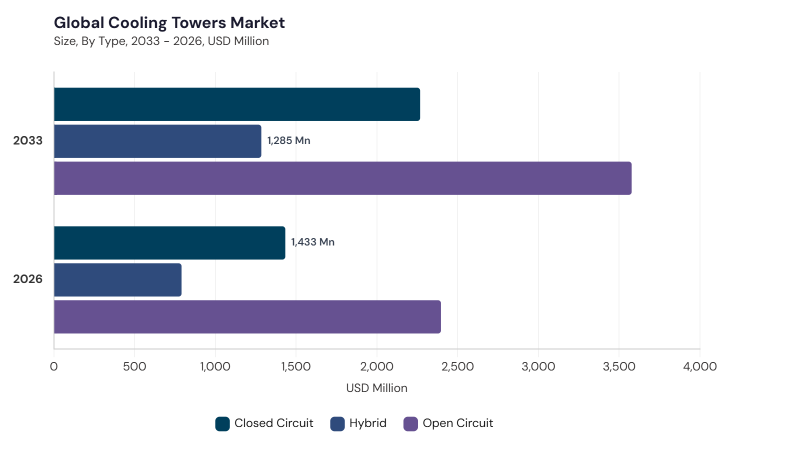
Based on Type, the market is segmented into Open Circuit, Closed Circuit, and Hybrid. The Open Circuit market dominated the Global Cooling Tower Market by Type in 2025, and would continue to be a dominant market till 2033; thereby, achieving a market value of USD 3.6 billion by 2033, growing at a CAGR of 5.9 % during the forecast period. The Closed Circuit market is expected to witness a CAGR of 6.8% during (2026 - 2033). The Hybrid market is expected to witness a CAGR of 7.2% during (2026 - 2033).
Open Circuit cooling towers remain widely used because they offer effective heat rejection with relatively simple installation and operating requirements. Closed Circuit towers are preferred in applications requiring cleaner fluid circulation, reduced fouling, and better reliability. Hybrid towers are gaining relevance in water-stressed regions and facilities seeking flexible cooling performance. Sustainability, environmental regulation, and lifecycle efficiency are influencing demand across all type segments.
Based on Application, the market is segmented into Industrial, HVAC, Power Generation, and Oil & Gas. The Industrial market dominated the Global Cooling Tower Market by Application in 2025, and would continue to be a dominant market till 2033; thereby, achieving a market value of USD 1.9 billion by 2033, growing at a CAGR of 5.5 % during the forecast period. The HVAC market is expected to witness a CAGR of 6.6% during (2026 - 2033). Additionally, The Power Generation market is expected to witness highest CAGR of 6.9% during (2026 - 2033).
Industrial users rely on cooling towers to maintain process efficiency, reduce equipment stress, and support continuous operations. HVAC applications benefit from growing commercial infrastructure and demand for energy-efficient building cooling. Power generation facilities require large-scale cooling infrastructure to maintain plant efficiency and operational reliability. Oil & Gas applications depend on durable cooling systems that can withstand demanding operating environments and process-related heat loads.
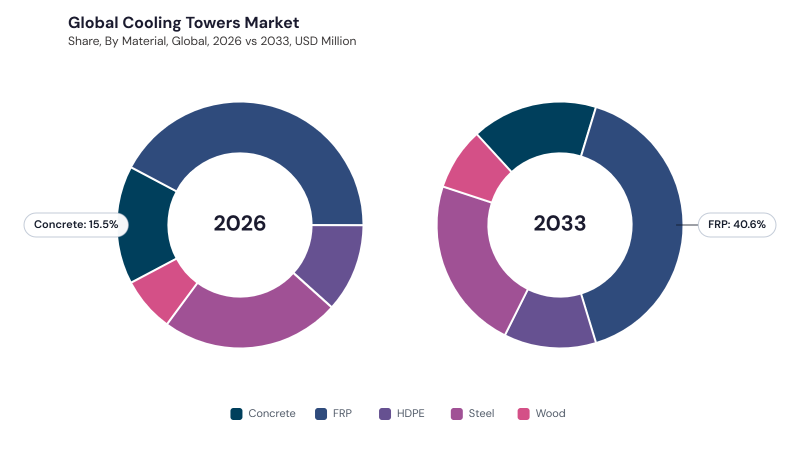
Based on Material, the market is segmented into FRP, Steel, Concrete, HDPE, and Wood. The FRP market dominated the Global Cooling Tower Market by Material in 2025, and would continue to be a dominant market till 2033; thereby, achieving a market value of USD 2.9 billion by 2033, growing at a CAGR of 5.8 % during the forecast period. The Steel market is expected to witness a CAGR of 5.9% during (2026 - 2033). Additionally, The Concrete market is expected to witness highest CAGR of 7.4% during (2026 - 2033).
FRP is preferred where corrosion resistance, installation flexibility, and low maintenance are important. Steel is used in demanding industrial applications where strength and structural reliability are required. Concrete supports long-life infrastructure in power generation and large industrial facilities. HDPE is gaining attention in moderate-duty applications due to chemical resistance and ease of installation. Wood remains limited to legacy and retrofit installations where traditional systems are still in use.
Free Valuable Insights: Cooling Tower Market Size to reach $7.1 Billion by 2033
Region-wise, the Cooling Tower Market is analyzed across North America, Europe, Asia Pacific, and LAMEA. APAC region has dominated the cooling tower market, capturing a market value of USD 2.8 billion, expanding at a CAGR of 6.8%. The North America market is estimated to experience significant growth with a CAGR of 5.7% during forecast period. Moreover, Europe market is predicted to witness a CAGR of 6%.
Asia Pacific continues to benefit from urban development, expanding industrial capacity, and increasing demand for reliable process cooling. North America is driven by data center expansion, replacement demand, and water saving technology adoption. LAMEA is gaining traction through industrial growth, oil & gas projects, and enhancing infrastructure investment across the region.
| Report Attribute | Details |
|---|---|
| Market size value in 2026 | USD 4.6 billion |
| Market size forecast in 2033 | USD 7.1 billion |
| Base Year | 2025 |
| Historical Period | 2022 to 2024 |
| Forecast Period | 2026 to 2033 |
| Revenue Growth Rate | CAGR of 6.4% from 2026 to 2033 |
| Number of Pages | XX |
| Tables | XX |
| Report Coverage | Market Trends, Revenue Estimation and Forecast, Segmentation Analysis, Regional and Country Breakdown, Competitive Landscape, Market Share Analysis, Company Profiling, Companies Strategic Developments, SWOT Analysis, Product Life Cycle Analysis, Value Chain Analysis, Market Consolidation Analysis, Key Customer Criteria, Pandemic Impact Analysis, and Winning Imperatives |
| Segments Covered | Type, Application, Material, and Geography |
| Country Scope |
|
| Companies Included | SPX Technologies, Inc.; Baltimore Aircoil Company, Inc.; EVAPCO, Inc.; John Cockerill Hamon; Kelvion Holding GmbH; Paharpur Cooling Towers Ltd.; Babcock & Wilcox Enterprises, Inc.; ENEXIO Management GmbH; Liang Chi Industry Co., Ltd.; Thermax Limited |
By Type
By Application
By Material
By Geography
Expected to reach USD 7.1 billion by 2033, growing at 6.4% CAGR during 2026-2033.
Open Circuit segment leads, projected to achieve USD 3.6 billion by 2033.
SPX Technologies, Baltimore Aircoil, EVAPCO, John Cockerill Hamon, Kelvion, Paharpur, Babcock & Wilcox, ENEXIO, Liang Chi.
Asia Pacific leads, expected to reach USD 2.8 billion by 2033.
Energy-efficient cooling demand and stringent water regulations drive market growth.
FRP segment dominates, projected to reach USD 2.9 billion by 2033.
Our team of dedicated experts can provide you with attractive expansion opportunities for your business.








 Unique Offerings