The sample copy of this report is available for access.
The LAMEA Cattle Management Software Market is expected to reach USD 380.2 million by 2029, growing at a CAGR of 12.9% during (2026 - 2033).
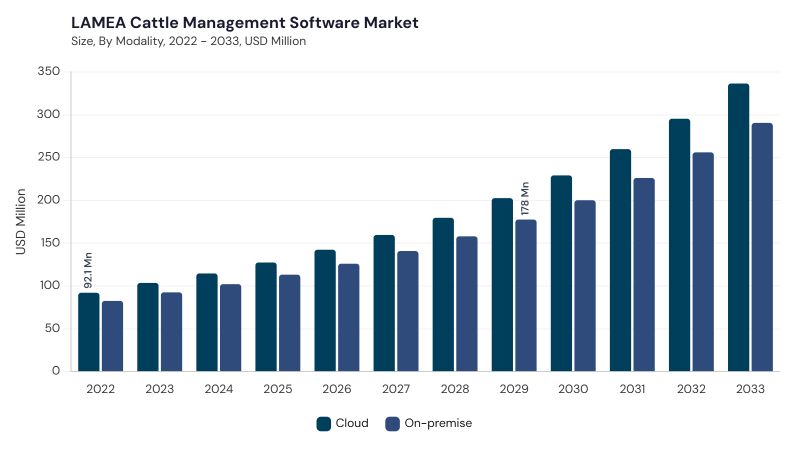
The LAMEA Cattle Management Software Market is developing across a highly heterogeneous livestock landscape, covering commercially important beef-producing environments in Latin America, technologically intensive dairy operations in the Gulf, and large but comparatively under-digitized cattle populations across Africa. Brazil and Argentina create opportunities around beef herd management, electronic identification, breeding, pasture management, animal health, movement, and traceability, while the UAE and Saudi Arabia emphasize intensive dairy management, precision feeding, environmental monitoring, automation, and food-security-linked production. South Africa combines commercial livestock operations with emerging traceability infrastructure, while Nigeria is beginning to strengthen national livestock data systems, identification, and digital management.
Electronic animal identification, livestock traceability, mobile-first platforms, cloud-based management, and integrated health, breeding, feeding, and productivity records are shaping current market development. Brazil’s individual identification plan, Argentina’s mandatory electronic identification for calves, South Africa’s livestock traceability implementation, and Nigeria’s national livestock information system are creating stronger digital foundations for cattle software adoption. Large beef operations require tools connecting RFID, weights, grazing, breeding, movement, treatments, and commercial performance, while Gulf dairies prioritize continuous monitoring, feed optimization, cooling, milking, and predictive health. However, high system costs, rural connectivity limitations, diverse production models, digital-skill gaps, data-quality challenges, and interoperability between public and private systems continue to influence adoption across LAMEA.
Based on Sector, the market is segmented into Dairy and Meat. The Dairy market dominated the LAMEA Cattle Management Software Market by Sector in 2025, and would continue to be a dominant market till 2033; thereby, achieving a market value of USD 241.9 million by 2029, growing at a CAGR of 12.4 % during the forecast period. The Meat market is expected to witness a CAGR of 13.7% during (2026 - 2033).
Dairy remains a technology-intensive area because dairy animals generate frequent information through milking, feeding, reproduction, health, lactation, and activity monitoring. Commercial dairies in Brazil, Argentina, South Africa, Saudi Arabia, the UAE, and other markets can use centralized platforms to connect milk production with health, feeding, reproductive status, and sensor information. Meat retained a promising presence due to demand for cattle identification, weight assessment, herd movement, supply-chain traceability, slaughter readiness, pasture use, feedlot performance, and commercial sale decisions. As Brazil and Argentina move further toward individual traceability and African markets strengthen livestock information systems, Meat offers strong long-term potential for specialized beef-management software.
Based on Software, the market is segmented into Monitoring, Trading/Breeding Management, and Other Software. The Monitoring market dominated the LAMEA Cattle Management Software Market by Software in 2025, and would continue to be a dominant market till 2033; thereby, achieving a market value of USD 249.3 million by 2029, growing at a CAGR of 12.6 % during the forecast period. The Trading/Breeding Management market is expected to witness a CAGR of 13.3% during (2026 - 2033).
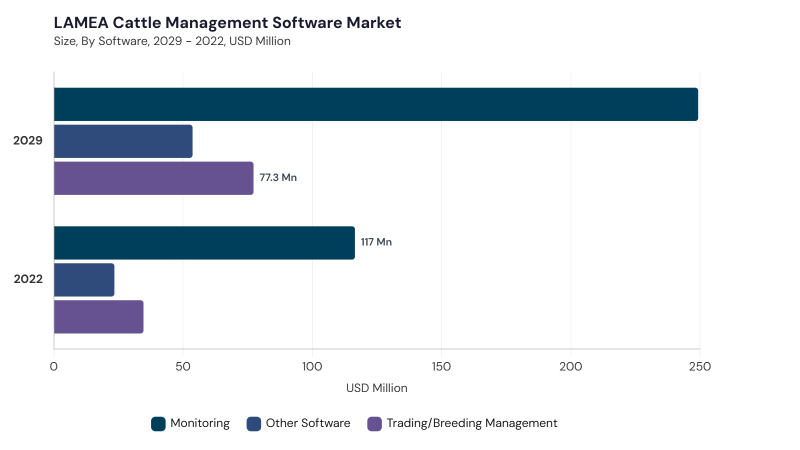
Monitoring software includes animal activity, behavior, temperature, rumination, feeding, location, production, and other indicators generated through sensors, equipment, or mobile systems. It helps commercial dairies, feedlots, and high-value breeding operations reduce dependence on manual observation by identifying animals requiring specific attention. Trading/Breeding Management supports reproductive records, heat detection, insemination, pregnancy, calving, genetics, offspring, animal valuation, inventory, movement, purchasing, and sale decisions. Other Software includes livestock inventory, grazing, movement records, vaccination, treatment history, traceability, employee tasks, veterinary records, market information, financial analysis, regulatory reporting, and broader farm-business management. Greater availability of mobile agricultural technologies and connected livestock solutions is improving software access across the region.
Based on Modality, the market is segmented into Cloud and On-premise. Cloud deployment enables remote access, centralized records, multi-property management, software updates, advisor collaboration, historical analytics, and scalable decision support without requiring every farm to maintain complex local IT infrastructure. It is especially useful for livestock enterprises, veterinarians, advisors, and government-linked systems managing geographically dispersed cattle information.
On-premise demonstrated a promising presence among intensive dairies, feedlots, and enterprises requiring local data control, customized workflows, continuous equipment operation, and independence from uninterrupted internet access. Hybrid architectures are becoming increasingly relevant as critical milking, feeding, identification, sorting, and environmental systems operate locally while cloud services support analytics, backup, remote access, and multi-site reporting.
Based on Application, the market is segmented into Milking Harvesting Management, Health Monitoring, Breeding Management, Feeding Management, and Other Application. Milking Harvesting Management supports milk yield, milking frequency, animal identification, parlor or robotic performance, milk-quality indicators, equipment utilization, and production deviations. Health Monitoring secured a substantial share as producers focus on disease surveillance, vaccination, veterinary intervention, treatment histories, movement restrictions, sensor-based alerts, and livestock-loss reduction.
Breeding Management supports heat detection, insemination, pregnancy, calving, sire and dam records, genetics, replacement selection, and reproductive performance, while Feeding Management supports ration planning, feed inventory, intake tracking, feed costs, group allocation, pasture supplementation, and automated feeding. Other Application includes animal identification, movement, grazing, inventory, traceability, vaccination, veterinary services, employee management, regulatory compliance, sustainability records, market information, and financial analytics, expanding the role of cattle software beyond basic production management.
Free Valuable Insights: Cattle Management Software Market Size Worth USD 4881.6 Million billion by 2033
Based on Country, the market is segmented into Brazil, Argentina, UAE, Saudi Arabia, South Africa, Nigeria, and Rest of LAMEA. The Brazil market dominated the LAMEA Cattle Management Software Market by Country in 2025, and would continue to be a dominant market till 2033; thereby, achieving a market value of USD 112.4 million by 2029, growing at a CAGR of 11.7 % during the forecast period. The Argentina market is expected to witness a CAGR of 13.8% during (2026 - 2033). Additionally, The UAE market is expected to witness a CAGR of 10.4% during (2026 - 2033).
Across LAMEA, cattle management software adoption varies with beef and dairy scale, traceability regulation, digital infrastructure, connectivity, and livestock modernization. Brazil emphasizes large-scale beef management, PNIB identification, SISBOV traceability, RFID integration, grazing, breeding, pasture management, and dairy monitoring. Argentina is advancing through mandatory electronic identification for calves, increasing demand for tag scanning, movement records, health tracking, inventory, and offline field management. The UAE focuses on intensive dairy operations, heat-stress management, feeding precision, automation, and cloud analytics, while Saudi Arabia prioritizes large commercial dairies, resource efficiency, cooling, reproduction, and health monitoring. South Africa combines dairy and beef management with RFID, disease surveillance, movement control, and regulatory traceability. Nigeria remains at an earlier stage, supported by livestock tagging, mobile data collection, vaccination, treatment, and inventory systems, while other LAMEA markets emphasize affordable mobile tools, traceability, cloud platforms, and local support.

By Sector
By Software
By Modality
By Application
By Country
Set to reach $380.2 Million by 2029, growing at 12.9% CAGR during 2026-2033.
Brazil leads with $112.4 million by 2029, growing at 11.7% CAGR during the forecast period.
The Dairy sector will achieve $241.9 million by 2029, growing at 12.4% CAGR during the forecast period.
Monitoring software will reach $249.3 million by 2029, growing at 12.6% CAGR during the forecast period.
The Argentina market is expected to witness a CAGR of 13.8% during 2026-2033.
The Meat sector will grow at a CAGR of 13.7% during 2026-2033.
Our team of dedicated experts can provide you with attractive expansion opportunities for your business.




 Unique Offerings
