The sample copy of this report is available for access.
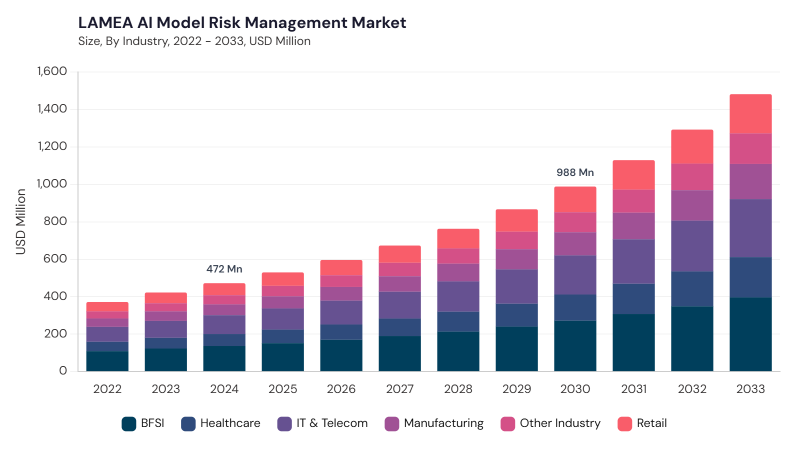
The LAMEA AI Model Risk Management Market is expected to reach USD 866.9 million by 2029, growing at a CAGR of 13.9% during (2026 - 2033).
The LAMEA AI Model Risk Management Market evolved from limited and fragmented approaches to AI oversight toward more structured frameworks focused on bias, data privacy, operational reliability, and regulatory compliance. Early adoption remained cautious because of uneven digital infrastructure, limited specialist expertise, and relatively immature governance requirements across Latin America, the Middle East, and Africa. Expanding use of AI in banking, telecommunications, government, healthcare, and other high-impact sectors gradually increased demand for dedicated model validation, explainability, monitoring, and governance capabilities. Current market development increasingly combines automated risk assessment, lifecycle governance, real-time monitoring, explainable AI, and compliance-focused controls adapted to diverse regulatory and operating environments.
Regulatory intervention, continuous model oversight, ethical AI, cybersecurity integration, and hybrid deployment models are shaping current market development. Enterprises increasingly require solutions capable of identifying model drift, bias, anomalous behavior, data-security risks, performance deterioration, and compliance gaps throughout the AI lifecycle. Digital transformation and expanding AI adoption across financial services, telecom, healthcare, manufacturing, retail, and public services are strengthening demand for scalable and locally adaptable governance platforms. Cloud-based monitoring, automated validation, real-time analytics, and integrated risk frameworks are broadening adoption, although fragmented regulations, high implementation costs, talent shortages, infrastructure constraints, data-sovereignty concerns, and limited interoperability continue to influence deployment across LAMEA.
Based on Industry, the market is segmented into BFSI, IT & Telecom, Retail, Healthcare, Manufacturing, and Other Industry. The BFSI market dominated the LAMEA AI Model Risk Management Market by Industry in 2025, and would continue to be a dominant market till 2033; thereby, achieving a market value of USD 240.3 million by 2029, growing at a CAGR of 12.9 % during the forecast period. The IT & Telecom market is expected to witness a CAGR of 13.6% during (2026 - 2033). Additionally, The Retail market is expected to witness highest CAGR of 14.5% during (2026 - 2033).
BFSI emphasizes explainability, validation, continuous monitoring, fairness, auditability, and compliance across financial applications. IT & Telecom applies AI risk controls to network optimization, cybersecurity, customer-service automation, intelligent infrastructure, and data-intensive platforms, while Retail focuses on merchandising, personalization, customer segmentation, demand forecasting, pricing, and digital-commerce governance. Healthcare requires oversight of predictive analytics, diagnostics, patient-facing systems, and administrative workflows, whereas Manufacturing emphasizes reliability in intelligent quality control, equipment analytics, automation, and production optimization. Other Industry includes energy, transportation, agriculture, logistics, public services, and additional sectors progressively formalizing AI governance.
Based on Deployment, the market is segmented into Cloud, On-premises, and Hybrid. The Cloud market dominated the LAMEA AI Model Risk Management Market by Deployment in 2025, and would continue to be a dominant market till 2033; thereby, achieving a market value of USD 445.7 million by 2029, growing at a CAGR of 13.3 % during the forecast period. The On-premises market is expected to witness a CAGR of 14.3% during (2026 - 2033). Additionally, The Hybrid market is expected to witness highest CAGR of 14.7% during (2026 - 2033).
Cloud deployment supports scalable model monitoring, automated governance, validation, compliance reporting, and remote accessibility with lower upfront infrastructure requirements. On-premises deployment remains important for financial institutions, government-linked organizations, healthcare entities, and large enterprises requiring greater control over sensitive data, proprietary models, security policies, and data residency. Hybrid deployment combines cloud scalability with localized control, allowing sensitive workloads and critical data to remain within managed environments while cloud resources support broader analytics and collaboration. Differences in infrastructure maturity, regulatory requirements, and data-sovereignty expectations across LAMEA continue to strengthen demand for flexible deployment strategies.
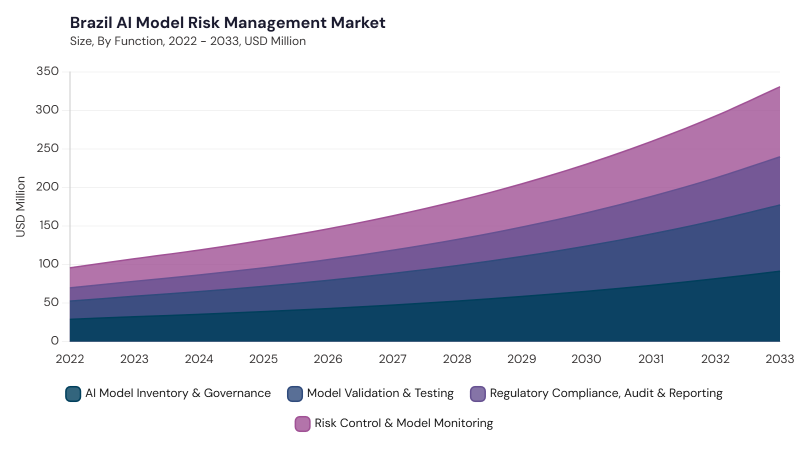
Based on Function, the market is segmented into AI Model Inventory & Governance, Risk Control & Model Monitoring, Model Validation & Testing, and Regulatory Compliance, Audit & Reporting. AI Model Inventory & Governance provides centralized visibility into model ownership, purpose, lifecycle status, metadata, risk classification, and governance responsibilities. Risk Control & Model Monitoring focuses on continuous supervision of model drift, bias, operational anomalies, accuracy deterioration, fairness, and changing risk exposure after deployment.
Model Validation & Testing evaluates model performance, robustness, explainability, accuracy, and suitability through structured testing and scenario-based assessment before AI systems influence critical processes. Regulatory Compliance, Audit & Reporting supports documentation, audit trails, transparency reporting, accountability, compliance checks, and evidence of adherence to evolving AI governance requirements across multiple LAMEA jurisdictions.
Free Valuable Insights: AI Model Risk Management Market Size Worth USD 16.7 Billion billion by 2033
Based on Country, the market is segmented into Brazil, Argentina, UAE, Saudi Arabia, South Africa, Nigeria, and Rest of LAMEA. The Brazil market dominated the LAMEA AI Model Risk Management Market by Country in 2025, and would continue to be a dominant market till 2033; thereby, achieving a market value of USD 204.7 million by 2029, growing at a CAGR of 12.4 % during the forecast period. The Argentina market is expected to witness a CAGR of 14.4% during (2026 - 2033). Additionally, The UAE market is expected to witness a CAGR of 12.9% during (2026 - 2033).
Across LAMEA, AI model risk management adoption is being shaped by localized regulation, explainability, continuous monitoring, cybersecurity, and expanding enterprise AI deployment. Brazil emphasizes transparent governance, auditability, enterprise-wide risk integration, continuous monitoring, and sector-specific controls, while Argentina focuses on model explainability, automated risk detection, localized compliance, cloud infrastructure, and lifecycle governance. The UAE is advancing regulatory harmonization, explainable AI, cybersecurity integration, real-time monitoring, and enterprise risk alignment, whereas Saudi Arabia emphasizes AI ethics, automated compliance, continuous risk oversight, localized governance, and AI-ready infrastructure. South Africa focuses on formal governance frameworks, explainability, real-time monitoring, cybersecurity coordination, and workforce capability development, while Nigeria emphasizes transparent governance, cloud-based platforms, automated risk assessment, regulatory alignment, and locally adapted solutions. Rest of LAMEA continues to develop explainable AI, cloud-based governance, continuous monitoring, compliance automation, and scalable risk-management frameworks suited to diverse regulatory and infrastructure environments.

By Industry
By Deployment
By Function
By Country
Set to reach $866.9 Million by 2029, growing at 13.9% CAGR during 2026-2033.
Brazil will achieve a market value of USD 204.7 million by 2029, growing at a CAGR of 12.4% during 2026-2033.
The BFSI industry will reach USD 240.3 million by 2029, growing at a CAGR of 12.9% during 2026-2033.
Cloud segment will reach USD 445.7 million by 2029, growing at a CAGR of 13.3% during 2026-2033.
The Retail segment is expected to witness the highest CAGR of 14.5% during 2026-2033.
Our team of dedicated experts can provide you with attractive expansion opportunities for your business.




 Unique Offerings
