The sample copy of this report is available for access.
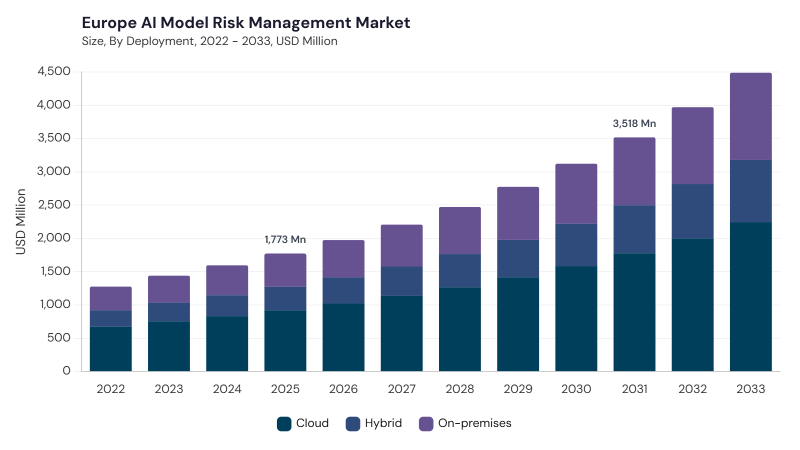
The Europe AI Model Risk Management Market is expected to reach USD 3518.0 million by 2031, growing at a CAGR of 12.4% during (2026 - 2033).
The Europe AI Model Risk Management Market evolved from traditional model-validation practices, particularly within financial services, toward comprehensive governance frameworks designed specifically for increasingly complex artificial intelligence systems. Expansion of deep learning, natural language processing, and generative AI introduced new concerns around bias, transparency, cybersecurity, explainability, and operational reliability, encouraging organizations to move beyond fragmented compliance processes. Regulatory developments across Europe further accelerated adoption of structured AI risk assessment, documentation, monitoring, and accountability mechanisms. Current practices increasingly combine model governance, continuous validation, explainability, automated controls, audit readiness, and enterprise-wide oversight to support trustworthy and compliant AI deployment.
Regulatory harmonization, explainable AI, automated model monitoring, enterprise governance integration, and growing use of AI in high-stakes applications are shaping current market development. Organizations increasingly require platforms capable of identifying model drift, bias, unexpected outputs, security vulnerabilities, and compliance gaps throughout the AI lifecycle. The EU AI Act and broader data-protection requirements are strengthening demand for risk classification, documentation, audit trails, continuous monitoring, and transparent model behavior. Cloud-native governance platforms, automated compliance workflows, real-time analytics, and specialized model validation are broadening adoption, although regulatory complexity, high implementation costs, interoperability limitations, data-governance requirements, and technical challenges related to model explainability continue to influence deployment.
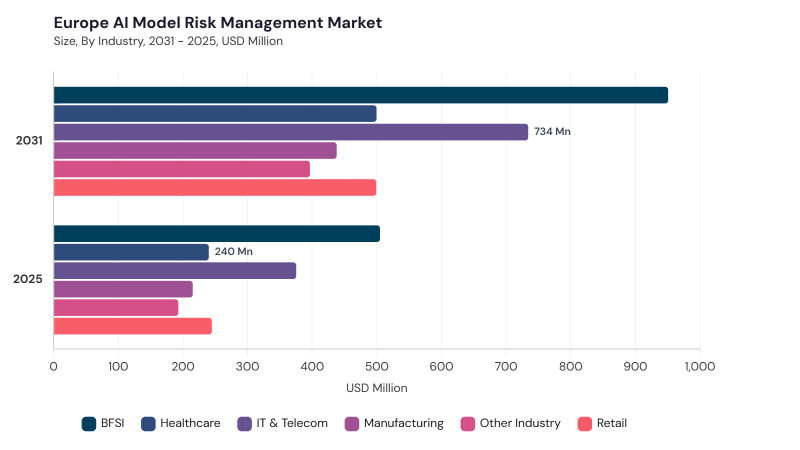
Based on Industry, the market is segmented into BFSI, IT & Telecom, Retail, Healthcare, Manufacturing, and Other Industry. The BFSI market dominated the Europe AI Model Risk Management Market by Industry in 2025, and would continue to be a dominant market till 2033; thereby, achieving a market value of USD 950.7 million by 2031, growing at a CAGR of 11.4 % during the forecast period. The IT & Telecom market is expected to witness a CAGR of 12.2% during (2026 - 2033). Additionally, The Retail market is expected to witness highest CAGR of 13% during (2026 - 2033).
BFSI emphasizes model governance, explainability, continuous validation, auditability, and compliance for high-impact financial applications. IT & Telecom applies AI risk controls across network optimization, cybersecurity, predictive maintenance, fraud prevention, and digital service delivery, while Retail focuses on personalization, inventory planning, demand forecasting, dynamic pricing, and consumer-data governance. Healthcare requires rigorous oversight of AI-enabled diagnostics, patient monitoring, workflow optimization, and clinical decision support, whereas Manufacturing emphasizes reliability of predictive maintenance, intelligent production, quality control, and automation systems. Other Industry includes transportation, utilities, professional services, public-sector entities, and other sectors progressively formalizing AI risk-management practices.
Based on Deployment, the market is segmented into Cloud, On-premises, and Hybrid. The Cloud market dominated the Europe AI Model Risk Management Market by Deployment in 2025, and would continue to be a dominant market till 2033; thereby, achieving a market value of USD 1777.8 million by 2031, growing at a CAGR of 11.9 % during the forecast period. The On-premises market is expected to witness a CAGR of 12.9% during (2026 - 2033). Additionally, The Hybrid market is expected to witness highest CAGR of 13.1% during (2026 - 2033).
Cloud deployment supports continuous model monitoring, automated compliance reporting, centralized oversight, collaborative risk assessment, and rapid updates across distributed AI environments. On-premises deployment remains important for organizations prioritizing data sovereignty, internal security, localized control, and management of sensitive AI workloads within tightly governed infrastructure. Hybrid deployment combines cloud scalability with on-premises control, allowing sensitive data and models to remain within private environments while using cloud resources for broader analytics and monitoring. Europe's emphasis on data protection, interoperability, and responsible AI is strengthening demand for flexible deployment architectures capable of maintaining consistent governance across distributed systems.
Based on Function, the market is segmented into AI Model Inventory & Governance, Risk Control & Model Monitoring, Model Validation & Testing, and Regulatory Compliance, Audit & Reporting. AI Model Inventory & Governance provides centralized tracking of models, ownership, lineage, usage context, risk classification, and governance policies. Risk Control & Model Monitoring focuses on continuous detection of drift, bias, performance deterioration, anomalous behavior, fairness issues, and changing risk exposure after deployment.
Model Validation & Testing evaluates accuracy, robustness, explainability, fairness, and operational suitability through stress testing, sensitivity analysis, back-testing, and other validation approaches. Regulatory Compliance, Audit & Reporting supports risk documentation, evidence collection, audit trails, regulatory reporting, accountability, and demonstrable adherence to evolving European AI governance requirements.
Free Valuable Insights: The Worldwide AI Model Risk Management Market is projected to reach USD 16.7 Billion billion by 2033, at a CAGR of 12.7%
Based on Country, the market is segmented into Germany, UK, France, Russia, Spain, Italy, and Rest of Europe. The Germany market dominated the Europe AI Model Risk Management Market by Country in 2025, and would continue to be a dominant market till 2033; thereby, achieving a market value of USD 649.2 million by 2031, growing at a CAGR of 10.8 % during the forecast period. The UK market is expected to witness a CAGR of 11.4% during (2026 - 2033). Additionally, The France market is expected to witness a CAGR of 13.3% during (2026 - 2033).
Across Europe, AI model risk management adoption is being shaped by regulatory compliance, explainability, continuous monitoring, cybersecurity, and integration with broader enterprise governance. Germany emphasizes risk classification, model transparency, explainability, cyber resilience, automated monitoring, and compliance-oriented governance, while the UK focuses on auditable risk controls, explainable AI, lifecycle monitoring, legacy-system integration, and sector-specific risk frameworks. France is advancing automated risk detection, regulatory tracking, stress testing, interoperable governance, and real-time compliance monitoring, whereas Russia emphasizes localized data governance, explainability, cybersecurity integration, automated oversight, and compliance with domestic regulatory requirements. Spain focuses on transparency, automated monitoring, anomaly detection, scalable cloud-based governance, and locally adapted compliance practices, while Italy emphasizes real-time risk scoring, explainability, cloud-enabled governance, cybersecurity integration, and regulatory automation. Rest of Europe continues to develop risk classification, responsible AI frameworks, continuous monitoring, regulatory documentation, localized compliance, and integrated AI governance aligned with diverse national requirements.

By Industry
By Deployment
By Function
By Country
Set to reach $3518.0 Million by 2031, growing at 12.4% CAGR during 2026-2033.
Germany leads with $649.2 million by 2031, growing at a CAGR of 10.8% during 2026-2033.
BFSI sector dominates with $950.7 million by 2031, growing at 11.4% CAGR during 2026-2033.
Cloud segment reaches $1777.8 million by 2031, growing at 11.9% CAGR during 2026-2033.
France market is expected to witness a CAGR of 13.3% during 2026-2033.
Retail market is expected to witness the highest CAGR of 13% during 2026-2033.
Our team of dedicated experts can provide you with attractive expansion opportunities for your business.




 Unique Offerings
