The sample copy of this report is available for access.
“Global Heterogeneous Integration Market to reach a market value of USD 60,173.39 Million by 2033 growing at a CAGR of 14.3%”
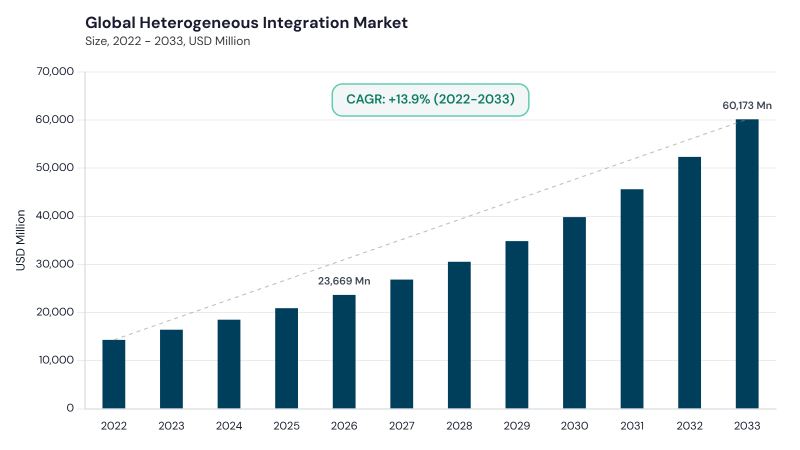
The Global Heterogeneous Integration Market is expected to reach USD 60.1 billion by 2033, growing at a CAGR of 14.3% during (2026 – 2033).
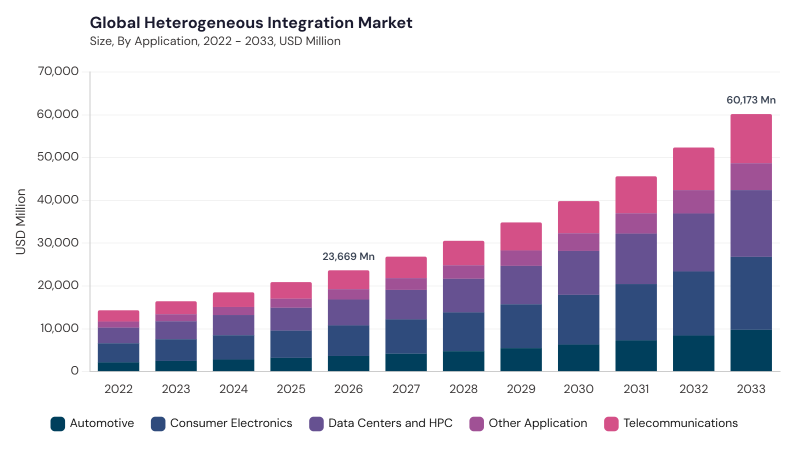
Heterogenous integration market is experiencing growing demand due to rising focus on higher semiconductor performance, compact architectures, faster data transfer, reduced power consumption, and cost-efficient scaling beyond traditional Moore’s Law. Rising adoption of chiplets, 3D integration, 2.5D packaging, advanced interconnects, high-bandwidth memory, and system-in-package solutions is further supporting the market growth. Market emerged as a response to growing semiconductor functionality and performance needs beyond the limits of monolithic scaling.
Heterogeneous integration market is experiencing strong growth as semiconductor companies largely move beyond single-die scaling toward multi-die, modular, and package-level system architectures. These technologies help enhance performance, increase bandwidth, reduce latency, support compact system designs, and lower power consumption. Market demand is further driven by high-performance computing, AI accelerators, electric vehicles, 5G infrastructure, consumer electronics, data center processors, and autonomous systems, requiring closer integration of memory, logic, photonics, RF, and sensor components.
Heterogenous integration market is highly consolidated and technology-intensive, with competition driven by OSAT providers, foundries, advanced packaging specialists, and integrated device manufacturers. Competition is centered on interconnect performance, packaging density, hybrid bonding, thermal management, yield optimization, HBM integration, CoWoS capacity, and manufacturing scale. Market competition is predicted to depend on advanced substrates, chiplet interoperability, package reliability, AI-driven design tools, high-volume multi-die manufacturing readiness, vertical stacking capabilities, and package reliability.
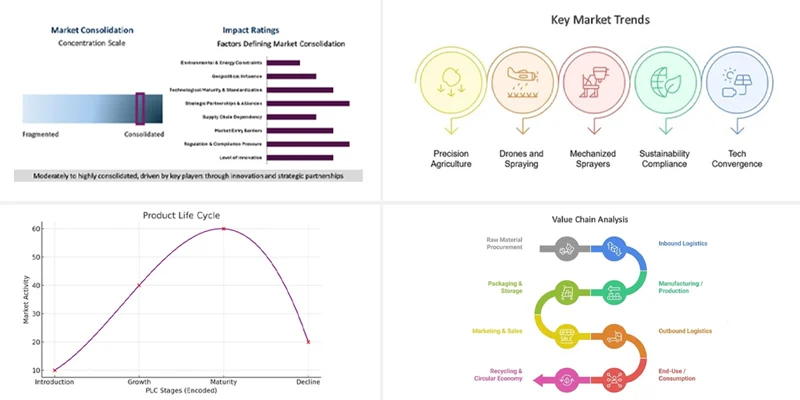

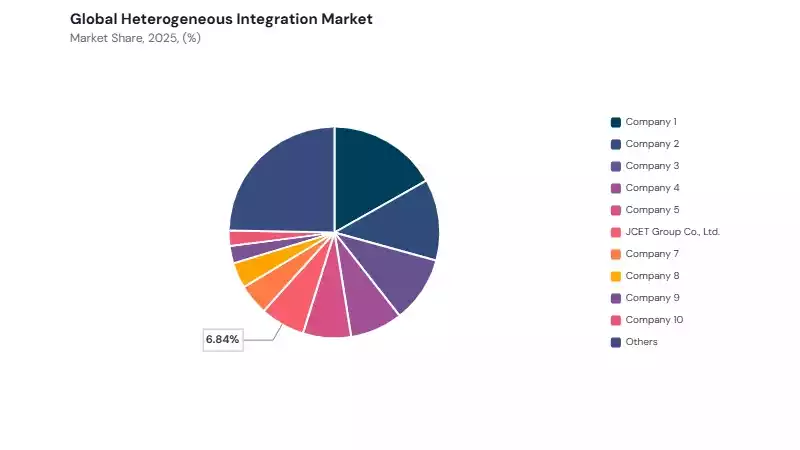
Heterogeneous integration market is largely fragmented with competition driven by Amkor Technology, ASE Technology, Intel, Samsung Electronics and JCET. InFO platforms, and TSMC leads through CoWoS SoIC, while Amkor and ASE support the market through SiP, OSAT, fan-out, 3D, 2.5D and chiplet integration capabilities. JCET, Intel, Samsung, ChipMOS, Powertech, Hana Micron, and Tongfu further strengthen the market through memory packaging, proprietary packaging, advanced testing solutions, and wafer-level assembly. Market competition largely rely on hybrid bonding, CoWoS capacity, chiplet interoperability, HBM integration, package yield, substrate availability, and thermal performance.
Based on Application, the market is segmented into Consumer Electronics, Data Centers and HPC, Telecommunications, Automotive, and Other Application. The Consumer Electronics market dominated the Global Heterogeneous Integration Market by Application in 2025, and would continue to be a dominant market till 2033; thereby, achieving a market value of USD 17.0 billion by 2033, growing at a CAGR of 13.2 % during the forecast period. The Data Centers and HPC market is expected to witness a CAGR of 14.5% during (2026 - 2033). The Other Application market is expected to witness a CAGR of 14.6% during (2026 - 2033).
Consumer Electronics leads the market due to demand for compact, power-efficient, and high-functionality devices integrating computing, imaging, connectivity, sensors, and AI capabilities. Data Centers and HPC are expanding strongly as AI accelerators, high-bandwidth memory, and advanced processors require tighter logic-memory integration. Telecommunications benefits from 5G infrastructure, RF modules, networking hardware, and edge computing. Automotive demand is supported by EVs, ADAS, digital cockpits, connectivity, and centralized computing architectures, while Other Application includes industrial, medical, aerospace, and specialized computing uses.
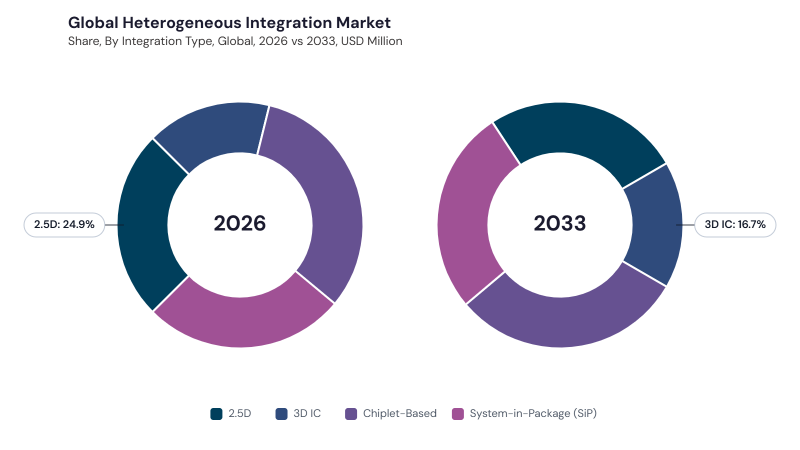
Based on Integration Type, the market is segmented into Chiplet-Based, System-in-Package (SiP), 2.5D, and 3D IC. The Chiplet-Based market dominated the Global Heterogeneous Integration Market by Integration Type in 2025, and would continue to be a dominant market till 2033; thereby, achieving a market value of USD 18.3 billion by 2033, growing at a CAGR of 13.4 % during the forecast period. The System-in-Package (SiP) market is expected to witness a CAGR of 14.5% during (2026 - 2033). Additionally, The 2.5D market is expected to witness highest CAGR of 14.9% during (2026 - 2033).
Chiplet-Based integration leads the market as it enables modular semiconductor design by combining compute, memory, and I/O dies within scalable architectures. SiP remains important for compact multifunctional packages used across consumer electronics, IoT, automotive, and communications devices. The 2.5D segment is supported by interposer-based integration and high-bandwidth processor-memory connectivity. 3D IC is gaining traction as vertical stacking, hybrid bonding, TSVs, and thermal management improvements enable higher density and lower latency integration.
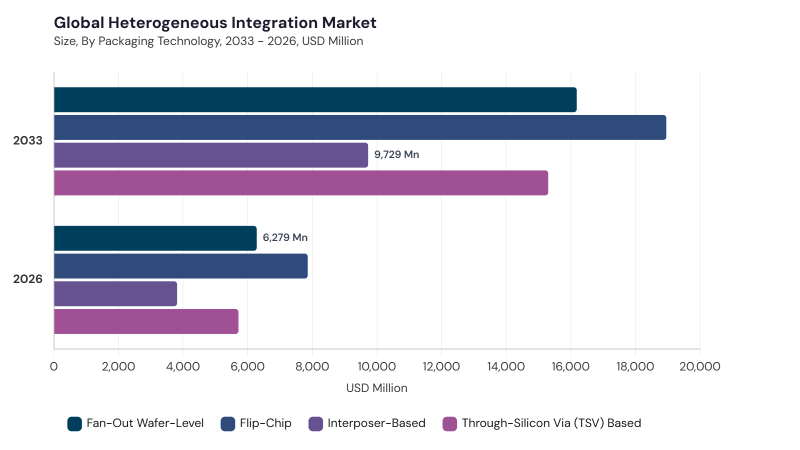
Based on Packaging Technology, the market is segmented into Flip-Chip, Fan-Out Wafer-Level, Through-Silicon Via (TSV) Based, and Interposer-Based. The Flip-Chip market dominated the Global Heterogeneous Integration Market by Packaging Technology in 2025, and would continue to be a dominant market till 2033; thereby, achieving a market value of USD 18.9 billion by 2033, growing at a CAGR of 13.4 % during the forecast period. The Fan-Out Wafer-Level market is expected to witness a CAGR of 14.5% during (2026 - 2033). Additionally, The Through-Silicon Via (TSV) Based market is expected to witness highest CAGR of 15.1% during (2026 - 2033).
Flip-Chip dominates the market due to its established manufacturing base, strong interconnect density, efficient electrical performance, and suitability for high-performance semiconductor packages. Fan-Out Wafer-Level packaging is gaining demand as thinner package profiles and redistribution layers support compact device designs. TSV-Based packaging is important for vertical die connections, stacked memory, and high-bandwidth architectures. Interposer-Based packaging supports multi-die systems by enabling dense routing between logic, memory, RF, and other heterogeneous components.
Free Valuable Insights: Heterogeneous Integration Market Size to reach $60.1 Billion by 2033
Region-wise, the Heterogeneous Integration Market is analyzed across North America, Europe, Asia Pacific, and LAMEA.
The Asia Pacific led the heterogeneous integration market in 2025, and is expected to be dominant till 2033, thereby capturing a market value of USD 27.1 billion by 2033, expanding at a CAGR of 14.6 % during 2026-2033. The North America region is predicted to grow at a CAGR of 13.5% during the forecast period. Moreover, the Europe market is estimated to expand at a CAGR of 13.9% during 2026-2033.
APAC region has experienced the growth because of advanced packaging infrastructure, extensive semiconductor manufacturing capacity, investments in 2.5D, chiplet, and 3D integration technologies, OSAT strength. North America market is driven by high-performance computing demand, AI infrastructure, domestic advanced packaging initiatives, and semiconductor design leadership. Europe benefits from industrial applications, automotive electronics, regional packaging ecosystem development, and semiconductor programs. LAMEA is gradually growing through data center growth, digital infrastructure, telecommunications modernization, and growing adoption of advanced semiconductor technologies.
| Report Attribute | Details |
|---|---|
| Market size value in 2026 | USD 23.6 billion |
| Market size forecast in 2033 | USD 60.1 billion |
| Base Year | 2025 |
| Historical Period | 2022 to 2024 |
| Forecast Period | 2026 to 2033 |
| Revenue Growth Rate | CAGR of 14.3% from 2026 to 2033 |
| Number of Pages | 642 |
| Tables | 720 |
| Report Coverage | Market Trends, Revenue Estimation and Forecast, Segmentation Analysis, Regional and Country Breakdown, Competitive Landscape, Market Share Analysis, Company Profiling, Companies Strategic Developments, SWOT Analysis, Product Life Cycle Analysis, Value Chain Analysis, Market Consolidation Analysis, Key Customer Criteria, Pandemic Impact Analysis, and Winning Imperatives |
| Segments Covered | Application, Integration Type, Packaging Technology, Region |
| Country Scope |
|
| Companies Included | Taiwan Semiconductor Manufacturing Co. Ltd., ASE Technology Holding Co., Ltd., Amkor Technology, Inc., Samsung Electronics Co., Ltd., Intel Corporation, JCET Group Co., Ltd., Tongfu Microelectronics Co., Ltd., Powertech Technology Inc., ChipMOS Technologies Inc., and Hana Micron Inc. |
By Application
By Integration Type
By Packaging Technology
By Geography
Expected to reach USD 60.1 billion by 2033, growing at 14.3% CAGR during 2026-2033.
Consumer Electronics leads, projected to reach USD 17.0 billion by 2033.
Taiwan Semiconductor Manufacturing Co. Ltd., ASE Technology Holding Co., Ltd., and Amkor Technology, Inc. dominate.
Asia Pacific leads, projected to hit USD 27.1 billion by 2033.
Advanced functionalities and miniaturization in electronics are enhancing demand.
Chiplet-Based segment leads, expected to reach USD 18.3 billion by 2033.
Our team of dedicated experts can provide you with attractive expansion opportunities for your business.








 Unique Offerings